Showing posts with label picture book. Show all posts

Tuesday, February 10, 2026

7. Searching for Mr. Johnson's Song


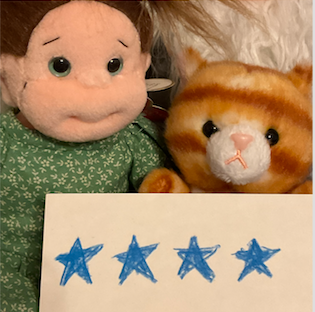
7. Searching for Mr. Johnson's Song. Ariel Vanece. Illustrated by Jade Orlando. 2025. 32 pages. [Source: Library] [4 stars, picture book, hymns, friendship]

First sentence: In the summer, Caius spends his mornings on Mr. Johnson's front porch. 

Premise/plot: Caius loves his neighbor, Mr. Johnson. On good days, Mr. Johnson is still singing his song--a hymn--though he fumbles with remembering the words. Lately, Mr. Johnson hasn't felt like singing his song at all. His memory problems are getting him down. Caius goes in search of Mr. Johnson's song so he can potentially cheer his neighbor up when he sings it. 

The song Mr. Johnson loves to sing is "Further Along." 

My thoughts: I enjoyed this one. I am glad I read it. I wasn't expecting the hymn connection when I checked it out from the library. It is a sweet story about a young boy who loves his neighbor and wants to be his friend and cheer him up. 

I definitely recommend sharing the song with young ones if they are unfamiliar with it. 


© Becky Laney of Operation Actually Read Bible

Friday, July 25, 2025

57. Hand to Hold


57. Hand to Hold. JJ Heller. 2021. 40 pages. [Source: Library] [4 stars, picture book]

First sentence: Trees are made for climbing. Days are made for sun. Puddles are for jumping. Fields are made to run. Stars are made for counting and for wishes coming true. Sleep is made for dreaming, and I have dreams for you. Stones are made for skipping. Stories are to tell. Life is made for living. I pray you live it well.

Hand to Hold is a picture book adaptation of JJ Heller's lullaby, "Hand to Hold." 

I have only recently discovered JJ Heller's music. It was--and is--LOVE at first listen. While "Hand to Hold" isn't my absolute favorite and best song of her work, it is a great song. I can see why it was chosen to adapt in picture book format. It's a lovely picture book to share with little ones--toddlers, preschoolers, pre-K, etc. It would be good for a family read aloud as well with multiple ages of children. 

It's sweet, adorable, playful. And the message, of course, is solid. A parents' love is unconditional. 


© Becky Laney of Operation Actually Read Bible

Thursday, July 10, 2025

55. From Me To You, Love God


55. From Me To You, Love God. Claire Freedman. Illustrated by Emily Boughton. 2025. 26 pages. [Source: Library] [picture book, 3 stars]

First sentence: If God sent you a letter, 
He'd say, "I love you so!
You're very precious to me,
and I want you to know."
God made you,
and He knows your name,
and so it's no surprise,
that the one and only,
uniquely YOU,
is perfect in His eyes!

From Me to You, Love God is a children's book, a picture book, published by Kregel. 

It is written in rhyme. It is definitely of the precious-precious-super-sweet narrative style. 

While God is mentioned on nearly every single spread of this one, the depth and substance as to who God is vague and generalized. Though we do get one 'Heavenly Father.' 

There is no mention of Jesus at all. Not even once. I think a choice was made. Perhaps I'm wrong. What is mentioned about God is certainly happy-happy-cozy-cozy and not at all controversial or offensive. 

There is not a great depth to the spiritual truths in this one. But one does get a sense that God is all-knowing, all-seeing, kind, good, and loving. There is more focus on God watching over YOU the one and only unique, supremely precious perfect YOU than anything else. (You get the impression that the message is God is so lucky, fortunate, blessed that there is a you in his life). The focus is definitely on God's love and loving YOU and loving everyone. But God is definitely a tame, gentle God in this one. 

Does a picture book *need* to present the gospel? Maybe. Maybe not. Does this book in anyway indicate that there is a gospel? No. Not really. The book doesn't really go there at all. For better or worse. I mean a book certainly doesn't have to present our need for the Savior, who the Savior is, how we're saved, what we're saved from, what our salvation means, the hope to which we cling, etc. 

The book begins with the premise *if* God sent you a letter....and then proceeds. The truth is we do have God's revelation. We do have his written word. While it may not be a letter written for us specifically as individuals. We have access to the very words of God. We know WHO he is because he has revealed himself to us. (Read Psalm 19 or 119 among dozens of other places that speak of the Word of God). We do not have to guess about who God is, what God has done, what God has promised, what God has said. Perhaps there was a missed opportunity to point little ones to the Word of God.

One of the book's premises is that little ones can look for EIGHTY letters in the illustrations. A seek and find if you will. The back copy reads, "they will find encouraged" when they spot these illustrated letters in the book because "God is always with them on life's journey." I certainly don't have issues with illustrators providing details for little ones to find. But it does seem odd to me at least that this is the highlight of the back copy. Like that is the most important thing about the book? 

There aren't a tremendous amount of Christian picture books published each year. I'd say there is a small number published each year. I always like to review them when I can because I know the need is there. I've read better. I've read worse. 

© Becky Laney of Operation Actually Read Bible

Friday, May 16, 2025

42. What to Do With Your Whirly Swirly Thoughts


42. What to Do With Your Whirly Swirly Thoughts. Jennie Allen. Illustrated by Nadia Gunawan. 2025. 32 pages. [Source: Library] [picture book, feelings and emotions, mental health, 4 stars]

First sentence: Oh, look at all your thoughts in that cute little head of yours!

Jennie Allen tackles the topic of children's mental health from a Christian perspective in What to Do With Your Whirly Swirly Thoughts. That's a simple enough summary. Is it too Christian to please some? Yes. Is it not Christian enough to please others? Maybe. Can you please everyone all the time? Definitely not.

The audience is children. I imagine elementary-aged children, but perhaps it could work with younger children as well [preschool, pre-K]. I don't know how well this would work with children *older* than that even if they have mental health concerns as well. 

The format is picture book, obviously. BRIGHT, bold colors. Plentiful illustrations, perhaps a little on the busy side. BUT since the book is about whirly, swirly thoughts and being overwhelmed with feelings and emotions, it makes sense that the illustrations are a little busy as well. 

The book offers practical tips on how to cope with 'whirly, swirly thoughts.' While the book as a whole is written with a Christian mindset in mind, the practical tips aren't confined to those you could reason from Scripture--if that makes sense. Tips include: talking about the thoughts out loud--either to God in prayer, to family, to friends, etc; practicing gratitude; physical exercise. The tips themselves are in some ways generic enough that they don't seem particularly religious--or exclusively religious. 

There's definitely some talk of God and Jesus. However, I was slightly disappointed that there's no mention of the Holy Spirit. Surprised because it is only by being filled with the Holy Spirit that we are able to have transformed, renewed minds [Romans 12:2], and are able to take every thought captive [2 Corinthians 10:5]. It is the Spirit that unites us to Christ and gives us the mind of Christ [1 Corinthians 2:16]. It is the Spirit who helps us to pray and speaks even when we're unable [see Romans 8]. 

I could not tell if the book dabbles into New Thought [which is in opposition to Christianity]. New Thought has increasingly become more and more common in Christian circles. Or if it's just trying to oversimplify Christianity for very young children. 

For an older audience or perhaps for all ages, I'd suggest either having a spiral book [index cards are great] where you write out verses to encourage, support, uplift, and feed your soul. Verses to have as a resource for big feelings, big thoughts, big emotions. You can revisit these verses daily, weekly, or on an as-needed basis. Though the more you KNOW before you are overwhelmed with swirly, whirly thoughts the better equipped you will be to stop them from growing. 

I'd also recommend actually READING the Bible. The more you know God THROUGH THE READING OF HIS WORD, the better equipped you are to face life. Again, the more familiar you are with the Word, the more equipped you are when you do face struggles. You know WHO to turn to, WHERE to go, and can have plans in place. You can PRAY SCRIPTURE back to God. You can be comforted by his promises and trust in him more.

MEMORY verses might also come in useful. 

I would also highly recommend MUSIC. Though music has its own pros and cons when it comes to how biblically sound or unsound it may be, having theologically rich, God-focuses songs that you can use to feed your soul is wonderful. Sometimes it is easier to SING than to pray. 

© Becky Laney of Operation Actually Read Bible

Thursday, April 24, 2025

38. When I Talk To God, I Talk About Feelings


38. When I Talk To God, I Talk About Feelings. Chrissy Metz and Bradley Collins. Illustrated by Lisa Fields. 2025. 32 pages. [Source: Library] [4 stars] [picture book]

First sentence: When I talk to God every day, there are so many things I want to say. Each day has its own special meaning. When I talk to God, I talk about feelings.

This one is a follow up to When I Talk To God, I Talk About You. It is primarily a concept book teaching children HOW to identify feelings and [a] way to express their feelings. The God of the picture book is 'generic' and 'nonoffensive.' For better or worse. 

It is not an exhaustive guide teaching children how to pray. 

There are ANIMAL characters throughout. Readers don't follow *one* set of animals, but many. 

The book is written in rhyme. 

ONE great thing about this one is that I found while the 'God' is more generic than not, the Bible provides ample--150 to be more precise--examples of people praying to God and expressing their feelings. The book of Psalms is packed full of emotions and feelings. Here we have human authors expressing many, many, many, many, many emotions and taking them to God. Some psalms even display MANY emotions. Because praying to God often led to a change of emotions/feelings. So the concept of talking to God about your feelings is not a foreign concept--at least not entirely. 

Again if you only ever talk to God about yourself, your feelings, your emotions, and you just keep it focused on you, you, you, you, and you, then it might not be the best prayer ever. (The Psalms are always God-centered as well.) But this book doesn't have to be a instructional guide on HOW specifically to pray to God. 

© Becky Laney of Operation Actually Read Bible

37. When I Talk To God, I Talk About You


37. When I Talk To God, I Talk About You. Chrissy Metz and Bradley Collins. Illustrated by Lisa Fields. 2023. 32 pages. [Source: Library] [4 stars] [picture book]

First sentence: When I talk to God, goes what I do? It's really quite simple: I talk about you. I prayed for the day that you would arrive. I dreamt of your smile and the color of your eyes. You're sprouting like a weed kissed by the sun. I love hearing your giggles. You're so silly and fun.

Premise/plot: Two things to keep in mind--mostly for me to keep in mind. A) This is generic, non-offensive God. Don't expect more than that. B) This is a picture book that exists to celebrate a parent's love for a child. Don't expect more than that. 

There are ANIMAL characters throughout. Readers don't follow *one* set of animals, but many. 

The book is written in rhyme. 

The 'plot' or 'story' is talking about the many different ways one might 'pray' or 'talk to God' about his/her child through many stages and ages of life. Again animal characters make this slightly weird in places if you're an overthinker. 

My thoughts: When compared to other books celebrating parenthood like GUESS HOW MUCH I LOVE YOU or LOVE YOU FOREVER, it certainly holds up well. Very similar in tone and theme. Yes, the book mentions God, but, not specifically THE GOD OF THE BIBLE, the trinitarian God,  the God that might offend. I had to keep reminding myself of the limited nature of this book. Obviously not meant to be an exhaustive book on what to pray and how to pray.


© Becky Laney of Operation Actually Read Bible

Tuesday, April 22, 2025

36. God's Masterpiece


36. God's Masterpiece: An Adventure in Discovering Your Worth. Elisabeth Hasselbeck. Illustrated by Julia Seal. 2025. 40 pages. [Source: Library] [3 stars; picture book]

First sentence: Come along with me, my friend. I can't wait for you to see some of the most famous art made for you and me. 

God's Masterpiece is an odd picture book. Half of the text is art appreciation--written in [forced] rhyme, unfortunately--and the second half of the book (also written in rhyme) is about how you are God's true masterpiece. The book concludes with a mirror so you can admire God's masterpiece--you, of course.

Of the two halves I prefer the focus on art. I enjoy the introduction of particular art pieces by particular artists. Some are extremely famous and will likely be familiar to adults. Others perhaps not as much. I think a definite argument could be made that a) God IS a creative God. b) man who is made in the image of God is creative too. That would be a worthwhile message to share with little ones. 

The second half takes a little more liberty with theology. It is not all the way off. Psalm 139 is proof of that. But it is more like a crazy fun house mirror type of interpreting scripture. I think there are definite true statements and statements that push things all the way down the slippery slope. I think God can absolutely LOVE us and be our Creator without making it so absurdly all about us. The mirror was a little over the top for me. 

I think ALL of creation--think Genesis 1 and 2, as well as many psalms--was pronounced good, very good. That God was pleased with his creation. I think one could definitely argue that ALL humans have worth and value because they were made in the image of God. Though the 'image of God' is fractured since the fall. Still *all* humanity has worth, value, etc. 

But what is missing in this book is JESUS. Perhaps because "God" especially a "Master Painter" God is infinitely less offensive than Jesus--a Savior, a Deliverer, the KING OF KINGS and LORD OF LORDS. Does God love us? YES. Absolutely. That is why he sent JESUS to save us from our sins. 


© Becky Laney of Operation Actually Read Bible

Friday, January 24, 2025

7. Poems and Prayers for the Very Young


7. Poems and Prayers for the Very Young. Martha Alexander (compiler and illustrator). 1973. Random House. 24 pages. [Source: Bought] [3 stars, vintage picture book, poetry]

First sentence: I wake in the morning early
And always, the very first thing,
I poke out my head and I sit up in bed
And I sing and I sing and I sing.

I enjoy collecting vintage picture books. This one has a slightly Christian theme. I would say ninety percent celebrate nature and common joys in life and ten percent give a nod to God. It does include the Lord's Prayer and a few other familiar poem-prayers that you might have heard depending on your background.

I think it is a lovely-enough collection of poems. The poems aren't so religious and "Christian" that you are in any way teaching your children theology. But the poems are pleasant enough and not anti-Christian either. 

I definitely liked the soft, soothing illustrations.

© Becky Laney of Operation Actually Read Bible

Friday, September 27, 2024

45. Joni Eareckson Tada

 45. Joni Eareckson Tada. Kristyn Getty. Illustrated by Hsulynn Pang. 2024. 32 pages. [Source: Library] [5 stars] [picture book biography]

First sentence: Joni was born the youngest of four sisters in Baltimore, USA. She was called Joni after her dad, John. He had been hoping for a boy! Joni had sparkling blue eyes, a clever mind, and lots of energy.

I have read several books written by Joni Eareckson Tada. I know I've read two autobiographies and a handful of other books she's written on other topics. So I was SUPER, SUPER, SUPER excited to see that a children's biography was coming this year. 

This one is a picture book biography for readers of all ages. It introduces her life story and her ministry. Let's be honest, this may be the introduction to her life story for younger generations. I do think her story is important; her ministry is important. 

I would recommend this one. 


© Becky Laney of Operation Actually Read Bible

Monday, July 15, 2024

38. Just In Case You Ever Feel Alone


Just In Case You Ever Feel Alone. Max Lucado. Illustrated by Eve Tharlet. 2024. 32 pages. [Source: Library]

First sentence: God knows everything about you. He knew you'd have happy days, and He knew you'd be sad. So He gave us each other, and I'm so very glad. God put us together. He made us a home. I hope you'll always know that...just in case you feel alone. 

This Christian children's book--picture book--stars bears. It is essentially your basic parent loves child super unconditionally picture book. There are so many--mostly from a "secular" perspective and others from Christian publishers. This is that kind of picture book with a few God mentions thrown in. 

I will try to clarify. This picture book has "book ends" if you will that bring God into the story. Yes, it is about parental love. But it adds on a further element that tackles God's omnipresence AND the practice of prayer. Both are good for children (and adults) to know and put into practice. So it does go beyond the stereotypical sugary-sweet parents love unconditionally picture book. (Have you noticed that *these* almost always, always, always star animals--bunnies, bears, etc.?)

© Becky Laney of Operation Actually Read Bible

Thursday, June 6, 2024

32. Who Are You? A Little Book About Your Big Identity


Who are You? A Little Book About Your Big Identity.  Christina Fox. Illustrated by Daron Parton. 2024. 32 pages. [Source: Review copy] 

First sentence: Who are you? What really makes you...you?

Who Are You? is a Christian picture book for families to share with little ones. It asks a big question--a question that seems to be becoming bigger and bigger in recent years. The question? Who are you? What makes you you? Are you WHAT you do? Are you WHAT you like? Are you WHAT others say about you? Are you WHAT you feel? Are you WHAT you look like? NO, NO, NO. 

The picture book celebrates that humanity is made in the IMAGE OF GOD. We as humans have a CREATOR. Not just a creator--far, distant, aloof. But a LOVING, caring, faithful Creator who sent his son, his one and only Son, his only begotten Son, to die for us, to atone for our sins, to reconcile us with our Father in heaven. 

The book provides a Christian [biblical] answer to the question, who are you. It also touches on how knowing who we are--in Christ--impacts how we should live. 


© Becky Laney of Operation Actually Read Bible

Friday, March 1, 2024

20. Eve and Adam and Their Very First Day


Eve and Adam and Their Very First Day. Leslie Kimmelman. Illustrated by Irina Avgustinovich. 2023. [October 24] 32 pages. [Source: Library]

First sentence: It was Eve's first day in the Garden of Eden. Actually, it was her first day anywhere, since she was newly created. God had made her wonderfully well. Eve was not afraid of anything. She was not afraid of the wild green tangle of the garden. Not afraid of the tall leafy trees soaring up into the sky. Not afraid of the vivid, rainbow-colored flowers growing all around her, their sweet scents perfuming the air.

Eve is the star of the show in Leslie Kimmelman's light-hearted retelling of the creation story. (Note the shift from Adam and Eve to Eve and Adam. Adam perhaps should join Ken in singing "I'm Just Ken." Adam is introduced four pages into the text.) 

The main theme seems to be that Eve (and Adam) were created by God and lived fearlessly (well, mostly).  (And to give credit where credit is due, I do think that Adam and Eve were free from fear--as we know and experience fear. I do think fear is a result of sin, of the fall of creation.) 

Eve finds Adam super cute and adorable but a little lacking in imagination and intelligence. Quote from the text, "Maybe it was because Adam had been first. Eve came second, and, well, practice makes perfect." (To be fair to the author, Eve does admit she is NOT perfect two seconds after saying that she was perfect.) 

About a third of the way through the story, the pair are startled and frightened by rain, thunder, and lightning. This is the first time they've experienced fear but they turn to faith in God that all will be well...again. (I suppose theologians might have differing opinions on IF rain occurred before the Flood or not. I suppose this isn't the most critical issue one could have in the evangelical faith. [Note: when I say evangelical I do NOT mean anything related to politics.]) 

Soon one fright leads to another. Turns out ADAM is afraid of the dark. Good thing Eve isn't scared of the dark and can help calm him down. But as the darkness becomes truly darkness, even Eve becomes worried. Though not as bad as shivering Adam. The stars eventually make their appearance and the two nestle up comfy-cozy together. (The whole book presents Eve and Adam without clothes. So this nestling picture seems an odd choice. It is in some ways sweet. But in other ways, a little daring for a children's book.) 

The book ends with Eve (and Adam) declaring everything GOOD. Here is where I go from mildly perturbed to indignant. God has been an "extra" at best in this little play of creation. Definitely not front and center. The book itself has been very cutesy and light-hearted. In a way. Perhaps not a harmless way. Definitely a more pointed way. A way that makes Adam look weak, pathetic, a sidekick to Eve, her companion sure enough but not her equal. But I think the "slap in the face," if you will is when the author takes Scripture--God's declaration of creation's goodness [see Genesis 1:1-31]--and ends her story this way, "Eve and Adam saw that it was good." God barely registers as a footnote in the text. In Genesis 1 and 2, God is on the move--he is ACTIVELY creating, speaking, working, declaring. Make no mistake, any [intelligent] reading of the text reveals that God is front and center, the "main character" if you will, the whole point. This picture book pushes out the Creator and makes CREATION--specifically Eve--the focal point. 

As the title suggests, the picture book is "the first day, first night, second morning." The scene fades before Genesis 3.

I think I could be unimpressed but not particularly disgruntled if the picture book did not end with the phrase, "And Eve and Adam saw that it was good." I think it isn't so much the sentiment behind the literal words. I am 99.9% sure that Adam and Eve did look at God's creation and see goodness. It is the parroting of the biblical narrative and attributing God's declaration as originating from Eve that is unsettling. 

The book is in the difficult position. On the one hand, it isn't theologically or biblically sound enough for [some] Christians to want to share with little ones. And Adam and Eve narratives abound in Bible storybooks. This one isn't remarkable enough to be better than those. Will every Christian see this one as twisting Scripture? Maybe. Maybe not. Probably not. On the other hand, the subject matter itself--Adam, Eve, Garden of Eden, God--makes it a difficult sell to a general audience, a secular audience that may not want any hint of religion. For those wanting an Eve that more closely resembles the Barbie character from 2023's Barbie movie instead of the book of Genesis from the very Word of God, this one may be a good fit. 

Now, I will say--and I doubt anyone is still reading--that I did not dislike the artwork. I think the story is meant to be tongue-in-cheek, playful, light-hearted, fun and silly. I don't think the author truly has made a decision to play around with the truth of Scripture. It may come off as irreverent to me, but I don't assume that that was authorial intent. 

© Becky Laney of Operation Actually Read Bible

Saturday, January 20, 2024

10. God Is Here


God Is Here. Lisa Tawn Bergren. Illustrated by Greg Stobbs. 2023. 40 pages. [Source: Library] [picture book; children's book]

First sentence: "Mama, where is God?" 

God is Here is a picture book for Christian parents to share with little ones. (Well, I think it goes beyond "little ones." I think it can be read aloud, shared, with a wide range of ages. It is a picture book--not a board book. There is a moderate amount of text per page. Not heavy. Not light--moderate.) It teaches the doctrine of God's omnipresence. God is EVERYWHERE all the time. God is on heaven and earth. God is with us from birth to death--on earth. We will spend eternity with God in heaven. Forever and ever and ever and ever and ever God is with us. No matter what--all situations, all circumstances. 

It does contain a full gospel presentation. (Well, a full-ish gospel presentation. It doesn't come right out and define what sin in and why we need a Savior, so parents might want to paint a bigger picture of what God is saving us from.) 

Here's the text:

"Another name for Jesus is Immanuel," Mama whispered. "It means 'God is with us.' God sent his Son to live with us, to show us how much he loves us." "That was nice of him," the girl said. "It was the nicest, best thing anybody could've ever done for us," Mama said with a nod. "But then Jesus died?" "He did--to save us. Because he lived and died for us, he'll always be in our hearts." "Whew," the girl said. "You can't get closer than that." 

As this theological discussion is taking place, the girl and her mother are being the "hands and feet" of the Lord as they go about their lives in the city. They are shown being "the light of the world" and the "city on a hill." The illustrations reveal faith in action. The text is doctrinally substantive. For example, in not so many words, the conversation is had where is God when bad things happen. 

© Becky Laney of Operation Actually Read Bible

Wednesday, January 17, 2024

8. How To Get A Mommy To Sleep


How To Get a Mommy To Sleep. Amy Parker. Illustrated by Natalia Moore. 2020. 32 pages. [Source: Library] [Children's book, picture book]

First sentence: Getting Mom to take a rest
is hard to do--it's true!
She seems to want to stay up late
No matter what you do!
The key is starting early!
When you get out of bed,
Make sure you're right by Mommy's side
Before she lifts her head.

Premise/plot: This picture book has some role reversal going on. A young child is telling readers how to properly take care of Mom--all day and all night. 

My thoughts: This one was cute. There are clues throughout that give it a Christian twist. Like a banner/sign/decoration in their home that says, "Be still and know that I am God." The illustrations celebrate the ordinary home life--a blessing from the Lord for sure. In one illustration, for example, the mom is surrounded by her two kids and her CAT. The illustrations don't always match perfectly with the narrative. Sometimes they reveal the messiness of life instead of good intentions. Sometimes the illustrations hold all the humor. For example, the child is encouraging you, the reader, to help your mom at the store by keeping the list and checking things off. Meanwhile the illustrations reveal, him putting FIVE boxes of Dino O's in the cart. I'm going to guess this is a sugary cereal that they maybe don't need five boxes of! (Though I could be wrong and it could be dinosaur shaped pasta.) The book ends with a prayer.

© Becky Laney of Operation Actually Read Bible

Tuesday, January 9, 2024

2. Mortimer's Christmas Manger


Mortimer's Christmas Manger. Karma Wilson. Illustrated by Jane Chapman. 2005. 40 pages. [Source: Library] [Picture book, holiday, animal fantasy]

First sentence: In a big house lived a wee mouse named Mortimer. He dwelled in a dark hole under the stairs. Nobody ever noticed little Mortimer. And Mortimer liked it that way. But he didn't like his hole. "Too cold. Too cramped. Too creepy," squeaked Mortimer.

ETA: I've reread this one several times now. It is one I always find myself coming back to because it is a great example of how a picture book can include Christian themes without being too-much. 

Premise/plot: Mortimer is in search of a new home, a better home. To his surprise, he finds such a home…easily. But it's a home filled with statues. There is even a statue of a baby of all things?! The baby is easily shoved OUT of the way. And Mortimer settles into a MOUSE-SIZE bed, happy at last. But will that happiness last? And why do the humans keep putting the statues back up day after day?!

My thoughts: When Mortimer encounters Jesus (Or "statue-baby-Jesus") for the first time, his response was quick: THERE'S NO ROOM FOR YOU HERE, OUT YOU GO. I think Mortimer's response is the natural human response to the actual Jesus. People may "have room" for baby Jesus a couple of days each December. Shoved in amongst other activities or festivities. But is there a place for Jesus in their actual lives, year round? Not just the baby Jesus, the harmless, inoffensive Jesus. But the born-to-die, Savior-Rescuer. (Jesus can't be squeezed into little corners, little pockets of our lives. He's the LORD of the universe.  But I digress.) 

Mortimer has a second encounter with Jesus. This time it's the Jesus of the Word. He overhears the family reading the Christmas story. He learns who Jesus is, he learns what Jesus came to do. This changes everything…for Mortimer. Jesus must come. He must go. They can't both sleep in the manger. And Mortimer surrenders what was never really "his" to Jesus. He also offers up a prayer. 

The story has a happy ending because the family has been busy making a gingerbread house. Of course Mortimer thinks it's a direct answer to his prayers! 

© Becky Laney of Operation Actually Read Bible

Monday, December 11, 2023

87. The Pine Tree Parable


The Pine Tree Parable. Liz Curtis Higgs. 1997. 36 pages. [Source: Library] [picture book]

First sentence: The farmer and his family grew all kinds of things all year 'round, like flowers, vegetables, and pumpkins. Their favorite things to grow were Christmas trees. "He plants a pine tree, and the rain makes it grow." Isaiah 44:14

Premise/plot: A family learns more about the true meaning of Christmas in this children's book. The farmer's wife--all the characters are nameless, not surprising since this one is aiming to be a parable--has reserved the absolute best pine tree for herself. Year after year the tree remains her pride and joy. It is not for sale. Others are for sale, I believe, and some are even free. When a poor family comes to the tree farm, the little girl falls in love with the gorgeous, amazing, not-for-sale tree, will the farmer's wife have a change of heart? 

My thoughts: This was definitely my first time reading The Pine Tree Parable. I think it's a solid story about the meaning of Christmas. I think there are many positive elements to the story. I don't know exactly that using this many verses out of context is to be praised offhand. But the story does flow nicely--out of context verses and all. 

The verses woven into the story: Isaiah 44:14, Ezekiel 31:7, Job 28:19, Proverbs 22:2, Ezekiel 31:5, Proverbs 13:12, Matthew 18:5, Proverbs 19:17, Galatians 5:14, 2 Corinthians 9:7, 2 Corinthians 8:9, 

© Becky Laney of Operation Actually Read Bible

Sunday, December 10, 2023

86. The Legend of the Candy Cane


The Legend of the Candy Cane. Lori Walburg. Illustrated by James Bernardin. 1997. 32 pages. [Source: Library]

First sentence: One dreary evening in the depths of November a stranger rode into town. He stopped his horse in front of a lonely storefront. The windows were boarded shut and the door was locked fast. But the man looked at it, smiled, and said, "It will do."

Premise/plot: This is a picture book "origin" story for the popular Christmas treat, the candy cane. Children learn from a candy maker (candy shop owner) the spiritual significance and symbolism used in the candy cane.

My thoughts: I liked this one well enough. I do love candy canes (though it is an extremely rare treat these days). I have heard most of these before though that might just be because I read this twenty-five years ago. 

© Becky Laney of Operation Actually Read Bible

Tuesday, October 17, 2023

72. Broken Crayons Still Color


Broken Crayons Still Color. Toni Collier and Whitney Bak. Illustrated by Natalie Vasilica. 2023. [August] 40 pages. [Source: Library] [Picture book]

First sentence: Avery loved coloring. She didn't have many crayons, but yellow flamingos and green unicorns were more fun anyway. Then one day she got a new crayon box with tons of colors: turquoise like the new nursery, violet red like her new shoes, and cadet blue like her new house.

Premise/plot: Avery learns valuable life lessons from talking crayons. Her parents interject now and then with reminders about God and Jesus, but, mainly it's the crayons doing the heavy lifting in inspiring Avery's resilience. 

My thoughts: I appreciate the overall big picture message that broken crayons still color. I like modeling the idea that things don't have to go perfectly perfect in life for things to work out. I didn't necessarily love the talking crayons. Is it wrong to teach kids coping skills that are more mainstream and of the world than strictly bible-based? Probably not. This is in many ways a picture book about how to handle/cope with emotions--big, small, and everything in between. I do wish it was more of a balance because the jacket copy is pushing the idea that this book is gospel-focused and the gospel resonates within the story...and I just don't see that. 


© Becky Laney of Operation Actually Read Bible

Thursday, May 18, 2023

47. Petunia


Petunia. Roger Duvoisin. 1950. 32 pages. [Source: Library]

First sentence" In the meadow, early one morning, Petunia, the silly goose, went strolling. She ate a bug here, clipped off a clover leaf there, and she picked at the dewdrops on the goldenrod leaves. 

Premise/plot: Petunia stars in this classic picture book from 1950. Petunia doesn't like being thought of as a "silly goose." So when Petunia literally stumbles across a book--though she doesn't really know what books are really for--she becomes a proud goose, a very proud goose. Carrying this newfound "wise book" everywhere she goes, Petunia is convinced that she is the wisest and best. Everyone starts coming to her for advice, but, her advice tends to do more harm than good. Petunia--book or not--is a silly goose. After a near-disaster--pride goeth before a fall--Petunia realizes something--the book is for reading. Possessing a book without having read it, without really knowing it, without really experiencing all it has to offer is shortsighted at best, foolish at worst. So Petunia decides...perhaps just perhaps...it's time she learns how to read.

My thoughts: I read this one and instantly saw some spiritual insights or lessons to be learned. Were these insights intentional by the author--maybe, maybe not. But even if they weren't, I think there's much food for thought to be gleaned. 

Quotes:

So Petunia picked up the Book, and off she went with it. She slept with it....she swam with it...and, knowing that she was so wise, Petunia also became proud, and prouder, and prouder...so proud that her neck stretched out several notches. 

and

Now she saw that there was something written inside the Book which she could not read. So she sat down and thought and thought and thought, until at least she sighed, "Now I understand. It was not enough to carry wisdom under my wing. I must put it into my mind and in my heart. And to do that I must learn to read."

--- 

There are lessons to be learned indeed from Petunia. It isn't enough to own a Bible, to carry a Bible to church, to nominally say you love the Book. One must "put it into the mind and heart..." and this requires "spiritual eyes" to see and read with. The Bible is meant to be read, known, loved, followed, obeyed, cherished, treasured. It's not a prop. Petunia was proud--without reason, without knowledge. And even if it hurts, one must admit that this can sometimes be the case with christians as well.  

One more thing, Petunia also thought the book was "giving" her wisdom--without a single page being opened, without a single page being read. Her advice was coming from her own heart, her own mind. Her "wisdom" which she was proclaiming and so proud of was of her "vain imaginations" if you will. She was a silly goose. Now the book in question is certainly not the book. There's no reason to think Petunia is carrying *that* particular book. But the lesson remains. Just because someone has a Bible as a prop, holding it, waving it around, doesn't necessarily mean that what they're teaching comes from the Book. 

© Becky Laney of Operation Actually Read Bible

Wednesday, August 10, 2022

31. I Belong


I Belong: Heidelberg Catechism Question and Answer 1 for Children. Joyce Holstege. Illustrated by Meagan Krosschell. 2022. 48 pages. [Source: Review copy]

What is thy only comfort in life and death?
That I with body and soul, both in life and death, am not my own, but belong unto my faithful Savior Jesus Christ; who, with his precious blood, hath fully satisfied for all my sins, and delivered me from all the power of the devil; and so preserves me that without the will of my heavenly Father, not a hair can fall from my head; yea, that all things must be subservient to my salvation, and therefore, by his Holy Spirit, he also assures me of eternal life, and makes me sincerely willing and ready, henceforth, to live unto him.

I absolutely LOVE, LOVE, LOVE, LOVE, LOVE, CRAZY LOVE the Heidelberg Catechism. And the first question is the ABSOLUTE BEST. But you may have noticed that it uses a lot of big words, big concepts, and is, well, perhaps not the most accessibly phrased. I still love, love, love it--as an adult. But wouldn't it be wonderful if this oh-so-amazing catechism question could be broken down in such a way as to be truly accessible to children....

Joyce Holstege's picture book does just that. Each two page spread breaks down a phrase of the first question and answer. It is not an either/or. Readers get the original phrasing + additional explanations and paraphrases. Each explanation reads like a devotional. I would, in fact, recommend treating the book as such. Going through the book slowly-but-surely with children. Reading it together. Perhaps taking turns reading aloud with older children. But this is definitely something that I think parents and children should do together. Just a spread--possibly two--each day. Perhaps even reviewing previous spreads you've read before to revisit the material.

It does do a gospel invitation-presentation. Or perhaps a 'theology 101' if you will. These are some legitimate, substantive questions. This book covers the basics of the faith. 

Link to the publisher's site Reformed Free Publishing Association.

© Becky Laney of Operation Actually Read Bible