Showing posts with label 2004. Show all posts

Thursday, March 27, 2025

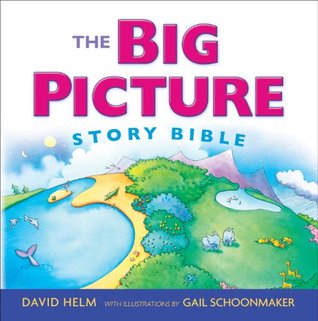
29. The Big Picture Story Bible


29. The Big Picture Story Bible. David R. Helm. Illustrated by Gail Schoonmaker. 2004. Crossway Books. 451 pages. [Source: Review copy] [5 stars]

First sentence from the Old Testament section: The Bible is God's story, and it begins with these big words: "In the beginning, God created the heavens and the earth." Do you know how God created everything? Simply by speaking words. Imagine, making the world with words! Strong words. Powerful words. With words God created everything!

First sentence from the New Testament section: Years passed without a single word from God. And the years turned into many years, and the many years turned into hundreds of years. And the great promises of God seemed to fade away. Israel became less important in the world. Other nations became great--strong nations, powerful nations, whose kings ruled over God's people. One such king...was Caesar Augustus.

The Big Picture Story Bible is one of my favorite bible story books. Why? Because it presents the Bible not as a series of entertaining, informational, educational, inspirational stories but as a unified story. The Bible does in fact have a big picture. If you miss the big picture, you miss the point. By understanding--grasping, appreciating--the big picture, you are enabling yourself to appreciate the smaller as well because you can see how everything fits, everything belongs.

The Big Picture Story Bible has twenty-six illustrated stories. Together they tell one big story. These stories build upon one another. They are interconnected. Everything is building up to the big climax--the appearance of Jesus Christ. The first eleven stories cover the Old Testament. The remaining fifteen stories cover the New Testament.

The Bible is for believers young and old. The story it tells is grand, glorious, but above all TRUE and TRUSTWORTHY. Yet people of all ages can struggle to read the Word for themselves. Perhaps because it seems so strange and otherworldly. Perhaps because it is intimidating. Perhaps because they don't know where to begin. A familiarity with the BIG PICTURE of the Bible could be the very boost one needs to begin to ACTUALLY read the Bible.

The Big Picture Story Bible gives readers of all ages the orientation they need to grasp not only the story but the theology behind the story. It covers the basics of the gospel, the good news of Jesus Christ. It is not so thorough and comprehensive that it would ever--could ever--take the place of the Word itself. That would be silly. But by showing you the structure of the Word, how everything fits together, how every story belongs to the whole, it can be a considerable help.

I think this one is for readers of all ages. I definitely think parents with children should have this one in their homes. (Christian parents and grandparents). Parents have an awesome responsibility to teach and instruct their children in the faith. It isn't anyone else's responsibility to do so for you. It is a great task, but it isn't an impossible one. It's never too early. It's never too late. You might feel overwhelmed, but you can learn alongside your children. You can go on this glorious, wonderful journey together.

But I also think adults without children could benefit from this one as well. There are a million excuses why believers don't read the Bible. Grasping the big picture and holding onto the big picture could be a great stepping stone into actually reading the Bible and tasting for yourself the sweetness of the Lord.

© Becky Laney of Operation Actually Read Bible

Monday, May 27, 2019

Book Review: The Big Picture Story Bible

The Big Picture Story Bible. David R. Helm. Illustrated by Gail Schoonmaker. 2004. Crossway Books. 451 pages. [Source: Borrowed]

First sentence from the Old Testament section: The Bible is God's story, and it begins with these big words: "In the beginning, God created the heavens and the earth." Do you know how God created everything? Simply by speaking words. Imagine, making the world with words! Strong words. Powerful words. With words God created everything!

First sentence from the New Testament section: Years passed without a single word from God. And the years turned into many years, and the many years turned into hundreds of years. And the great promises of God seemed to fade away. Israel became less important in the world. Other nations became great--strong nations, powerful nations, whose kings ruled over God's people. One such king...was Caesar Augustus.

The Big Picture Story Bible is one of my favorite bible story books. Why? Because it presents the Bible not as a series of entertaining, informational, educational, inspirational stories but as a unified story. The Bible does in fact have a big picture. If you miss the big picture, you miss the point. By understanding--grasping, appreciating--the big picture, you are enabling yourself to appreciate the smaller as well because you can see how everything fits, everything belongs.

The Big Picture Story Bible has twenty-six illustrated stories. Together they tell one big story. These stories build upon one another. They are interconnected. Everything is building up to the big climax--the appearance of Jesus Christ. The first eleven stories cover the Old Testament. The remaining fifteen stories cover the New Testament.

The Bible is for believers young and old. The story it tells is grand, glorious, but above all TRUE and TRUSTWORTHY. Yet people of all ages can struggle to read the Word for themselves. Perhaps because it seems so strange and otherworldly. Perhaps because it is intimidating. Perhaps because they don't know where to begin. A familiarity with the BIG PICTURE of the Bible could be the very boost one needs to begin to ACTUALLY read the Bible.

The Big Picture Story Bible gives readers of all ages the orientation they need to grasp not only the story but the theology behind the story. It covers the basics of the gospel, the good news of Jesus Christ. It is not so thorough and comprehensive that it would ever--could ever--take the place of the Word itself. That would be silly. But by showing you the structure of the Word, how everything fits together, how every story belongs to the whole, it can be a considerable help.

I think this one is for readers of all ages. I definitely think parents with children should have this one in their homes. (Christian parents and grandparents). Parents have an awesome responsibility to teach and instruct their children in the faith. It isn't anyone else's responsibility to do so for you. It is a great task, but it isn't an impossible one. It's never too early. It's never too late. You might feel overwhelmed, but you can learn alongside your children. You can go on this glorious, wonderful journey together.

But I also think adults without children could benefit from this one as well. There are a million excuses why believers don't read the Bible. Grasping the big picture and holding onto the big picture could be a great stepping stone into actually reading the Bible and tasting for yourself the sweetness of the Lord.


© Becky Laney of Operation Actually Read Bible

Tuesday, May 15, 2018

Book Review: Rebekah in Danger

Rebekah in Danger: Peril at Plymouth Colony. Sisters in Time #2. Colleen L. Reece. 2004. Barbour Books. 144 pages. [Source: Review copy]

First sentence: "I'm tired of working," eleven-year-old Rebekah Cunningham muttered to herself as she crawled into her familiar hiding place under the chicken coops on the Mayflower's deck.

Rebekah is very much her brother's keeper in this historical children's novel set in Plymouth Colony. Will can get into trouble easily. He always means well. Or so he claims. He wants to help out. He wants to be a big manly, man--even though he's a boy. So he "helps" out by following along behind the men when they go exploring or hunting. He also "helps" out by going hunting on his own. He doesn't always tell anyone he's about to wander off. So without Rebekah's oh-so-watchful eye upon him, his whereabouts would be more unknown. Unfortunately, Rebekah hates tattling and prefers scolding herself. (A few times a crisis would have been avoided if she'd left him and gone to tattle to someone--anyone.)

But believe it or not there were real threats facing ALL the colonists and not just the Cunningham family. Whether it was intentional or not on the author's part, the very real perils are overshadowed by family dramas and childish woes. Woes like Rebekah's complaining and muttering about having to work because she's a girl. (Does she not realize that EVERY single person--perhaps minus the babies and toddlers--is hard at work. That every single day brings its challenges. That their survival is very much uncertain. They are surviving--or not--day by day, week by week, month by month. No family--except the oh-so-lucky Cunninghams--is free from loss.)

If a young girl complaining about being a girl is your idea of fun, then this one is worth your time.

I was disappointed with this second book in the series. I liked some aspects of it. But I would have appreciated some continuity between book one and two. After all, they are both set at the same time and the same place. 1620-1621, the Mayflower and Plymouth Colony. Would it have been so difficult to have Rebekah be friends with Sarah and John be friends with Will. After all, the community IS small. After spending all those months together they are bound to have known each other.

I like historical fiction generally. And plenty of times historical fiction feels authentic. But there are times when it feels like the heroine is too modern--her sensibilities so thoroughly modern--that all she does is complain that things in 1621 aren't as they are in 2001.

Times were DANGEROUS and PERILOUS. I just wish the characterization had been better. Perhaps a book for an older audience wouldn't be afraid to be more authentic and intense.

© Becky Laney of Operation Actually Read Bible

Wednesday, May 9, 2018

Book Review: Sarah's New World

Sarah's New World: The Mayflower Adventure. (Sisters in Time #1) Colleen L. Reece. 2004. Barbour Books. 138 pages. [Source: Review copy]

First sentence: Twelve-year-old John Smythe lay flat on the floor of the dark hallway. His right ear was pressed against the crack under the door to the parlor. He strained to make out what his parents' low voices were saying.

Premise/plot: Sarah and John Smythe are two of the children aboard the Mayflower. The Smythe family is excited to be going to the New World, a place where they can worship freely without threat of persecution. But the journey to America will not be an easy one. The voyage will be difficult for both Pilgrims and Strangers alike.

My thoughts: I enjoyed this one. I may not love, love, love the cover. But books should not be judged by their covers in the first place, right?! I will add that this is more John's story than Sarah's story. He is two years older. He is the one who likes to eavesdrop. He's the one who is often sharing news--even gossip--with his family. He is the one who is more adventurous and active on board the Mayflower. Sarah is definitely more of a passive heroine. She listens. She scolds. She obeys. She encourages.

The book blends fictional characters in with historical figures--men, women and children who actually sailed on the Mayflower. The book does a good job of providing context. Part of this comes through info dumps--sections of text where a LOT of information is shared via dialogue for the benefit of young readers. Faith is central to the family and there is discussion of what religious freedom is and why it's important.

© Becky Laney of Operation Actually Read Bible

Monday, October 6, 2014

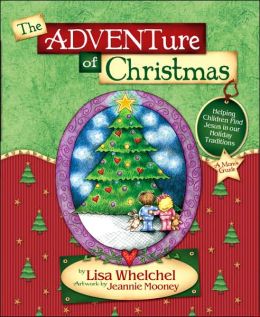
Book Review: The ADVENTure of Christmas

The Adventure of Christmas: Helping Children Find Jesus in Our Holiday Traditions. Lisa Whelchel. Illustrated by Jeannie Mooney. 2004. Multnomah Books. 72 pages. [Source: Library]

I enjoyed reading Lisa Whelchel's The ADVENTure of Christmas. The premise of this one is simple. Christ can be found in the traditions that many of us already have. Christ may not be obviously seen in the traditions that we have. But with a little research, a little work, he can be.

Readers can bring Christ into focus, more into focus, the whole holiday season. Readers don't have to worry that by putting up a tree and lights that they are giving into the world, into a commercialized holiday.

This book isn't necessarily one parents would read aloud to their kids. Though they could read paragraphs here and there. It is a resource or reference for parents to read. Each chapter focuses on one tradition. The tradition is discussed or explained. This is where the research comes in. Where, why, when, who, how, etc. Each chapter includes at least on activity, usually hands-on activity. (Some chapters have just one activity for the family to do together. But some chapters have a handful of activities.) Each chapter includes a teachable moment.

The table of contents:

  • Introduction
  • Advent Wreath
  • The Christmas Tree
  • Lights on the Tree
  • Ornaments on the Tree
  • The Candy Cane
  • The Star
  • X-mas Greetings
  • Outdoor Lights
  • The Colors of Christmas
  • Angels
  • Candles
  • Christmas Cards
  • Baking
  • Caroling
  • The 12 Days of Christmas
  • Wrapping Gifts
  • Giving Gifts
  • Santa Claus
  • Christmas Pageants
  • Nativity Scenes
  • The Wise Men
  • December 25th
  • Opening Presents
  • Christmas Dinner
  • The Christmas Story

From "The Christmas Tree"
The Christmas tree is a beautiful reminder of why Jesus was born in the first place--to die for you and me. "He himself bore our sins in his body on the tree, so that we might die to sins and live for righteousness" (1 Peter 2:24, NIV). As we put up the Christmas tree in our homes, it can only deepen our joy if we remember His death at this time of His birth. It is because He died for us that we can receive the eternal life represented by the evergreen boughs. Have you ever noticed that the boughs of your tree extend out like the arms of Jesus stretched upon the cross as He offered His life to anyone who would come to Him in faith? And your Christmas tree is very definitely pointing toward heaven and, as Jesus did with His words and His actions, drawing our attention to the Father who loves us. So when you stand before your Christmas tree, stand tall, as the tree does, and be a witness for Jesus. Let it direct your attention to the Father above. Fix your eyes on Jesus, then open your arms wide to touch others with His spirit of love. Then you, too, will be pointing people toward heaven--and to life beyond the power of death. (8)

© Becky Laney of Operation Actually Read Bible

Friday, June 27, 2014

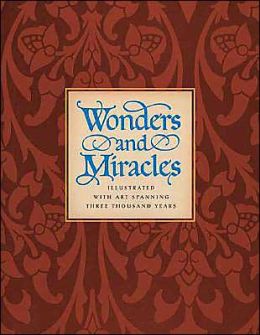
Book Review: Wonders and Miracles

Wonders and Miracles: Eric Kimmel, editor. 2004. Scholastic. 144 pages. [Source: Library]

Of the Passover books I've read the past two weeks, Wonders and Miracles is certainly the most comprehensive. Its thoroughness and/or complexity makes it for a slightly different age level than the others. Though parents could definitely select some readings from this one to share with their children. Wonders and Miracles is a compilation of resources from a variety of authors, a balanced blend of fiction and nonfiction. It even includes poetry. From the first page until the last, this one is just packed with information.

I learned so much by reading this one!

From the introduction:
It is a holiday filled with contradictions. It is a solemn religious event, but also a joyous feast. We celebrate our freedom from oppression, yet we do not rejoice over the sufferings of our oppressors.
All the members of the family, from the oldest to the youngest, take part in the Seder, the ritual Passover meal. Children play an important part, since the Torah requires us to tell them the Passover story.
The story is told in bits and pieces. Some of the most important parts are left out. Moses, the hero of the Exodus, is never mentioned during the Seder. His name does not appear even once in the traditional Haggadah (the collection of readings from the Bible and other writings) that is recited at this time.
Consequently, it is not surprising that many people attending a Seder for the first time--and even some who have celebrated Passover in their homes for years--miss the meaning of the many layers of ritual, tradition, and history underlying the Passover observance.
Passover is a holiday both ancient and modern; simple, yet rich in meaning and symbolism; timeless, yet ever changing. Its traditions draw on centuries of history, art, and literature. The texts and illustrations used in this book come from all over the world and span 3,000 years. This book was created to give people of all ages a fuller, richer understanding of what Passover means.
The book, as I mentioned, is complex and detailed. It is just packed with information. I definitely learned while reading it, and enjoyed myself in the learning process. Definitely recommended for those curious about Passover.

© Becky Laney of Operation Actually Read Bible

Monday, May 19, 2014

Book Review: (The Puritan Pulpit) Jonathan Edwards

(Puritan Pulpit) Jonathan Edwards 1703-1758. (Containing 16 Sermons Unpublished In Edwards' Lifetime) Compiled and Edited by Dr. Don Kistler. Soli Deo Gloria. 286 pages. [Source: Bought]

I have been wanting to read Jonathan Edwards for over a decade. I own several books by Jonathan Edwards. But this collection of previously unpublished sermons turned out to be the most reader-friendly of the bunch. I would definitely recommend this one to anyone who wants a more reader-friendly introduction to Jonathan Edwards. I have two ideas on what might make this one more reader-friendly. One, each sermon stands on its own. So as a reader, you can approach each sermon on its own. I found the chapters to be of a good length, a varying length. Some sermons being about twelves pages perhaps, and, others being a bit longer. Personally, I set out to read one to two sermons per day over two weeks. I found this worked really well. Two, sermons have a definite audience. These sermons were written, were preached, to an audience with the intent of being understood. So there is a certain clarity. He wanted to save souls; he wanted to reach the lost and/or teach the saved. Here we find instruction and food for thought. His sermons offer a bit of a challenge in that they are asking the reader (or the listener, originally) to evaluate where he/she stands in relation to Christ. Each sermon is broken down into two sections: Doctrine and Application.

Here are the sixteen sermons:

  1. God Never Changes His Mind
  2. It Is Well For Us That God Is Not As We Are
  3. God Doesn't Thank Men For Doing Those Things He Commands Them
  4. Men's Addiction to Sin is No Excuse, But An Aggravation
  5. God Is Kind to the Unthankful and the Evil
  6. A Man May Eternally Undo Himself in One Thought of His Heart
  7. There Is A Mutual Abhorrence Between God and Wicked Men
  8. There Is Nothing Like Seeing What God Is To Make Men Sensible To What They Are
  9. God Does What He Pleases
  10. Tis The Spirit of a Truly Godly Man to Prefer God Before All Other Things Either In Heaven or On Earth
  11. Christ is the Christian's All
  12. God Is Everywhere Present
  13. Spiritual Appetites Need No Bounds
  14. There Is Much of the Goodness and Mercy of God Appearing in the Commands He Has Given Us
  15. Contending With God
  16. God Is A Being of Transcendent Mercy

I loved, loved, loved this collection. Did I love, love, love each sermon equally? Did I profit by each sermon equally? Of course not. I needed to hear some more than others. I am so glad I didn't assume that this collection of sermons would be "too difficult" for me to read and appreciate!


© Becky Laney of Operation Actually Read Bible

Saturday, September 15, 2012

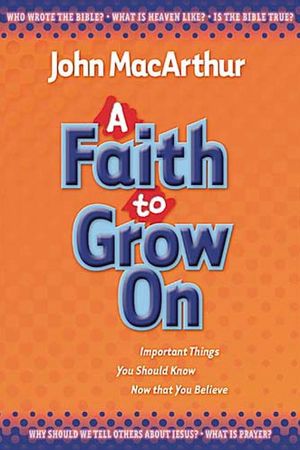
Book Review: A Faith To Grow On

A Faith To Grow On. John MacArthur. 2000/2004. Thomas Nelson. 192 pages.

A Faith To Grow On is essentially a book for children and (younger) young adults on the basics of the Christian faith. The book is divided into twelve chapters:

  • God
  • Creation
  • Sin
  • Bible
  • Jesus
  • Salvation
  • Worship
  • Prayer
  • Church
  • Forgiveness
  • Evangelism
  • Heaven

Each chapter is divided or subdivided into two-page spreads that often focus on questions OR share and explain a portion of Scripture. For example, chapter one is broken down into these questions:

  • Can we see God?
  • Are we like God?
  • How are we different from God?
  • What does God want from us?
  • What keeps us from knowing God?
  • How long has God been alive?
  • Is God perfect?
  • Is there only one God?
  • What should we do when we don't understand God?
  • What we understand about God?

Some of the questions are natural, others feel a little more forced. Each two page spread is a blend of introduction, explanation, and sometimes application. Also included on each spread are a handful of Scripture verses on the topic. I didn't find the "word scrambles" for each spread necessary. But that could just be me!

Some of the chapters are longer than others, some are quite short. But overall, I think the book offers something of substance to readers. I do think it is important to have quality educational books to share with children. This one would be great for families OR for a church setting.

© Becky Laney of Operation Actually Read Bible

Saturday, April 14, 2012

Book Review: Letters to a Diminished Church

Letters To A Diminished Church: Passionate Arguments for the Relevance of Christian Doctrine. Dorothy Sayers. 2004. Thomas Nelson. 280 pages.

Official Christianity, of late years, has been having what is known as bad press. We are constantly assured that the churches are empty because preachers insist too much upon doctrine--dull dogma as people call it. The fact is the precise opposite. It is the neglect of dogma that makes for dullness. The Christian faith is the most exciting drama that ever staggered the imagination of man--and the dogma is the drama.

I never know whether to start with the good news or the bad news when writing a book review. To me, this book was a slight disappointment, but I'll need to clarify. While I was familiar with Sayers oh-so-excellent work as a mystery writer during the 1920s and 1930s, I was unfamiliar with her work as a writer of theology or christian living. I read half-a-dozen Sayers quotes in a Michael Horton book earlier this year, and it was LOVE. I mean I thought her work, her writing, her insights were absolutely wonderful, brilliant, wise. I LOVED them so much I typed them all up and shared them as a Sunday Salon post. So my expectations were exceedingly high. And I ordered Letters to a Diminished Church because I thought it sounded very, very promising.

The good news is that this book has two of the best essays ever. "The Greatest Drama Ever Staged" is one of the best, best, best essays ever. These seven pages are truly must-read-material. I mean these pages are rich in truth. Sayers' insights are great. "What Do We Believe?" is an interesting essay that challenges readers to think about what they really believe and if their so-called beliefs impact how they do in fact live daily in a practical way. It is not as brilliant, perhaps, as "The Greatest Drama Ever Staged," but it is at least practical. "The Dogma is the Drama" is a quirky little piece with some truth to it. (Think Screwtape Letters). It is in an unusual question-and-answer format. Sayers is writing what the average person *may* say in response to these general-and-basic questions. Questions such as "What does the church think of God the Father? What does the church think of God the Son? What does the church think of God the Holy Spirit? etc. This article is more about how Christianity is misunderstood by many--even those who have some experience with church. In other words, what answers would the person off the street be like if asked these basic creedal questions. "Creed or Chaos?" is an excellent essay or article. It is definitely in the top two from this collection. I'd definitely consider it must-read.

The bad news is that the remaining essays were dry(er) and less relevant to the general readership. Among other things Sayers emphasizes the creative-imaginative artist; art and Art in the world; literature and literary criticism. I personally could not work up enthusiasm for essays like "The Faust Legend and the Idea of the Devil," "The Writing and Reading of Allegory," and "Toward a Christian Esthetic."

I'm not saying that the only quote-worthy sections are the four essays that I absolutely loved and adored. There were a few gems hidden in the other essays, but, you had to be super-super patient. And even then it wasn't a sure-thing.

Quotes:

Sayers' on TOLERANCE

It is the sin that believes in nothing, cares for nothing, seeks to know nothing, interferes with nothing, enjoys nothing, loves nothing, hates nothing, finds purpose in nothing, lives for nothing, and remains alive only because there is nothing it would die for. We have known it far too well for many years. The only thing perhaps that we have not known about it is that it is a mortal sin. (103)

Sayers' on PREACHERS

If spiritual pastors are to refrain from saying anything that might ever, by any possibility, be misunderstood by anybody, they will end--as in fact many of them do--by never saying anything worth hearing. (117)

© Becky Laney of Operation Actually Read Bible

Monday, July 11, 2011

Book Review: How To Find God in the Bible

How to Find God in the Bible: A Personal Plan For the Encounter of Your Life. Woodrow Kroll. 2004. Multnomah. 204 pages.

How to Find God in the Bible is a great little book. I found it to be practical and substantive. You would think that there is only so much that can be said about the Bible. After all, this year I've read Taking Back the Good Book by Woodrow Kroll, Read Your Bible One Book at A Time by Woodrow Kroll, How To Study The Bible. R.A. Torrey, Discovering Jesus: Why Four Gospels to Portray One Person? T.D. Alexander, Knowing Scripture. R.C. Sproul, and How To Get The Most From God's Word. John MacArthur. Yet I haven't found that to be the case. Yes, some chapters may touch on the same subjects, but for the most part each book has been unique; each written in its own style with its own goals.

I am not sure that How to Find God in the Bible is the best of the best of the best of the best. BUT. I do know that I loved it. I found it informative. Each chapter was packed with information. Information that was practical and relevant. And it was written in a very straightforward, reader-friendly style. It wasn't trying to do too much. It wasn't trying to turn the reader into the BEST BIBLE SCHOLAR ever. It wasn't trying to convince the average reader to try to learn Hebrew and Greek. It wasn't trying to persuade you to spend ten hours a day in study and meditation. It also wasn't trying to defend the Bible against skeptics, agnostics, and atheists. You won't find theories and arguments and rhetoric here. No this is a practical book for practical people who want to read the Bible for themselves.

The book is written in three parts. Part One is "Prepare to Encounter God." Part Two is "Why the Bible Can Change Your Life." Part Three is "Four Amazing Bible Discoveries."

Each chapter has an "In this chapter" feature which I just loved. (Maybe because I'm a reviewer who is always trying to find specific things that I want to include in my post. But I believe it has to be useful for other reasons too!)

I'm not a *big* list person--or chart person--but for some reason, I just LOVED the use of charts and lists in this one. For example, there's a list of "people with whom God spoke directly" and "people with whom God spoke through angels" in chapter one. And then there is the list in chapter seven "fourteen reasons to exalt the Lord Jesus Christ."

Favorite quotes:
Every time you read the Bible, you should be prepared for anything. You never know what will happen. (41)
Don't fail to read the Bible simply because you have difficulty relating to the translation. Find a version you do understand. I'm often asked which version of the Bible I think is the best, and I always respond, "The one you read." It doesn't matter if you are convinced your version is the most accurate there is. If you don't read it, you won't connect with God. Hurdle the language barrier by choosing a Bible that is comfortable for you. Then read it for all it's worth. (61)
God doesn't buy the idea of hopelessness because "with God all things are possible" (Matthew 19:26). (109)
"...people have chosen to use the Bible to support their point of view instead of trusting the Bible enough to let it change their point of view--and their way of life." (121)
I have often said that if Christians blew the dust off their Bibles at the same time, we'd all get killed in the dust storm. If you are to benefit from God's Word, you're going to have to read it. It's how you connect with God. (173) 

Saturday, March 26, 2011

Book Review: The Big Picture Story Bible

The Big Picture Story Bible. David R. Helm. 2004/2010. Crossway Publishers. 456 pages.

The Bible is God's story, and it begins with these big words: "In the beginning, God created the heavens and the earth." Do you know how God created everything? Simply by speaking words. Imagine, making the world with words! Strong words. Powerful words. With words God created everything! He made the stars, the sun, and the moon. He made the animals, the fish, the trees, and flowers too. Everything! And then after all these things, God created... People!

Can you see Adam and Eve? God put his people in the Garden of Eden. They were made in the image of God. They were to be the rulers of God's place.
Adam and Eve were very special to God. Did you know that you are also very special to God? You are special because you are made in his image too! Being created in the image of God must have made Adam and Eve very, very happy. God was happy too. He was pleased with his world and his people because he saw that they were very good. Nothing was wrong. Nothing was bad. Nobody disobeyed God. In the very beginning, everything and everyone knew how good God was. God gave Adam and Eve good words to obey. He told them not to eat from a special tree. You see, God was teaching Adam and Eve that he was their king, that people were to obey God's word. God also said that if Adam and Eve disobeyed his word, they would surely die. So God's people, Adam and Eve, lived in God's place, the Garden of Eden. And they ruled God's world by obeying his good word. Do you know what happened next?

I loved this one. I LOVED, LOVED, LOVED this one! It was MUCH bigger than I was expecting! You might think a book with four-hundred pages would be text-heavy. That even if the book was written with young children in mind, that the text would overwhelm the book. But that isn't the case at all. It's filled with illustrations by Gail Schoonmaker. And the illustrations are great--very bold, vibrant. But not in an overwhelming way. Not in a glittery way. They worked really well! The little details were great!

The text is simple and direct--without much fuss and nonsense--yet it is profound too. (I liked how the narrator speaks directly to readers. Asking them to participate in the story. I thought that was a great touch.) I liked the stories Helm included. I liked how the stories were presented. How they all tied together. I also liked the balance between text and illustration.

I think this would be a great book for parents and grandparents to share with the children in their lives. I think this book would make a great read-aloud. And if your child is already reading, perhaps, you can take turns reading to one another. I think there's enough in the stories to lead to  good discussion!

There is a definite theme to this bible storybook collection. Dare I say it? It's evangelical! I remember Mike Abendroth of Bethlehem Bible Church preaching a sermon called "The Gospel in Twelve Words." (The LINK is to an mp3 of the sermon.) These are twelve key words--organized under four questions--that can "help" you spread the gospel.
Who is God? Creator. Judge. Savior.
Who is Man? Fallen. Sinful. Foolish.
What Did Jesus Do? Redeemed. Reconciled. Resurrected.
What Did Jesus Command? Believe. Repent. Follow. 
Reading The Big Picture Story Bible, I was reminded of this sermon, of this outline. For in this book, we see a clear presentation of man and God. Of man's need for a Savior. Of God's loving care and provision. Of the BIG PICTURE of the Bible. So the stories are presented as being part of one BIG story. Everything is connected. Yet it isn't forced.

I would recommend this one to children. But I would also recommend it to adults. It's a clear overview of the entire Bible practically--and it can be read in one sitting. The language is clear, concise. If you're not sure what the "big picture" of the Bible is--how these 66 books act as one big story--then this is the book for you.

There are eleven stories from the Old Testament: "The Very Good Beginning," "A Very Sad Day," "Life Outside the Garden," "God's Big Promise," "God's People Grow," "God's People Become Great," "God's Great Sign," "Going Into God's Place," "God's Blessings Grow," "Another Very Sad Day," and "God's Promise Remains."

There are fifteen stories from the New Testament: "Many Silent Years," "God's Promised One is Born," "God's Promised One is Announced," "God's New People Are Called," "Jesus Restores God's Place," "Jesus Reveals God's Kingdom," "A Blind Man Sees," "A Dead Man is Raised to Life," "Jesus Wears God's Kingly Crown," "Jesus' Followers Are in the Dark," "A Brand-New Day," "God's Promise is Explained," "God's New Kingdom Spreads," "Letters to Live By," and "The Very Good Ending."

The newest publication of The Big Picture Story Bible includes an audio book version of this one read by the author. (It's a little over 90 minutes in length.)


© Becky Laney of Operation Actually Read Bible

Saturday, January 17, 2009

Book Review: Baby Bible: Stories About Jesus


Currie, Robin. 2004. Baby Bible: Stories About Jesus. Illustrated by Cindy Brownsberger Adams. FaithKidz.

and

Currie, Robin. 2008. Baby Bible: Stories About Jesus. Illustrated by Constanza Basaluzzo.

This board book story-bible is great for young readers--babies, toddlers, preschoolers. The book presents a nice variety of stories centered on Jesus--from his birth to his ascension.

Each story is two pages. One of text. One of illustration. The text consists of title, scripture reference, narrative (with interaction prompts), and a concluding prayer.

For example,

Jesus At the Temple
Taken from Luke 2:41-50

Jesus and His family went on a long trip to the temple in Jerusalem. They walked and walked.

Tap your hands on your knees.

They liked to be with all their friends and pray and learn about God.

Fold your hands to pray.

In the temple lived teachers who read lots of books. Jesus asked them many questions. They were surprised that He knew so much.

Show me a surprised face.

You can learn about Jesus by reading the Bible--God's Word.

Thank you, God, for books to learn about Jesus. Amen.

I won't mention the illustrations because with one edition being out-of-print now and the newer edition being a different illustrator--one I haven't even seen--it wouldn't be all that helpful unless you happen to want to seek out this older edition and buy it used.

I will say this--I loved this book.

© Becky Laney of Young Readers