Showing posts with label 1979. Show all posts

Monday, May 8, 2023

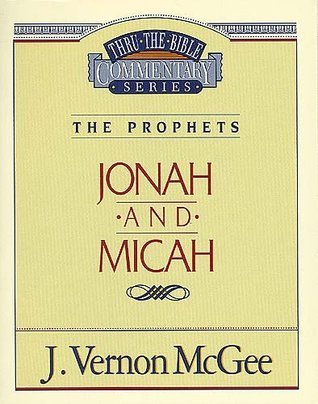
45. Jonah and Micah (Thru the Bible)


Thru the Bible #29: Jonah and Micah. 1979. 173 pages. [Source: Bought]

First sentence: Jonah is the book of the Bible which perhaps has been criticized more than any other. Unfortunately, many Christians thoughtlessly cast aspersions upon this important book in the canon of Scripture without realizing that they are playing into the hands of the critics and innocently becoming the dupes of the skeptics. 

This commentary covers two minor prophets--the books of Jonah and Micah. J. Vernon McGee continues his paragraph by paragraph commentary of the Bible. I wouldn't say that he goes into great detail with each and every verse. It's more "thought for thought" if you will. He's hoping to capture the "thought" and "meaning" of passages of bible books. If you're looking for breakdowns of Hebrew and Greek, then McGee probably isn't your man--your theologian. 

McGee is very casual, very conversational. Not because he doesn't have a high view of Scripture. He believes the Bible to be the very Word of God. He believes in all the things--inerrant, infallible, inspired, authoritative, etc. But he wants to reach people--all people. Not just elite scholars, but everyone. He wants EVERYONE to feel comfortable reading, studying, comprehending the Bible. 

I've read a dozen or so of McGee's commentaries. This one is slightly odd--for me. McGee's take on Jonah is perhaps not unique but not entirely expected. It was the first time I'd heard this interpretation. McGee believes that Jonah was DEAD for three days. Literally dead. God resurrected him and sent him on his way. I'd never really thought about if Jonah was DEAD or alive in the belly of the fish. I suppose it isn't a point on scripture that is absolute, that you have to make an absolute stand on. But the traditional view is that he was kept alive in the belly of the fish. Again, this was my first exposure to McGee's views. He argues that this is where the Old Testament makes it crystal clear that resurrection is possible. I think there are other examples of resurrection in the Old Testament--though perhaps not with the dead several days implication. But I don't think Jonah had to be literally dead for three days in order for Christ to make use of Jonah in his illustration. 

I do like the book of Micah. I think it is a relevant book in many, many ways. But McGee got a little subtracted, in my humble opinion. Again he made a point or two that I wasn't quite on board with. Namely he argues that the United States of America is in decline (if he left it at that it might not be worth a mention) and will not be a player--a world power--in the end days because it is not mentioned by name in the Bible. I'll let you think about that for a minute. That's neither here nor there as far as I'm concerned. I'd be more concerned if the United States of America was mentioned by name in the original languages of Scripture thousands of years before Christopher Columbus sailing the ocean blue. I don't think the lack of a country's name, a state name, indicates ANYTHING positive or negative. McGee will not be popular, perhaps, for his opinion that the Great Depression and World War II are judgments of God on the United States of America. Though that goes down a LOT more smoother than his statements on the Holocaust. I can't even begin to get into that here in this review. 

There were still plenty of good insights into both books. But this particular volume isn't topping my favorites list. 

© Becky Laney of Operation Actually Read Bible

Monday, December 28, 2020

110. Revelation 6-13


Thru the Bible Commentary Series: Revelation 6-13. J. Vernon McGee. Thomas Nelson. 192 pages. [Source: Bought]

First sentence: The sixth chapter of Revelation is the great watershed, the great divide, of the Book of Revelation. Here is a division that is all-important.

I am reading the Bible in 2020 using the daily M'Cheyne (Robert Murray M'Cheyne) plan. I thought it would add a layer of substance to in addition to the four chapters a day, to also read commentaries for those chapters. For that I am using Matthew Henry's Commentary on the Whole Bible. But the plan goes through the New Testament (and Psalms, I believe) twice. So now that I've finished Henry's commentary for the New Testament, I am tackling the New Testament commentary section of J. Vernon McGee's series.

This is not my first time reading J. Vernon McGee. I've read probably thirty or so of his commentaries. Most recently Revelation 1-5.

I really am LOVING McGee. This has been the best idea--to correspond my Bible reading with commentary reading. 

This is NOT my first time reading McGee's commentary on Revelation. In fact, I'd say that his commentary on Revelations was one of the first of his to read way back when. (The only one that might have come first was Isaiah or Jeremiah?) 

The second volume covers chapters six through thirteen. These are very intense chapters! The focus is on the Great Tribulation. McGee's approach is not to read our present into the interpretation of the Scripture. So you won't see McGee arguing that these Scriptures are being fulfilled in our days. He has definite ideas on what is important and what is less important. On what it is necessary to know and what is impossible to know.

What I have come to appreciate about the Thru the Bible commentaries is that even when I don't agree with every single little detail, every little point or insight made by McGee, I still find it of benefit overall. I enjoy his writing style, his accessibility, his enthusiasm.  
 
Favorite quotes:
Do you know that the Lord Jesus is the only One who is able to judge this earth? He is the One who is able to judge, not only because of who He is—He is God manifest in the flesh—but also because of what He has done. He created this earth, and that gives Him a right. He is worshiped in chapter 4 as the Creator. But then He also redeemed this earth, and in chapter 5 He is worshiped as the Redeemer. Since He is the Creator and the Redeemer, He is the only One worthy to judge this earth. He is the only One who is able to rule this earth. What a reflection upon the consummate conceit of little men down here who want to be judges!
Antichrist does not appear as a villain. After all, Satan’s angels are angels of light. He is not going to have horns or cloven feet. Rather, he is going to be the most attractive man the world has ever seen. They will elect him, and the world will acclaim him because he has come in his own name. But when he takes over, it sure is going to be bad for the world.
When Antichrist comes to power, he is going to talk peace, and the world will think that it is entering the Millennium when it is actually entering the Great Tribulation. The Great Tribulation comes in like a lamb, but it goes out like a lion. A promise of peace is the big lie the world is going to believe.
Death evidently has an all–inclusive, three–fold meaning that we do not ordinarily attach to it. We think of death as referring only to the body. (1) This is physical death, and it refers only to the body. It comes to a man because of Adam’s sin. (2) Then there is what is known as spiritual death, which is separation from, and rebellion against, God. We inherit a dead nature from Adam; that is, we have no capacity for God and no desire for Him at all. (3) Finally, there is eternal death, which is eternal separation from God. Unless a man is redeemed, this inevitably follows. This is the second death that we will find later on in Revelation 20:14.
Since this book is the last book of the Bible, the only requirement is to have a working knowledge of the sixty–five books which go before. Then you will find that this book makes a great deal of sense and is quite logical.
Then, does anybody get saved in the Great Tribulation period? My friend, I believe that there will be a greater company saved in that period than in any other seven–year period in the history of the world.
A great company is going to be saved, and this reveals that these judgments will accomplish a purpose for God. It will cause multitudes to turn to Him in this period, and it will cause another multitude to turn against Him. It is just like the effect of the sun shining down on a piece of soft clay. What will the sun do to the clay? It will harden it. What would be the effect of that same sunlight upon wax? It would melt it. The sun has the opposite effect upon clay and wax. The judgments of God are the same. In our lives as believers, when trouble comes to us—I’ve discovered this in my own life—it will either draw us to God or drive us from Him.
The gospel is not God asking you to do something; it is God telling you that He has done something for you. The gospel is not your giving something to God; the gospel is God’s giving something to you. The gift of God is eternal life in Christ Jesus.
The Book of Revelation is the last book in the Bible because a working knowledge of the sixty–five books preceding it is the basic requirement for an understanding of its vivid language.
You do not interpret Revelation by itself; there are sixty–five books before it. 
That all of God’s men are immortal until God is through with them is a wonderful comforting thought for today. And when He is through with you, He will remove you from the earth.

In the Gospels the emphasis is on the death of Christ. In the Epistles the emphasis is upon the resurrection of Christ. In the Book of Revelation the emphasis is upon the ascension of Christ. Protestantism, and even fundamentalism, has ignored the ascension of Christ, and this is one reason we have not had a great enough emphasis upon the present ministry of Christ.

© Becky Laney of Operation Actually Read Bible

Tuesday, December 15, 2020

104: Revelation 1-5 (Thru the Bible #58)


Revelation 1-5. (Thru the Bible #58) J. Vernon McGee. 1995 (published 1979???) 152 pages. [Source: Bought]

First sentence: In the first division of this book we see the person of Christ. We see Christ in His glory and position as the Great High Priest who is in charge of His church. We see Him in absolute control. In the Gospels we find Him meek, lowly, humble, and dying upon a cross. He made Himself subject to His enemies on earth. He is not like that in the Book of Revelation. He is in control. He is still the Lamb of God, but we see the wrath of the Lamb that terrifies the earth.

I am reading the Bible in 2020 using the daily M'Cheyne (Robert Murray M'Cheyne) plan. I thought it would add a layer of substance to in addition to the four chapters a day, to also read commentaries for those chapters. For that I am using Matthew Henry's Commentary on the Whole Bible. But the plan goes through the New Testament (and Psalms, I believe) twice. So now that I've finished Henry's commentary for the New Testament, I am tackling the New Testament commentary section of J. Vernon McGee's series.

This is not my first time reading J. Vernon McGee. I've read probably thirty or so of his commentaries. Most recently 2 John, 3 John, Jude.

I really am LOVING McGee. This has been the best idea--to correspond my Bible reading with commentary reading. 

This is NOT my first time reading McGee's commentary on Revelation. In fact, I'd say that his commentary on Revelations was one of the first of his to read way back when. (The only one that might have come first was Isaiah or Jeremiah?) 

The first volume covers the first five chapters.

The first three chapters introduce the Revelation and focus on the seven letters to the seven churches. McGee's insights on these letters is quite interesting. At the very least, he provides great background on the actual churches. He also argues that each church represents an age of the Christian church. You don't have to agree with him perfectly to learn from him. For example, you can think all of the letters are relevant all the time to every church and still gain from reading McGee's commentary. Chapters four and five take us to heaven and gives us a glimpse of the Worthy Lamb.

One thing that I definitely appreciated about this commentary is the fact that J. Vernon McGee is decidedly premillennialist. I don't always, always, always agree with him when it comes to interpreting the rapture and the Great Tribulation--I do affirm a literal thousand year reign. (That isn't really addressed in this one.) 

But I also really appreciated how accessible it makes the whole book. For example,
Let's look at the Book of Revelation as an airport with ten great airlines coming into it. We need to understand where each began and how it was developed as it comes into the Book of Revelation. The ten great subjects of prophecy which find their consummation here are these:
1. The Lord Jesus Christ. He is the subject of the book. The subject is not the beasts nor the bowls of wrath but the Sin-bearer. The first mention of Him is way back in Genesis 3:15, as the Seed of the woman.
2. The church does not begin in the Old Testament. It is first mentioned by the Lord Jesus in Matthew 16:18.
3. The resurrection and the translation of the saints (see John 14; 1 Thessalonians 4:13-181 Corinthians 15:51-52).
4. The Great Tribulation, spoken of back in Deuteronomy 4 where God says that His people would be in tribulation.
5. Satan and evil (see Ezekiel 28:11-18)
6. The "man of sin" (see Ezekiel 28:1-10)
7. The course and end of apostate Christendom (see Daniel 2:31-45; Matthew 13)
8. The beginning, course, and end of the "times of the Gentiles" (see Daniel 2:37-45Luke 21:24) The Lord Jesus said that Jerusalem will be trodden down of the Gentiles until the Times of the Gentiles are fulfilled.
9. The second coming of Christ. According to Jude 14-15, Enoch spoke of that, which takes us back to the time of the Genesis record.
10. Israel's covenants, beginning with the covenant which God made with Abraham in Genesis 12:1-3. God promised Israel five things and God says in Revelation that he will fulfill them all.
Now I want to make a positive statement: The book of Revelation is not a difficult book. The liberal theologian has tried to make it a difficult book, and the amillennialist considers it a symbolic and hard-to-understand book. Even some of our premillennialists are trying to demonstrate that it is weird and wild. Actually it is the most orderly book in the Bible. 
and
My friend, the Scripture does not leave us in the dark regarding what He is doing today. It mentions three very definite ministries.
First, there is the intercession of Christ. He is our Great High Priest. He is standing at the golden altar in heaven today, where He ever lives to make intercession for us (Hebrews 7:25). We love that part of His ministry. It is a wonderful thing.
Secondly, we have the intervention of Christ, He steps outside of the Holy Place to the laver. There He washes the feet of those who are His own. He washes those who have confessed their sins. Christians have sin, and those sins must be confessed in order to have fellowship with Him. "If we confess our sins, he is faithful and just to forgive us our sins, and to cleanse us from all unrighteousness." (1 John 1:9) He is girded today with the towel, and He carries the basin; He intervenes on our behalf.
There is yet another ministry of Christ that is not very popular. It is the ministry mentioned in the first chapter of Revelation, and I think that is one reason this section of Revelation is so little known. Here we see His ministry of inspection. What Christ is doing today is clearly outlined in the Scriptures. 
and
Yet the inscription on the cathedral in Lubeck, Germany, is still true:
Thus speaketh Christ our Lord to us:
Ye call Me Master and obey Me not.
Ye call me Light and see Me not.
Ye call Me Way and walk Me not.
Ye call me Life and choose Me not.
Ye call Me Wise and follow Me not.
Ye call Me Fair and love Me not.
Ye call Me Rich and ask Me not.
Ye call Me Eternal and seek Me not.
Ye call Me Noble and serve Me not.
Ye call Me Gracious and trust Me not.
Ye call Me Might and honor Me not.
Ye call Me Just and fear Me not.
If I condemn you, blame Me not. 
J. Vernon McGee gave me a lot to think about! 

Other favorite quotes:

Revelation does not originate or begin anything. Rather it consummates and concludes that which has been begun somewhere else in Scripture...This is the reason that a knowledge of the rest of the Bible is imperative to an understanding of the Book of Revelation. It is calculated that there are over five hundred references or allusions to the Old Testament in Revelation, and that, of its 404 verses, 278 contain references to the Old Testament. In other words, over half of this book depends upon your understanding of the Old Testament. 
To those who claim that it is all symbolic and beyond our understanding, I say that the Book of Revelation is to be taken literally. And when a symbol is used, it will be so stated. Also it will be symbolic of reality, and the reality will be more real than the symbol for the simple reason that John uses symbols to describe reality. In our study of the book, that is an all–important principle to follow. Let’s allow the Revelation to say what it wants to say.
Let’s keep in mind that this book is a revelation of Jesus Christ. In the Gospels you see Him in the days of His flesh, but they do not give the full revelation of Jesus Christ. There you see Him in humiliation. Here in Revelation you see Him in glory. You see Him in charge of everything that takes place. He is in full command. This is the unveiling of Jesus Christ... The Bible as a whole tells us what He has done, what He is doing, and what He will do. The Book of Revelation emphasizes both what He is doing and what He will do.
Notice also that there is a tie between Genesis and Revelation, the first and last books of the Bible. Genesis presents the beginning, and Revelation presents the end. Note the contrasts between the two books: In Genesis the earth was created; in Revelation the earth passes away. In Genesis was Satan’s first rebellion; in Revelation is Satan’s last rebellion. In Genesis the sun, moon, and stars were for earth’s government; in Revelation these same heavenly bodies are for earth’s judgment. In Genesis the sun was to govern the day; in Revelation there is no need of the sun. In Genesis darkness was called night; in Revelation there is “no night there” (see Rev. 21:2522:5). In Genesis the waters were called seas; in Revelation there is no more sea. In Genesis was the entrance of sin; in Revelation is the exodus of sin. In Genesis the curse was pronounced; in Revelation the curse is removed. In Genesis death entered; in Revelation there is no more death. In Genesis was the beginning of sorrow and suffering; in Revelation there will be no more sorrow and no more tears. In Genesis was the marriage of the first Adam; in Revelation is the marriage of the Last Adam. In Genesis we saw man’s city, Babylon, being built; in Revelation we see man’s city, Babylon, destroyed and God’s city, the New Jerusalem, brought into view. In Genesis Satan’s doom was pronounced; in Revelation Satan’s doom is executed. It is interesting that Genesis opens the Bible not only with a global view but also with a universal view—“In the beginning God created the heaven and the earth” (Gen. 1:1). And the Bible closes with another global and universal book. The Revelation shows what God is going to do with His universe and with His creatures. There is no other book quite like this.
There is a hard core of real facts in this book. What are "things"? One night Mrs. McGee and I took care of our little grandson. We let him play in the den where we keep a bunch of toys for him to play with when he stays with us. He went into the den and got out all of those things. In fact, he calls them his things. He spread them all over the floor of the den. We indulge the little fellow, and we didn't make him pick up all of his toys after he was through playing. We didn't pick them up either. So later that night, when I walked through the den, I stepped on some of his things. In fact, I stumbled over them and took a tumble. You can say that "things" are symbols, but you don't take a tumble over symbols. And in the book of Revelation, the "things" are made out of hard stuff. These "things" are reality. Any time John uses a symbol, he will make it clear to us that he is using a symbol. And we can be sure that he is using a symbol because the reality is far greater than the symbol. In fact, the symbol is a poor representation of the reality.   
“I am Alpha and Omega.” This is quite a remarkable statement in the Greek language. The alpha and omega are the first and last letters of the Greek alphabet. From an alphabet you make words, and Jesus Christ is called the “Word of God”—the full revelation and intelligent communication of God. He is the only alphabet you can use to reach God, my friend. The only language God speaks and understands is the language where Jesus is the Alpha and the Omega and all the letters in between. He is the “A” and the “Z,” and He is the “ABC.” If you are going to get through to God the Father, you will have to go through the Son, Jesus Christ.
Let me remind you that this is a Christocentric book. The glorified Christ is the subject. Don’t get your eyes on the horsemen or on the bowls of wrath or on the beasts—they are just passing through. Fix your eyes on the Lord Jesus Christ. He is the One who was, who is, and who will be. He is the same yesterday, today, and forever. And John is to write the vision he has had of Him.
Dwight L. Moody put it like this: “He who is born once will die twice; he who is born twice will die once.”
This is the church that Stanley High spoke of when he said: The church has failed to tell me that I am a sinner. The church has failed to deal with me as a lost individual. The church has failed to offer me salvation in Jesus Christ alone. The church has failed to tell me of the horrible consequences of sin, the certainty of hell, and the fact that Jesus Christ alone can save. We need more of the last judgment and less of the Golden Rule, more of the living God and the living devil as well, more of a heaven to gain and a hell to shun. The church must bring me not a message of cultivation but of rebirth. I might fail that kind of church, but that kind of church will not fail me.
I have a sermon which I have not preached in quite some while, which is entitled, “Why Do You Want to Go to Heaven?” Many people say that not everybody who is talking about heaven is going to heaven. The better question is, Why do you want to go to heaven? Is the idea to miss hell? I myself do not think that to be an unworthy motive, but may I say to you that if you go to heaven, you are going to find yourself either getting down on your face or getting up, worshiping the triune God and especially the Lord Jesus Christ. If you find worship boring down here and you are not interested in worshiping the Lord Jesus and expressing your heart’s desire to Him, why in the world do you want to go to heaven? We are going to spend a lot of time up there worshiping Him.

© Becky Laney of Operation Actually Read Bible

Thursday, December 10, 2020

102. Second and Third John, Jude


Thru the Bible #57: 2 and 3 John, Jude. J. Vernon McGee. 1979. 132 pages. [Source: Bought]

First sentence: A man whom I knew years ago in the South had the best way to divide the three epistles of John that I have ever heard.

I am reading the Bible in 2020 using the daily M'Cheyne (Robert Murray M'Cheyne) plan. I thought it would add a layer of substance to in addition to the four chapters a day, to also read commentaries for those chapters. For that I am using Matthew Henry's Commentary on the Whole Bible. But the plan goes through the New Testament (and Psalms, I believe) twice. So now that I've finished Henry's commentary for the New Testament, I am tackling the New Testament commentary section of J. Vernon McGee's series.

This is not my first time reading J. Vernon McGee. I've read probably thirty or so of his commentaries. Most recently 1 John.

I really am LOVING McGee. This has been the best idea--to correspond my Bible reading with commentary reading. 

This volume was great. These three SHORT epistles are ones that I've almost always skimmed over as "not as important" as the others. They're short--a bit repetitive. Quick reads, no doubt, easy to read. But I never really considered them WEIGHTY and RELEVANT. But these three are weighty and relevant. 

Quotes:
  • When truth and love come into conflict, truth is the one that is to predominate; it is the one that has top priority. Have you noticed that in 1 Corinthians 13: 13 Paul didn’t say, “Now abideth faith, hope, truth, and love”? He just said, “And now abideth faith, hope, charity [love], these three; but the greatest of these is charity [love].” But when truth is brought in, then truth comes first.
  • In other words, truth is worth contending for, and it is wrong to receive false teachers.
  • I believe that the truth in the Word of God is worth contending for. When I say truth, I mean, first, that which is basic to the fact that the Bible is the Word of God—there is no question in my mind about it.
  • The second thing of essential importance is the deity of Christ and His work upon the cross for us. When I meet a man who is true on these essentials, then he and I can disagree on non-essentials.
  • The key word in John’s first epistle is love, but it is a love that is confined to the family of God. The little children are to love each other in the family of God. This is the mark of a child of God: he loves Christ, and he loves the brethren. How God’s little children are to love each other is the entire sum and substance of that epistle.
  • You cannot wiggle out of this: if you do not practice righteousness in your life, you are not of God. This is the outward badge of a child of God. You are to know the Lord Jesus as your Savior, and the proof to others is that you practice righteousness in your life. And if you do not love your brother (your Christian brother—this is not the universal brotherhood of man, for the Bible does not teach that), then you are not a child of God.
  • We are to love people to the extent of taking the gospel to them.
  • You cannot love the sinners and their sin—we are not asked to do that. We are asked to love them enough to take the gospel to them. That is the important thing. We are to love them in that sense because God loves them. And then, when they turn to Christ, we will love them also.
  • All of this “love, love, love” stuff today actually is not biblical at all. We are told to love everybody, but there are some whom the Scriptures tell us not to love but to be very careful of.
  • The things that are in the world are identified with the people who are in the world and who have made it as it is. Our love is to take the gospel to them, to give them the Word of God.
  • The so-called apostle of love is going to shock you and me out of our sentimental complacency and our sloppy notion of love. Which one should prevail—truth or love? His startling reply is that truth comes first. Christ said, “I am the way, the truth, and the life.” He didn’t say, “I am love,” but He said, “… I am the way, the truth, and the life: no man cometh unto the Father, but by me” (John 14: 6). You have to come to the Father through Jesus Christ. There is no other way.
  • Love can be expressed only within the limitation and boundary that Scripture sets. Therefore, what about the false teacher? May I say to you, you are not to love the false teacher.
  • Truth and light are the same; they are the Word of God. As we have already seen, love and truth are inseparable. Christ is the epitome of both; He is the incarnation of both. He is the Truth, and He is love. God is love, and He is God. In addition to truth, there is a second word which is featured in this brief epistle—it is the word walk.
  • Our contemporary idea of “love, love, love,” that we are to love everyone who comes along, I do not find in the Word of God.
  • Salvation all stems from the love of God, but God does not save by His love or His mercy. After all, our God is a holy God, and the Bible says, “For God so loved the world, that he gave his only begotten Son …” (John 3: 16): You see, God did not so love the world that He saved the world—He didn’t do that. God so loved the world that by His mercy He provided a Savior for the world, and He can now save by grace.
  • Salvation is not only the expression of the love of God, but it is also an expression of the justice and righteousness of God. We not only need John 3: 16, but we also need Romans 3: 26: “To declare, I say, at this time his righteousness: that he might be just, and the justifier of him which believeth in Jesus.”
  • “For the truth’s sake, which dwelleth in us, and shall be with us forever.” You will know that these great truths are not something which God is going to change. He is not going to change His mind tomorrow and say, “Well, I’m going to act differently. I think public opinion is going in another direction, so I’ll change and go with public opinion.” God doesn’t change; He is not a weather vane.
  • There are folk who write to me and say, “You are very dogmatic in your teaching.” I always appreciate those letters because I am not always sure that I give that impression. I want to give that impression when I am teaching the Word of God. I am very dogmatic about it.
  • I do not quite understand this idea of watering down the Christian faith and saying that we are to love everybody, because I know that when you make a statement like that, you don’t love everybody. It is just impossible to do that. There are too many in this world who are unlovely.
  • A lot of us are unlovely, and, as a result, we are not loved. But God loves the world. We are not worth loving, but God loves us all. The important thing is that He tells believers to take the gospel to the world.
  • That is the way that you and I can show our concern and love, if you want to call it that. We are to take the gospel to the lost because God loves them, and then if we take it to them, a love will be begotten in our hearts for those who are actually our enemies.
  • We are so often urged today to get rid of that which separates us. My friend, if we get rid of all that separates us, there will not be anything left to hold us together.
  • The mark of the believer is to walk in truth. Truth is that which is dominant. The summum bonum for the Christian is whether or not he is walking in the truth and walking in the light. It isn’t how you walk but where you walk that is important. Are you walking in the truth?
  • “I have no greater joy than to hear that my children walk in truth.” John had been the pastor of the church in Ephesus and had led many to the Lord. It is a great joy to him, now that he is an old man, to hear that his converts, scattered out over the area of Asia, are still walking in truth.
  • Here again “walking in truth” means walking in right doctrine and in love for the brethren—his children manifested these things.
  • Studying the little Epistle of Jude is like working a gold mine because of all the rich nuggets which are here just for the mining.
  • We are beloved by God the Father and preserved for Jesus Christ. There are several words I must deal with in this text because of their importance. The first word is preserved. It is this word that gives us the key to the Book of Jude which presents the apostasy as it is presented nowhere else in Scripture. How frightful it is! But Jude doesn’t write just to frighten the daylights out of us. Nor does he write just to draw a vivid picture for our information; he gives us this background in order that he might give assurance in days of apostasy.
  • Now if a sheep is kept in safety, it is no credit to the sheep. A sheep cannot defend itself. It doesn’t have sharp fangs and claws to fight its enemy. Neither can it run. A jackrabbit can’t defend itself either, but a jackrabbit can get away from trouble. A sheep can’t even do that. A sheep is helpless. When one of God’s sheep says that he knows he is saved, he is not boasting of his own merit; he is boasting of his Shepherd.
  • He has a wonderful Shepherd. My friend, if you are saying that you are not sure of your salvation, you really are reflecting upon your Shepherd, because He says that He can keep you. He says that no created thing is able to take you out of His Father’s hand. It is a question of whether or not you can hold on to Him. It is a question of His holding on to you.
  • You see, salvation rests upon the Word of God. It is up to you whether you will believe Him or not. Your assurance of salvation rests upon that because He has made it very clear that you have a sure salvation. Here in Jude we are presented with the dark days of apostasy, and God still says that He is able to keep His own.
  • “And called.” Not only are we preserved in Jesus Christ, safe in Him, but we are also called. The word called, as it is used in Scripture, is not only an invitation that is sent out, but it is an invitation that is sent out and accepted and made real because of the Spirit of God.
  • We need to recognize the difference between these three words: mercy, peace, and love; then we need to see the strong relationship between them. Love is an attribute of God. Because God is love, He is merciful and has provided grace.
  • Although God loved you, He did not save you by love. You see, God has other attributes. He is holy. He is righteous. He is just. He simply cannot let down the bars of heaven and, by lowering His standards, bring you in. He cannot do that any more than a human judge can uphold the laws of the land and yet accept a bribe under the table for letting a criminal off.
  • If he does that, he is a crooked judge. And if God is going to do that with human beings, He is no better than a crooked judge. I do not mean to be irreverent because God is not a crooked judge. God has to maintain His holiness and His righteousness and His justice.
  • However, sin has brought tragedy to the human family. We often hear the question: Why does a God of love permit cancer? Well, disease and death came to the human family as consequences of sin. God sees the misery that sin has caused, and the mercy of God goes out to man. God is rich in mercy. If you come to Him as a sinner and accept His salvation, He will save you by grace. Then, because He is rich in mercy, He will extend His mercy to you. He will bring comfort to you at that time. He will help you and comfort your heart. You can trust Him in your time of need.
  • A sinner needs the grace of God, and he sure needs a whole lot of mercy—I’ve been using a great deal of it these past few years. Let me share with you from
  • Men must be justified before they can be sanctified. In the order of the manifestation of God’s purposes of salvation, the grace of God must go before the mercy of God. The grace must go before and take away and make way for the mercy of God.
  • Peace with God is to know that God is not difficult to get along with. He is not making it hard for me; He is not making it hard for you. He wants us to know that He hasn’t anything against us now that we know that we are sinners and have trusted Christ as our Savior.
  • “And we know that all things work together for good to them that love God, to them who are the called according to his purpose” (Rom. 8: 28). Dr. R. A. Torrey used to call this verse a soft pillow for a tired heart. What a wonderful promise it is!
  • My friend, certainly there are parts of the Word of God that you will not enjoy reading. There are sections that will step on your toes, and you would like to avoid that. But today it is necessary to build up ourselves on our most holy faith because these are days of apostasy.

© Becky Laney of Operation Actually Read Bible

Tuesday, December 1, 2020

99. 2 Peter


2 Peter. (Thru the Bible #55) J. Vernon McGee. 1979. 96 pages. [Source: Bought]

First sentence: Simon Peter is the author of this epistle (see 2 Pet. 1:1). However, the Petrine authorship of this epistle has been challenged more than the authorship of any other book in the New Testament.

I am reading the Bible in 2020 using the daily M'Cheyne (Robert Murray M'Cheyne) plan. I thought it would add a layer of substance to in addition to the four chapters a day, to also read commentaries for those chapters. For that I am using Matthew Henry's Commentary on the Whole Bible. But the plan goes through the New Testament (and Psalms, I believe) twice. So now that I've finished Henry's commentary for the New Testament, I am tackling the New Testament commentary section of J. Vernon McGee's series.

This is not my first time reading J. Vernon McGee. I've read probably thirty or so of his commentaries. Most recently James.

I really am LOVING McGee. This has been the best idea--to correspond my Bible reading with commentary reading. 

2 Peter is short--that is true enough--but it has a LOT to say to us. I think it is definitely relevant for believers today. 

Quotes:
  • As I mentioned in the Introduction, this marvelous little epistle is the “swan song” of the apostle Peter; that is, it is his final word to believers before his death by crucifixion.
  • We are not like criminals who have been pardoned and turned loose; we have been given a standing before God, and that standing is in Christ—accepted in the beloved!
  • I can say dogmatically today that I not only believe the Bible is the Word of God, I know it is the Word of God. The Holy Spirit has confirmed it to me, and, friend, you cannot have a higher confirmation than when the Holy Spirit confirms the Word of God to your heart and life and makes it very real to you.
  • Some folk accuse me of being too dogmatic. No, I’m not too dogmatic; I am just sure and positive, that’s all. If I didn’t believe the Bible to be the Word of God, I wouldn’t be teaching it.
  • Like a growing tree, a Christian should be developing courage, then knowledge, then self-control, and then endurance.
  • The Bible is not a pack of lies. The Bible is not a fairy story. The Bible is not a myth. The Bible is historical and factual. If you are sincere and want to give up your sins, God will make it real to you. If there is a veil over your eyes, it is not because you are mentally blind; it is because you do not want to give up your sins.
  • It is sheer nonsense for a preacher to stand at a pulpit and preach a sermon showing that he does not believe that the Bible is the Word of God.
  • We do not need to pay any attention to false prophets, but let me say this to you: You do need to check false teachers. You need to check all teachers, including the one whose book you are reading right now.
  • A false teacher knows what he is doing, and he does it deliberately.
  • This says that this earth has been stored up for fire. This is a very interesting expression, by the way, and it not only means stored up for fire but also stored up with fire (that could easily be the translation of it).
  • The suggestion is that there are resident forces present in the world which could destroy it. It is not that God is going to rain fire down from heaven but that this earth carries its own judgment. How well we know this today! You and I are living on a powder keg-or, more literally, on an atom bomb.
  • Do you know that you cannot keep God from loving you? You can reject His love, but you cannot keep Him from loving you. Neither can you keep it from raining, but you can raise an umbrella to keep the rain from falling on you. Also, you can raise the umbrella of indifference or the umbrella of sin or the umbrella of rebellion so that you won’t experience God’s love, but you cannot keep Him from loving you.


© Becky Laney of Operation Actually Read Bible

Friday, January 11, 2013

Book Review: Love Comes Softly (1979)

Love Comes Softly. Janette Oke. 1979. 240 pages.

The morning sun shone brightly on the canvas of the covered wagon, promising an unseasonably warm day for mid-October. Marty fought for wakefulness, coming out of a troubled and fitful sleep. Why did she feel so heavy and ill at ease--she who usually woke with enthusiasm and readiness for each new day's adventure? Then it all came flooding back, and she fell in a heap on the quilt from which she had just emerged. Sobs shook her body, and she pressed the covering to her face to muffle the sound.

Love Comes Softly is one of my comfort reads; it has been for decades. It is about a marriage of convenience or necessity. Clark, the hero, is a widower with a two-year-old daughter, Missy. Mary, the heroine, is a pregnant widow who is forced to bury her first husband and marry her second on the same day. (The preacher only comes around about two or at most three times a year.) She's young; she's grieving; she has no experience in the home. But Clark--who's grief is only a few months older than Marty's own--is patient, kind, understanding. He has a way of knowing when to speak, when to act, and when to be silent and appear not to notice whatever would bring her pain or embarrassment. But even though Clark is such a dear, pioneering life can be exhausting. AS she is preparing for the birth of her first child, the Lord is preparing her heart to love again...

I absolutely love and adore Love Comes Softly. There are plenty of memorable scenes in this one. I love the chapters leading up to Christmas. The chapter on Christmas day itself--and how they choose to celebrate it despite initial disappointments is sweet. There's also a great Easter chapter. There's so much to love about this one. It can be sweet and romantic (especially towards the end), but it can be funny as well, like when Marty makes her first batch of biscuits!

Do you have a favorite scene from Love Comes Softly?
“The truth of God's love is not that He allows bad things to happen, it's his promise that he will be there with us--when they do.”   
“Sometimes love isn't fireworks, sometimes love just comes softly.”

© Becky Laney of Operation Actually Read Bible

Saturday, June 4, 2011

Book Review: More Stories from Grandma's Attic

More Stories from Grandma's Attic. Arleta Richardson. 1979/2011. David C. Cook. 144 pages.

From The Nuisance in Ma's Kitchen
When Grandma called from the backyard, I knew I was in for it. She was using her would-you-look-at-this voice, which usually meant I was responsible for something.

"What, Grandma?" I asked once I reached the spot where she was hanging up the washing.

"Would you look at this?" she asked. "I just went into the kitchen for more clothespins and came back out to find this."

I looked where she was pointing. One of my kittens had crawled into the clothes basket and lay sound asleep on a clean sheet.

"If you're going to have kittens around the house, you'll have to keep an eye on them. Otherwise leave them in the barn where they belong. It's hard enough to wash sheets once without doing them over again."
I grew up loving the Grandma Attic series by Arleta Richardson. These books were definitely comfort reads to me. Books that I read again and again and again and again. Books with beloved characters that were my friends. I loved Mabel and Sarah Jane and Roy and Reuben. I did. So I was very excited to see that David C. Cook was reprinting these! The first two, In Grandma's Attic and More Stories From Grandma's Attic, are available now. The other two, Still More Stories from Grandma's Attic and Treasures from Grandma's Attic will be released in August. And a wonderful "treasury" of all four books will be released in October.

The stories from this collection are:

  • The Nuisance in Ma's Kitchen
  • Grandma's Sampler
  • Mrs. Carter's Fright
  • When Grandma Needed Prayer
  • The Stranger
  • The Big Snowstorm
  • Grandma and the Slate
  • A Pig in a Poke
  • Grandma's Day Off
  • How News Spread
  • Charlotte
  • The Slate Pencil
  • What Shall We Write About?
  • The Cover-Up
  • The Haircut
  • Grandma Makes A Friend


The books are decidedly moral, decidedly Christian. Most--if not all--stories have a definite moral or lesson attached to them. And these lessons are clearly stated or restated at the end of each story so there's no possibility of missing what the author wants you to know. Technically, I suppose this makes these stories didactic in nature. And technically, "modern" readers are supposed to frown on didactic literature whether they agree with it or not. But. You won't be hearing me complain. No. I still love these books. I do. There's no talking me out of it. Call me old-fashioned. But I will stay a loyal fan of these!


© Becky Laney of Operation Actually Read Bible