Showing posts with label 1988. Show all posts

Wednesday, June 18, 2014

Book Review: The Hawk That Dare Not Hunt

The Hawk That Dare Not Hunt. Scott O'Dell. 1975/1988. JourneyForth. 182 pages. [Source: Bought]

Tom Barton is the young hero of The Hawk That Dare Not Hunt By Day. Tom sails with his uncle. They're smugglers during the reign of Henry VIII. One of the things both are interested in, to a certain degree, is the Reformation, in part led by Martin Luther. The novel opens with Tom smuggling in some of Luther's pamphlets or tracts. It is not without risk.

One of the men he approaches early on is William Tyndale. Tyndale is able to put Tom in touch with some booksellers who might just be interested in Luther's work. During their conversation, Tyndale also lets Tom know that he's looking to leave England. Tom welcomes him aboard his uncle's ship even though they don't typically take passengers. The novel focuses on Tom's interest in the Reformation, his relationship with William Tyndale,  and his willingness to risk it all to smuggle dangerous books into England. The novel is about William Tyndale translating the New Testament into English.

Having the Bible in English is something that most readers take for granted, I imagine. This book brings that time period to life. I really loved this historical novel. I do.

© Becky Laney of Operation Actually Read Bible

Thursday, April 17, 2014

Book Review: Safe In The World

Safe in the World (The Assurance of Salvation #2). D. Martyn Lloyd-Jones. 1988. Crossway. 160 pages. [Source: Bought]

Safe in the World is the second book in the Assurance of Salvation series which is a collection of sermons--preached by Martyn Lloyd-Jones in the early 1950s--focused on exploring every aspect of John 17. The first book, Saved In Eternity, covered John 17:1-5. The second book covers John 17:6-15.

The Gospel of John is one of my favorite, favorite books of the Bible. I loved spending so much time in just one little chapter from that gospel. I wish that Martyn Lloyd-Jones covered every single chapter of the gospel of John.

There are twelve chapters:

Our Lord Prays For His Followers: His Reasons and Requests (John 17:6-19)
Not of the World (John 17:9)
God's People (John 17:6)
The Name of God (John 17:6-8)
The Name of God Revealed (John 17:6-8)
The Christian and the Truth of God (John 17:6-8)
Christ Glorified In Us (John 17:10)
Manifesting the Work of Christ (John 17:10)
True Joy (John 17:13)
Kept and Guarded but… (John 17:11-12, 15)
The World and the Devil (John 17:11-15)
God's Perfect Will (John 17:15)

I recommend The Assurance of Salvation because these sermons cover the essentials of the Christian faith. It addresses what it means to be a Christian, it focuses on how Christians should be living. I love the scriptural focus. I love how they make much of Christ!

Favorite quotes:
The more I try to live this Christian life and the more I read the New Testament, the more convinced I am that the trouble with most of us is that we have never truly realized what it is to be a Christian. It is our whole conception of what a Christian is, and of what the Christian life is meant to be, that is so defective, and that is why we miss so many blessings. That is why, too, we are often so troubled and perplexed and bewildered and why we react as we do to so many of the things that happen to us in this life and in this world. If only we understood what the Christian really is and the position in which he is placed, if only we realized the privilege and the possibilities of that position, and above everything, the glorious destiny of everyone who is truly a Christian, then our entire outlook would be completely changed. (207)
The way to love God is to begin to know God's love to you, and this doctrine is the high road to that love. Before time, before the creation of the world, he set his eye upon you, he set his affection upon you, you were marked, you were already put among his people. (229)
We talk about God, we argue about God, we express our opinions and we pray, yes, but the question is, do we know God, is God living to us, is he real to us? Is our prayer, therefore, vital? Is it a living communication and is a real transaction taking place? (245)
The basic, central thing about the Christian is that he is in a given relationship to the truth concerning our Lord and Savior Jesus Christ. (258)
The Christian, by definition, is a man who says, "I am nothing, I am what I am entirely by the grace of God." He is a man who is always flying to Christ, and one who disclaims anything in and of himself. (274)
Are we living epistles, read of all men, commending him, testifying to him and the power of his grace? That, the New Testament tells us, is what is meant by being a Christian. (283)
I know of no better way of starting my day than by saying to myself every morning, "I am one of the people in the world today through whom Christ is to be glorified. I am not here for myself, or for anything I want to do, the main thing for me this day is that Christ should be glorified in me." (292)
The Christian is meant to be a joyful person, one who is meant to experience the joy of salvation. (298)
I suppose there is nothing that so tends to rob us of our joy as our realization that we do not love him as we ought, because when we realize this, we become unhappy and miserable. I will tell you the best antidote to that: when you realize your love is weak and faint and poor and unworthy, stop thinking about your love, and realize that in spite of its poverty, he loves you. (303)
To know the Lord's joy is to realize that, and to realize, furthermore, that the Lord Jesus Christ came into the world for us, that he came in order to prepare us for God, and to deliver us from the guilt of our sin. He has done it all. He has borne the guilt and the punishment and the law is satisfied. (304)
The very fact that the Son of God came into this world at all is proof positive that man can never save himself. If man could save himself by his own exertions, the Son of God would never have come. The very fact that he has come proclaims that man at his best and highest will never be good enough. (325)
© Becky Laney of Operation Actually Read Bible

Wednesday, April 16, 2014

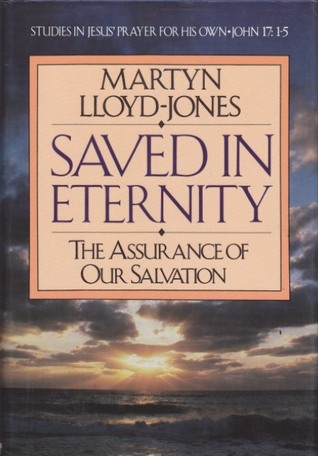
Book Review: Saved In Eternity

Saved In Eternity (The Assurance of Salvation #1) D. Martyn Lloyd-Jones. 1988. Crossway. 187 pages. [Source: Bought]

From the preface: The sermons in this book form the first part of a series on John 17 which Dr. Lloyd-Jones delivered on Sunday mornings in Westminster Chapel between 1952 and 1953. These particular sermons [Saved in Eternity] were preached between April and July 1952.

I have now read all four books in Lloyd-Jones' Assurance of Salvation collection. These four books explore the rich depths of John 17.

The first book, Saved In Eternity, merely covers the first five verses of John 17. Thirteen glorious chapters cover five glorious verses!

The Lord's Own Prayer (John 17:1)
Why Pray (John 17:1)
The Glory of God in the Plan of Salvation (John 17:1)
Our Security in God (John 17:1-5)
The Lord Jesus Christ, the Lord of Glory (John 17:1-5)
Antidote to Introspection (John 17:1-5)
It Is Finished (John 17:1-5)
The Hour Is Come (John 17:1)
That He Should Give Eternal Life To As Many As Thou Hast Given Him (John 17:2)
The Only True God (John 17:2-3)
A New Principle (John 17:2-3)
Filled With Life Anew (John 17:2-3)
Safe In His Eternal Kingdom (John 17:1-5)

I always suspected that I would love, love, love, absolutely LOVE Martyn Lloyd-Jones work if only I could stop being intimidated long enough to immerse myself. And indeed I do love him!!! I find him very readable! His writing is rich in scriptural truth. His love for the Word of God is very evident in his writing. I also love the depth and substance in his sermons. They are meaty sermons, but, ever-relevant.

From "The Lord's Own Prayer"
A quaint preacher in the seventeenth century said what is, I believe, the eternal truth about this prayer. "It is the greatest prayer that was ever offered on earth and it followed the greatest sermon that was ever preached on earth." In a sense nothing can be added to that. (11)
If we had nothing but John 17 we would surely have more than enough to sustain us, because here our Lord has given us an insight into our whole position, and into everything that is of importance and of value to us while we are in this world of time. (13)
We sometimes think that prayer is simple, but it is not. The great saints of all the centuries are agreed in saying that one of the most difficult things of all is to learn how to pray. If any Christian has been feeling cast down because he or she has found prayer difficult, they must not be discouraged, because it is the common experience of the saints. (16)
What he has done for us is that he has satisfied the law and all its demands. It is amazing to me how people can look at and preach about Christ, his life and death and never mention the law. Unless the law of God is satisfied, there is no salvation. (19)
From "Why Pray?"
Prayer, in many ways, is the supreme expression of our faith in God and our faith and confidence in the promises of God. There is nothing that a man ever does which so proclaims his faith as when he gets down on his knees and looks to God and talks to God. (35)
There is no conflict between the sovereignty of God and prayer, for it is the sovereign God who has chosen to do his work in this world through praying men and women. (37)
From "The Glory of God in the Plan of Salvation"
We want a bird's eye view of the whole Bible, and the result is that we miss the doctrine. (44) 
It is a tragedy that we tend to live as paupers in the spiritual realm, when God means us to be princes. (44)
Strangely enough, the Christian gospel--let me say this with reverence, lest I be misunderstood--the Christian gospel does not start even with the Lord Jesus Christ, it starts with God the Father. The Bible starts with God the Father always, everywhere, and we must do the same, because that is the order in the blessed Trinity: God the Father, God the Son, God the Holy Spirit. Salvation is entirely of God, it is the gift of God. (44)
The ultimate aim and object of our salvation is that we may glorify God. The essence of sin is that we do not glorify God--let us be quite clear about this; the essence of sin does not lie in the particular sins or actions of which you and I and others may be guilty. Now that is where we go wrong. We think of sin in terms of particular sins and that is why respectable people do not think they are sinners. They utterly fail to realize that the essence of sin is not to glorify God, and anybody who does not glorify God is guilty of sin of the foulest kind. (47)
From "It Is Finished"
God being God, cannot just forgive sin. Now the common idea about God, the one that we have instinctively, is that when we admit that we have sinned, all that is necessary is that we should come to God, say we are very sorry, and God will forgive us. But according to the Bible that is impossible, and I do not hesitate to use that word. As a preacher of the Christian gospel, I am compelled to say this and I say it with reverence: God, because he is God, cannot just forgive sin like that.
If you want me to prove what I am saying, this is how I do it. If God could have forgiven sin just by saying, "I forgive," he would have done so, and Christ would never have been sent into this world. The work that was given to him to do, this work, this assignment, this task, was given to the Lord Jesus Christ because, I say again, without it, God cannot forgive sin. He must not only justify the ungodly, he must remain just. The way of salvation must be consistent with the character of God. He cannot deny himself, he cannot change himself, he is unchangeable. (101)
He came to do certain things himself, and we are saved by what Christ has done for us, and not by what he tells us to do. (102)
He has done everything that is necessary for man to be reconciled to God. Have you realized, my friends, that this work is finished? (107)
The beginning of Christianity is the acceptance of this statement: "I have finished the work which thou gavest me to do." (107)
From "The Hour Is Come"
My friend, he came from heaven, he laid aside his glory, as we were considering earlier, in order to come to 'this hour.' He knew it from the beginning. He came to die, specifically to die. We have seen that, apart from that death on the cross, he cannot deliver me; that apart from the death on the cross, I say it again with reverence, even God cannot forgive man. The cross is absolutely essential, the cross was planned before the world was ever created. So the hour that produced the cross is the central, pivotal point, of history and God always knew about it, the Lord came for that hour. So we must never think of this hour as taking him by surprise, it was an hour that was appointed and determined, it was the crisis of the world itself. (113)
The cross of Jesus Christ makes this great proclamation. Unless I believe in him, unless I believe that his death at that hour is the only thing that reconciles me to God, I remain under the wrath of God. If I do not see that the wrath of God against my sin has been borne there by the Son of God, then the alternative is that I must live to experience the wrath of God: that is the essence of the Christian gospel. (120)
From "Filled With Life Anew"
To spend time in reading the Bible and in meditation is no burden to those who have eternal life. They delight in it, it is their greatest joy, because knowing God as they know him, they enjoy him. (169)
© Becky Laney of Operation Actually Read Bible

Wednesday, July 10, 2013

Book Review: Love Takes Wing (1988)

Love Takes Wing. Janette Oke. 1988. Bethany House. 240 pages. [Source: Own].

Love Takes Wing is the seventh book in the Love Comes Softly series by Janette Oke. It is the second book to focus on Belinda Davis, the last child, the "surprise" baby of Clark and Marty. Belinda is all grown up. But though men may be very interested in her, in marrying her, she's not at all interested in marrying. Not yet. Oh, she wants to marry someday. She does. But why do men keep proposing to her now? Perfectly charming, completely delightful men who just don't understand that she's not ready for marriage.

Belinda is a nurse who works closely with her brother Luke and another new doctor, Jackson Brown. When she's not busy nursing patients, there are two men: Rand and Jackson who are competing for her company.

This book sees Belinda becoming a companion of a very wealthy but oh-so-lonely woman and traveling to Boston and then Paris. Will Belinda find her way back home?

© Becky Laney of Operation Actually Read Bible

Thursday, November 15, 2012

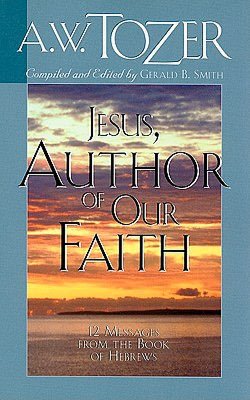
Book Review: Jesus, Author of Our Faith

Jesus, Author of Our Faith. A.W. Tozer. 1988. Christian Publications. 150 pages.

Earlier in the year, I reviewed Jesus, Our Man in Glory: Twelve Messages from the book of Hebrews. and Experiencing the Presence of God. Jesus, Author of Our Faith is (yet) another sermon collection that focuses on Hebrews. (That makes three Tozer books that share a common focus: Hebrews!!!) This collection seems to focus on Hebrews 11-13.

  • Jesus, Author of Our Faith
  • Enoch: Faith Takes Us to the Rapture
  • Noah: Faith Does What God Asks
  • Faith Answers When God Calls
  • Faith Values the Pilgrim Journey
  • Faith is Finding God for Ourselves
  • Faith Has Eyes Only for Jesus
  • Faith and Discipline Ready Us for Heaven
  • Faith Is Not Given Us to Faith
  • Faith's Manifesto: We Claim God Now!
  • Faith Will Endure the Final Shaking
  • Faith Rests on an Unchanging Jesus

This is a wonderful little book. I love reading Tozer because he's so zealous, so enthusiastic, so in-love with Christ, so diligent in the Word. And I do think he offers readers a chance to take their faith and beliefs seriously. Tozer can definitely be challenging and thought provoking because sometimes the message we NEED to hear isn't the message we WANT to hear. Or maybe we want the message to apply to others but not to ourselves. Tozer doesn't accept excuses, and he asks readers to think critically, which is a great thing.

Favorite quotes:
The Christian gospel always has been and must continue to be a gospel of alarm... The gospel message is a gospel of hope and good news to those who respond and believe. But the gospel message is starkly plain to those who do not believe. (34)
The greatest encouragement throughout the Bible is God's love for His lost race and the willingness of Christ, the eternal Son, to show forth that love in God's plan of redemption. The love of Jesus is so inclusive that it knows no boundaries. At the point where we stop caring and loving, Jesus is still there loving and caring. (144)


© Becky Laney of Operation Actually Read Bible