Showing posts with label 1991. Show all posts

Thursday, January 26, 2023

8. Seeking the Face of God: Nine Reflections on the Psalms


Seeking the Face of God: Nine Reflections on the Psalms. 1957/1991/2005. 172 pages. [Source: Bought]

First sentence: There can be no doubt at all but that the greatest matter confronting every man and woman born into this world is that which is put before us by this statement in Psalm 14. [Psalm 14:1] Nothing surely, can be more important than this question of our relationship to God.

The book is a collection of nine sermons originally preached in 1957 by D. Martyn Lloyd-Jones. It was published in the UK in 1991 and the first American edition of this book was published in 2005. All nine sermons are expository sermons expositing verses and chapters from Psalms. Some chapters are linked closely together--same Psalm, different verses. Other chapters are more loosely connected. All have something vital/relevant to say to the church. 

These are *some* of the verses he discusses. I am missing one, sadly, and I thought I was doing such a good job of taking notes. Oh well. 

Psalm 14:1
Psalm 50:21 
Psalm 84:5-7
Psalm 78:41
Psalm 63:1-3
Psalm 63:1-3
Psalm 16:8
Psalm 27:1,3

Early chapters discuss what it is to be a fool, what makes one a fool, what is the greatest folly, etc. He surprised me a bit--in a good way--by then going on to say what is the SECOND greatest folly. That was a thought-provoking chapter. The answer--to spoil the surprise--is Christians who profess to believe but then live as if there were no God. In the past few decades--2005 or later--this wouldn't be a big surprise. This has been stated in various books. But in 1957, this might have been a jolt to those sitting in the pew. [I don't think this message would be preached from the pulpit these days--unless you are Paul Washer.] 

Quote: Is there any greater folly than the folly of saying there is no God? It is the folly of people who say they believe in God but who in the tenor of their lives and in the whole of their conduct daily forget God and live exactly as if He did not exist.

All of the chapters focus on man's relationship with God and God's relationship with man. 

I definitely enjoyed reading this one. I decided to read it now [it's been in my tbr pile probably for a decade] because Martyn Lloyd-Jones is quoted frequently in the ESV Church History Study Bible. 

Truth doesn't change. Absolute truth doesn't change. So these sermons are relevant and beneficial. Some of his observations and conclusions do seem a tiny bit dated. He argues, for example, that anyone who does not believe in God [aka unbeliever, the lost, unsaved] is lacking a worldview. He insists that they don't have "any path" or "a path" and that mentally they are just lacking a [systematic] way of viewing the world or making sense of the world. I would disagree with that. I think there are MANY, MANY, MANY worldviews prevalent today, actively being promoted today. There are a lot of "isms" if you will. 

Favorite quotes:

Some say, "It's unthinkable that God should ever show what the Bible calls the wrath of God. My whole conception of God excludes the very possibility of wrath. I could not believe in a God who shows this anger against sin and the sinner." So they cut it out, and they do that on the grounds that they cannot believe it, because to them it is unthinkable. So you see, it is their thought that determines everything: "Thou thoughtest that I was altogether such an one as thyself." They are making God in their own image. So they do not hesitate to lay down their ideas as to what God is like and what He ought to do and what He ought not to do. They give their ideas of the love of God, the wrath and the justice of God, and His righteousness. The whole thing is determined by their own thoughts. So they speak about these things, but their whole attitude toward God and toward religion has no basis and no authority whatsoever apart from their own postulates.

Ten times worse than being outside and saying, "There is no God at all" is going to God and to His house in a formal manner only, and indeed almost with the idea that we are conferring some benefit upon Him. How nice of us! How good of us to have gone to a place of worship! We preen and pride ourselves on it.

You will never make yourself feel that you are a sinner, because there is a mechanism in you as a result of sin that will always be defending you against every accusation. We are all on very good terms with ourselves, and we can always put up a good case for ourselves. Even if we try to make ourselves feel that we are sinners, we will never do it. There is only one way to know that we are sinners, and that is to have some dim, glimmering conception of God.

Christ came into the world and died. Why? To bring us to God. It is all about God. It is not some comfortable feeling that you and I have to strive for; it is not having your body healed or a thousand and one other things. The whole object of Christ and His death upon the cross, His burial, and His resurrection is to bring us to God. And the ultimate test of our profession of the Christian faith is our thoughts about God, our attitude in His presence, our reverence and godly fear because our God is a consuming fire.

There is nothing more awful and reprehensible than to talk about Him and then to forget all about Him, and to live as if He were not there at all. Are you calling upon God for salvation? Have you seen your desperate need of Him? Do you know that you will have to face Him in the Judgment?

Perhaps there will be, as it were, a tape-recording played back to you of all you have said about God and how you have spoken about Him and His laws and declared His statutes. And then it will be read out to you-the things that you have done, the life you have lived, your self-centeredness, your selfishness, the fact that your whole life was not surrendered to God and lived to His glory and to His praise.
It is a tremendous thing to say you believe in God, but look at the implications.

Christian truth is a kind of ellipse, and there is one focus-God; but there is also another focus-man. And if we are to enjoy the experience of this writer, we must be as right about man as we are about God.

Men and women must realize their need, and the only people who know what it is to enjoy the blessings of Christian salvation are those who have already discovered that need. The tragedy, ultimately, of so many, indeed of all outside Christ, is that they have never really seen their need. That is why they have never seen their need of Christ; that is why they do not fly to Him as Savior; they have never seen themselves as they really are.

There is no knowledge of God except in Jesus Christ and Him crucified. He is the sacrifice that is placed upon the altar: He has made "his soul an offering for sin" (Isa. 53:10). "I am the way, the truth, and the life," He says of Himself. "No man cometh unto the Father, but by me" (John 14:6).

We are God's people, and we are meant to show forth His praises, His excellencies, His virtues. So the question that we must ask ourselves is, are we doing that? Are we individually enjoying the blessings of the Christian life as we should? What do we find as we look back and review the past year?

If we are uncertain about our forgiveness, we are definitely limiting God, and we have no right to be like that. God is our Father, and a father never wants his children to be unhappy, to be uncertain about the relationship-such a thing is inconceivable. So we have this abundant teaching in the Bible to give us certainty and assurance. And if we do not have it, we are guilty of putting a limit upon what is possible.

So if you want to set the Lord always before you, spend much time in regular, daily reading of the Bible. And let it be systematic reading, not just picking it up at random and turning to a favorite psalm and then to somewhere in the Gospels. No; it must be Genesis to Revelation! Go through the Book year by year. I think any Christian should be ashamed who does not go through the entire Bible once a year. Go through it systematically.

God's Word speaks to you-listen to Him, and you will come into His presence. Set Him before you by reading the Bible. You can do this also in prayer-talking to God and listening to Him.

Set the Lord always before you-the Lord Himself, not merely activities in His kingdom-because if you do not do this, you will become very dry in all your activism. Your heart will become cold, and in the time of need and trouble and trial you will not know where you are, and you will be a poor witness to the faith and to the grace that you have received and that you hold.


© Becky Laney of Operation Actually Read Bible

Monday, February 25, 2019

Book Review: The Christian Book of Mystical Verse

The Christian Book of Mystical Verse: A Collection of Poems, Hymns, and Prayers for Devotional Reading. A.W. Tozer, editor. 1991/2016. 177 pages. [Source: Bought]

First sentence: The purpose of this book is to bring together in one convenient volume some of the best devotional verse the English language affords, and thus to make available to present-day Christians a rich spiritual heritage, which the greater number of them for various reasons to not now enjoy.

The word mystic might throw some readers off--give the wrong impression--the introduction clarifies exactly what is meant by the word mystic.
The word “mystic” as it occurs in the title of this book refers to that personal spiritual experience common to the saints of Bible times and well known to multitudes of persons in the post-biblical era. I refer to the evangelical mystic who has been brought by the gospel into intimate fellowship with the Godhead. His theology is no less and no more than is taught in the Christian Scriptures. He differs from the ordinary orthodox Christian only because he experiences his faith down in the depths of his sentient being while the other does not. His religious experience is something elemental, as old as time and the creation. It is immediate acquaintance with God by union with the Eternal Son. It is to know that which passes knowledge.  
So what makes a poem or hymn mystical?!
The hymns and poems found here are mystical in that they are God-oriented; they begin with God, embrace the worshipping soul and return to God again.
The only healthy emotions are those aroused by great ideas, and even these must be restrained and purified by the Spirit of God or they will spend themselves in weak and sterile rhymes.
This devotional collection is arranged by topic or theme. The sections are: "Adoration of the Godhead," "Devotional Meditations on the Cross of Christ," "Penitential Reflections on Our Sins," "Rejoicing in Forgiveness and Justification," "Yearning for Purity of Heart," "Aspirations After God," "Delighting in God's Presence," "The Raptures of Divine Love," "The Rest of Faith," "The Spiritual Warfare," "Victory Through Praise," "The Prayer of Quiet," "The Bliss of Communion," "Joyous Anticipation of Christ's Return," and "Immortality and the World To Come."

Contributors include: Isaac Watts, Oliver Wendell Holmes, Sir John Bowring, Fredrick William Faber, Walter Shelly, Henry Hart Milman, Charles Wesley, Jacques Bridaine, Bernard of Clairvaux, John S.B. Monsell, Christina Rossetti, John Wesley, Johann Andreas Rothe, Nicolaus Ludwig Von Zinzendorf, Nahum Tate, Nicholas Brady, Jeanne Marie de la Motte-Guyon, Gerhard Tersteegen, Oliver Holden, Paul Gerhardt, Mary Bowley Peters, George C. Neumark, William Cowper, Jean Sophia Pigott, Anna Laetitia Waring, Thomas Blacklock, Martin Rinckart, Michael Angelo, Thomas Moore, John Newton, Thomas Hastings, T.P, Johann Scheffler, Horatius Bonar, Reginald Heber, Philipp Nicolai, John Cennick, Henry Ware, Christian F. Gellert, Lord Plunket, Pierre Abelard, Anne R Cousin, and Bernard of Cluny. Some contribute just one or two pieces. Others contribute DOZENS.

I began reading this one with a good deal of skepticism. I'm not a fan of the word mystical or mystic. But I am a fan of A.W. Tozer. These poems--hymns--were selected by Tozer and among his favorites. I am not naturally drawn to poetry--and while I love music--I usually need to HEAR music to love a lyric.

I can't say that I had a reaction to every poem. That would be a lie. But I did find myself loving a handful of poems. As in LOVING. I wasn't expecting that. I wasn't expecting these words to speak to me--to speak of me.

From "Lord of All Being, Throned Afar" by Oliver Wendell Holmes
Grant us thy truth to make us free,
and kindling hearts that burn for thee,
till all thy living altars claim
one holy light, one heavenly flame. 
This flame/fire/burning theme is NOT new to modern worship music.

From "The Thought of God" by Frederick W. Faber
The thought of Thee, above, below,
Around me and within,
Is more to me than health and wealth,
Or love of kith and kin. (second stanza)
To think of Thee is almost prayer,
And is outspoken praise;
And pain can even passive thoughts
To actual worship raise. (tenth stanza)
O Lord! I live always in pain,
My life's sad undersong,
Pain in itself not hard to bear,
But hard to bear so long.  (eleventh stanza)
Little sometimes weighs more than much,
When it has no relief;
A joyless life is worse to bear
Than one of active grief. (twelfth stanza)
All murmurs lie inside Thy Will
Which are to Thee addressed;
To suffer for Thee is our work,
To think of Thee our rest. (fourteenth stanza)
This one resonated with me. I'm not sure I love the 'joyless life is worse to bear than one of active grief' bit. BUT all the rest I've shared...I've lived.

From "The Fear of God" by Frederick W. Faber
A special joy is in all love
For objects we revere;
Thus joy in God will always be
Proportioned to our fear. (fourth stanza)
They love Thee little, if at all,
Who do not fear Thee much;
If love is Thine attraction, Lord!
Fear is Thy very touch. (twelfth stanza)
I think the fear of God is a lost doctrine that desperately needs to be rediscovered by the modern church.

"God Is Present Everywhere" by Oliver Holden
They who seek the throne of grace,
Find that throne in every place;
If we live a life of prayer,
God is present everywhere.
In our sickness or our health,
In our want or in our wealth,
If we look to God in prayer,
God is present everywhere.
When our earthly comforts fail,
When the foes of life prevail,
'Tis the time for earnest prayer;
God is present everywhere.
Then, my soul, in every strait
To thy Father come and wait;
He will answer every prayer;
God is present everywhere. 
From "All Must Be Well" by Mary Bowley Peters
Through the love of God our Savior, all will be well
Free and changeless is his favour, all, all is well.
Precious is the blood that healed us,
perfect is the grace that sealed us,
strong the hand stretched forth to shield us,
all must be well. (first stanza)
We expect a bright tomorrow, all will be well.
Faith can sing through days of sorrow, 'All, all is well.'
On our Father's love relying,
Jesus every need supplying,
in our living, in our dying,
all must be well. (third stanza)
From "Jesus, I Am Resting, Resting" by Jean Sophia Pigott
Jesus! I am resting, resting
in the joy of what Thou art;
I am finding out the greatness
Of thy loving heart.
Thou has bid me gaze upon Thee,
And Thy beauty fills my soul,
For, by Thy transforming power,
Thou has made me whole. (stanza one)
Oh, how great Thy loving kindness,
Vaster, broader than the sea:
Oh, how marvelous Thy goodness,
Lavished all on me!
Yes, I rest in Thee, Beloved,
Know what wealth of grace is Thine,
Know Thy certainty of prime,
And have made it mine. (stanza two)
From "Bless, O My Soul! The Living God by Isaac Watts
Bless, O my soul, the living God,
Call home my thoughts that roam abroad;
let every power within me join
in work and worship so divine.
Lord God, how wondrous are your ways!
How firm your truth, how large your grace!
You take great mercy at your throne,
and thus you make your glories known. (first stanza)
Lord, your eternal love is sure
for all your saints, and will endure!
Let not this wonder that is wrought
be lost in silence and forgot!
Let all the earth behold your face;
let all adore and know your grace;
the noblest with the humble join
in work and worship all divine. (third stanza)
God's Eternal Now by Gerhard Tersteegen
Now stillness 'midst the ever-changing,
Lord, my rest art Thou;
So for me has dawned the morning,
God's eternal NOW.
Now for me the day unsetting,
Now the song begun;
Now, the deep surpassing glory,
Brighter than the sun.
Hail! All hail! thou peaceful country
Of eternal calm;
Summer land of milk and honey,
Where the streams are balm.
There the Lord my Shepherd leads me,
Wheresoe'er He will;
In the fresh green pastures feeds me,
By the waters still.
Well I know them, those still waters!
Peace and rest at last;
In their depths the quiet heavens
Tell the storms are past,
Nought to mar the picture fair,
Of the glory resting there. 
I haven't decided absolutely that this is my new favorite poem. But I'm considering.

From "My Heart Is Resting, O My Lord," by Anna Laetitia Waring
My heart is resting, O my God--
I will give thanks and sing;
My heart is at the secret source
Of every precious thing.
Now the frail vessel Thou has made
No hand but Thine shall fill--
For the waters of the Earth have failed,
And I am thirsty still. (first stanza)
Glory to Thee for strength withheld,
For want and weakness known--
And the fear that sends me to Thy breast
For what is most my own.
I have a heritage of joy
That yet I must not see;
But the hand that bled to make it mine
Is keeping it for me.  (second stanza)
"O! Tell Me, Thou Life and Delight of My Soul" by Thomas Hastings
O! tell me, Thou life and delight of my soul,
Where the flock of Thy pastures are feeding;
I seek Thy protection, I need Thy control,
I would go where my Shepherd is leading.
O! tell me the place where Thy flocks are at rest,
Where the noontide will find them reposing?
The tempest now rages, my soul is distress'd,
And the pathway of peace I am losing.
O! why should I stray with the flocks of Thy foes,
'Mid the desert where now they are roving,
Where hunger and thirst, where affliction and woes,
And temptations their ruin are proving!
O! when shall my foes and my wandering cease?
And the follies that fill me with weeping!
Thou Shepherd of Israel, restore me that peace
Thou dost give to the flock Thou art keeping.
A voice from the Shepherd now bids thee return
By the way where the footprints are lying:
No longer to wander, no longer to mourn;
O fair one, now homeward be flying! 
From "At the Lord's Table" by Horatius Bonar
I have no help but Thine; nor do I need
Another arm save Thine to lean upon;
It is enough, my Lord, enough indeed;
My strength is in Thy might,
Thy might alone.
Mine is the sin, but Thine the righteousness;
Mine is the guilt, but Thine the cleansing blood;
Here is my robe, my refuge, and my peace,
Thy blood, Thy righteousness, O Lord my God. (second to last stanza)
Prayer Before Communion by Reginald Heber
Bread of the world, in mercy broken,
Wine of the soul, in mercy shed,
By whom the words of life were spoken,
And in whose death our sins are dead:
Look on the heart by sorrow broken,
Look on the tears by sinners shed;
And by Thy feast to us the token
That by Thy grace our souls are fed. 
"The Blessed Morrow" by Gerhardt Tersteegen
'Midst the darkness, storm, and sorrow,
One bright gleam I see;
Well I know the blessed morrow
Christ will come for me.
'Midst the peace, the joy, the glory
And the light, God's own,
Christ for me is watching, waiting,
Waiting 'til I come.
Long the blessed Guide has led me,
By the desert road;
Now I see the coming splendor,
Splendor of my God.
There amidst the love and glory
He is waiting yet;
On His hands a name is graven
He can ne'er forget.
Who is this, who comes to meet me,
On the desert way,
As the Morning Star foretelling
God's unclouded day?
He it is who came to win me,
On the cross of shame;
In his glory well I know him,
Evermore the same.
O the blessed joy of meeting,
All the desert past;
O the wondrous words of greeting,
He shall speak at last!
He and I together ent'ring
The fair realm above;
He and I together sharing
All the Father's love.
Where no shade nor stain can enter,
Nor the gold be dim,
In His holiness unsullied,
I shall walk with HIm.
Meet companion then for Jesus,
From Him, for Him, made--
Glory of God's grace forever
There in me displayed.
He who in His hour of sorrow
Bore the curse alone;
I who through the lonely desert
Trod where He had gone;
He and I, in that bright glory,
One deep joy shall share--
Mine, to be forever with Him;
His, that I am there.
I haven't decided if I love, love, love this one...or not. At the very, very least it's given me food for thought. I haven't unpacked ALL the theology yet of this one. But for some reason it is resonating with me. It is in the section upon Joyous Anticipation of Christ's Return.

From "Jesus Lives, and So Shall I" by Christian F. Gellert
Jesus lives, and so shall I.
Death! thy sting is gone forever:
He, who deigned for me to die,
Lives, the bands of death to sever.
He shall raise me with the just:
Jesus is my Hope and Trust.
Jesus lives and reigns supreme;
And, His kingdom still remaining,
I shall also be with Him,
Ever living, ever reigning.
God has promised; be it must.
Jesus is my Hope and Trust. (first two stanzas)


© Becky Laney of Operation Actually Read Bible

Wednesday, February 20, 2019

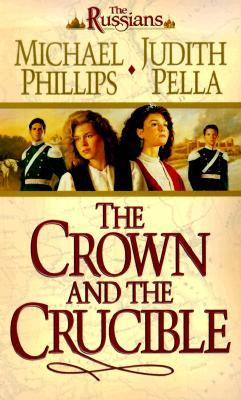
Book Review: The Crown and the Crucible

The Crown and the Crucible. (The Russians #1) Michael R. Phillips and Judith Pella. 1991. Bethany House. 416 pages. [Source: Bought]

From the prologue: 368 AD The solitary figure of a man receded into the distance.

From chapter one: A solitary figure bent himself against the elements.

Premise/plot: The Crown and The Crucible is the first in a seven book historical series set in Russia. The first novel opens in the 1870s.

Yevno Burenin and his wife have five children but he dotes on his oldest two Anna and Paul. Though they've been "free" for a little over a decade, life is still incredibly difficult. The family is facing a tough choice: should they send their oldest daughter, Anna, away to be a servant in a nobleman's household? If they do, then she might be able to support herself and find her own way in the world. If they don't, then, well they'll continue to struggle to have enough food to eat. Yevno feels that Anna is his brightest child--she can read and write--and that she deserves her best chance at life. Paul is bright but perhaps not wise. He's fallen into "bad" company--revolutionary company that is promoting dangerous ideas that could overturn the government.

The novel mainly follows Anna with only the occasional return to her family--her father and brother. Anna DOES decide to leave her family and small village. And she does begin her new life as a servant--first in the kitchen as a scullery maid--and then as a lady's maid. Now if you're thinking that's a HUGE jump--it is. But Anna catches--quite by accident--the attention of the spoiled Princess. The Princess Katrina is looking to replace her bossy Nanny with a maid near her own age. So Anna starts her training under the guidance of Nina--the maid of Katrina's mother Princess Natalia.

Readers follow the lives of two families primarily--Anna's peasant family and Katrina's noble family. Also some scenes with the tsar and his family are included here and there--but they are never the main focus.

My thoughts: I LOVED, LOVED, LOVED this one. It had me at hello. Okay perhaps the prologue didn't hook me--nor did it deter me--but once I met Yevna and his family it was LOVE AT FIRST SIGHT. (And I was thankful I had taken the time to read the prologue.) I found this an addictive novel to read. I thought the writing was absolutely fantastic.

Quotes:

He treasured the written word almost as if he were able to read books himself. The Bible and the book of fairy tales were his two favorites.
God brings new winds to our lives to keep us from being too attached to this world, and to make us trust Him. He brings the rains, he brings the snows, then He brings back the sun. Always life is changing. No matter what happens, He will sustain us through it.
Even if from fairy tales, she knew something of the scope of human nature. She realized there were good people and evil. She knew there were choices to be made that would determine her future.
“A hundred servants!” repeated Anna. “I thought the prince had only his wife and two children!” “And no doubt they think they live as peasants because they have only twenty-five servants each!” Polya laughed.
If the army has taught me anything, it is that people are people. A man is a man, a woman is a woman—whatever their background and upbringing may have been.
The next hour passed as if it were only a few minutes. Oblivious to the frigid temperature, the son of a prince and the daughter of a peasant spoke openly and freely, as if no barriers existed between them.
It was a blessing there was no mirror. Poor Katrina had no idea how silly she looked.
“But rain is good, Papa, and troubles are not.” “How do you know that, my son?” “Is it not obvious?” “In time of flood, the rain appears as an enemy. Yet without the rains, the earth could not survive half a year. Might it not be so with the pains of life as well? 
My heart is so grateful that you are here—call it a fairy tale, call it whatever you wish. I was only saying that for most Russians, except for the privileged few, their lives are a matter of fate.
Fingal smiled. “No, that is not what I mean, dear Anna. Education and wisdom are unrelated. I love education and learning and knowledge, but give me a man with wisdom any time.” “Faith does not come by education, Princess, any more than wisdom does,” said Fingal. “What do you mean?” “Faith is something you practice, something you live—not a subject you learn about, like mathematics.” “But how do you do it, if you don’t know anything about it?” “Everyone knows enough to begin,” said Fingal with a tender smile.


© Becky Laney of Operation Actually Read Bible

Friday, January 29, 2016

Book Review: Spiritual Disciplines for the Christian Life

Spiritual Disciplines for the Christian Life. Donald S. Whitney. 1991/2014. NavPress. 341 pages. [Source: Bought]

Since reading Donald Whitney's book on prayer last fall, I've been wanting to read his earlier book on spiritual disciplines. What I most loved about his book on prayer was that it was passionately practical, extremely straightforward, and ENCOURAGING. It approached the subject of prayer honestly, the fact that most Christians struggle--have struggled, will struggle--with prayer, with the act of daily prayer. It was a book that built-you-up and supported you. It was just a life-changing book. Spiritual Disciplines for the Christian Life, however, takes a different approach. For the record, it was written at least two decades before his newest book on prayer. I wouldn't say I felt encouraged or supported after reading the book. Instead, I'd say I felt discouraged, overwhelmed, and not knowing HOW anyone would ever truly apply the "practical" aspects found in each and every chapter. I wouldn't go so far as to say that Whitney makes the disciplines an aspect of earning one's salvation, or earning God's attention or approval. Far from it. I get the idea that Whitney understands--grasps--the concept of grace. But surely there is a more reader-friendly approach to spiritual disciplines to help believers learn and grow.

You might get the impression, I didn't like or enjoy the book. That isn't true. I did. In parts. A chapter or two at a time. I loved his two chapters on Bible reading. One focused more on hearing and reading the Bible. The other focused more on studying and meditating on the Bible. (He includes, I believe, SIXTEEN methods of meditating on Scripture.) Both were great chapters. I also enjoyed his chapter on prayer, though, it wasn't nearly as good as the book he's recently written on the subject. I liked that he recommended reading theology as a way to grow spiritually.

So what does the book cover besides bible-reading and prayer? It has chapters on worship, evangelism, serving in the church and community, stewardship both of your time and your money, fasting (yes, fasting which he urges can't be skipped over), silence and solitude, journaling, learning (reading theology), and perseverance.

One thing I definitely appreciated was Whitney quoting other believers--Puritans, Spurgeon, etc.

Overall, I think the book makes some valid points, and offers a few practical tips on how to become more disciplined spiritually. But read cover-to-cover, even taking a week to do so, will more likely overwhelm you than encourage you.


© Becky Laney of Operation Actually Read Bible

Friday, July 24, 2015

Book Review: Transforming Grace

Transforming Grace. Jerry Bridges. 1991. NavPress. 207 pages. [Source: Borrowed]

I loved, loved, loved Jerry Bridges' Transforming Grace. It is a MUST READ in my opinion. If you've never read Jerry Bridges before, you don't know what you're missing. He is a GREAT author that every Christian--every Christian who reads--should try. And Transforming Grace would be a great introduction to his work.

Why? Well, because people NEED to know about grace, to embrace grace, to come to a greater, deeper appreciation of what grace is and all that it means. Not that any person can fully and totally comprehend God's grace and 'all that it means.' But you can live in awe of it, and let it transform you day by day, year by year. Grace isn't something to celebrate a couple of times in your life. It's something to celebrate each and every day.

Believers need to preach the gospel to themselves daily--and reading Jerry Bridges, well, may just help you remember to do just that. I believe that the book would prove beneficial to new believers and to old believers--those who have perhaps been in the faith for decades, but, could use a little refreshing. (Who doesn't need refreshing from the Spirit?!) The truth, in my opinion, never gets old. The good news is GREAT news. And one never outgrows one's need for gospel-truth, for the richness of grace.

Table of Contents:

  • The Performance Treadmill
  • Grace--Who Needs It?
  • Grace--It Really Is Amazing
  • The Generous Landowner
  • Does God Have A Right?
  • Compelled by Love
  • The Proof of Love
  • Holiness: A Gift of God's Grace
  • Called To Be Free
  • The Sufficiency of Grace
  • The Least of All God's People
  • Appropriating God's Grace
  • Garments of Grace

Quotes:
One of the best kept secrets among Christians today is this: Jesus paid it all. I mean all. He not only purchased your forgiveness of sins and your ticket to Heaven, He purchased every blessing and every answer to prayer you will ever receive. Every one of them--no exceptions. Why is this such a well-kept secret? For one thing we are afraid of this truth. We are afraid to tell even ourselves that we don't have to work anymore, the work is all done. We are afraid that if we really believe this, we will slack off in our Christian duties. (19)
What, then, is the grace by which we are saved and under which we live? Grace is God's free and unmerited favor shown to guilty sinners who deserve only judgment. It is the love of God shown to the unlovely. It is God reaching downward to people who are in rebellion against Him. Grace stands in direct opposition to any supposed worthiness on our part. (22)
You are loved and accepted by God through the merits of Jesus, and you are blessed by God through the merit of Jesus. Nothing you ever do will cause Him to love you any more or any less. He loves you strictly by His grace given to you through Jesus. (73)
To live by grace is to live solely by the merit of Jesus Christ. To live by grace is to base my entire relationship with God, including my acceptance and standing with Him, on my union with Christ. It is to recognize that in myself I bring nothing of worth to my relationship with God, because even my righteous acts are like filthy rags in His sight (Isaiah 64:6). Even my best works are stained with mixed motives and imperfect performance. I never truly love God with all my heart, and I never truly love my neighbor with the degree of consistency with which I love myself. (101)
God never allows pain without a purpose in the lives of His children. He never allows Satan, nor circumstances, nor any ill-intending person to afflict us unless He uses that affliction for our good. God never wastes pain. He always causes it to work together for our ultimate good, the good of conforming us more to the likeness of His Son (see Romans 8:28-29). (139)
The Bible is God's self-revelation to us of all He wants us to know about Himself and His provision for our salvation and our spiritual growth. It is God's only objective, authoritative communication. to us. If we are to appropriate the grace of God then, we must become intimate friends with the Bible. We must seek to know and understand the great truths of Scripture: truths about God and His character, and truths about man and his desperate need of God's grace. (177)
It is difficult for us to see God's hand of love in the adversities and heartaches of life because we persist in thinking, as the world does, that happiness is the greatest good. Thus we tend to evaluate all our circumstances in terms of whether or not they produce happiness. Holiness, however, is a greater good than happiness, so God arranges and orchestrates circumstances to produce holiness before happiness. He is more concerned about our eternal than our temporal welfare and more concerned about our spiritual than our material welfare. So all the trials and difficulties, all the heartaches, disappointments, and humiliations come from His loving hand to make us partakers of His holiness. (183)

© Becky Laney of Operation Actually Read Bible

Friday, January 30, 2015

Book Review: Living by the Book

Living by the Book. Howard G. Hendricks and William D. Hendricks. 1991. Moody. 350 pages. [Source: Borrowed]

Read.
This.
Book.
Yes, I'm talking to you! If you have any desire at all to read the Bible OR study the Bible or meditate on the Bible or pray using the Bible, this book is for you. They will show you throughout the book how to read a verse, how to read a paragraph, how to read a chapter, how to read a book.

Living by The Book is many things: practical, straight-forward, and reader-friendly. The authors will take you step by step by step by step and teach you how to read the Bible, how to turn your reading of the Bible into studying the Bible. There are three main sections: OBSERVATION, INTERPRETATION, and APPLICATION.
1. Observation. In this step, you ask and answer the question, What do I see? The moment you come to the Scriptures you ask, What are the facts? You assume the role of a biblical detective, looking for clues. No detail is trivial.
2. Interpretation. Here you ask and answer the question, What does it mean? Your quest is for meaning. Unfortunately, too much Bible study begins with interpretation, and furthermore, it usually ends there. But I'm going to show you that it does not begin there. Before you understand, you have to learn to see. Nor does it end there, because the third step is…
Application. Here you ask and answer the question, How does it work? Not, Does it work? People say they're going to make the Bible "relevant." But if the Bible is not already relevant, nothing you or I do will help. The Bible is relevant because it is revealed. It's always a return to reality. And for those who read it and heed it, it changes their lives. (35-6)
Within each section, the authors teach you exactly what you need to know, what you need to keep in mind, etc. For example, in the first section OBSERVATION, there are "10 Strategies to First-Rate Reading" and "Six Things To Look For."

I've said that the book is practical. Each chapter is written to help you, to teach you, to guide you, to illustrate how and why. In Read Repeatedly, one of the "10 Strategies to First-Rate Reading" here are the practical tips:

  • read entire books in one sitting
  • start at the beginning of the book 
  • read the Bible in different translations
  • listen to an audio bible
  • read the Bible out loud
  • set up a schedule for Bible reading 

In Read Selectively, another one of the 10 Strategies, the authors give readers six questions to ask any passage of Scripture.

  • Who?
  • What?
  • Where?
  • When?
  • Why?
  • Wherefore?

This is a book that almost is so very, very good that it needs to be reread regularly--perhaps once a year--to refresh and encourage readers.

© Becky Laney of Operation Actually Read Bible

Monday, January 5, 2015

Book Review: How To Worship Jesus Christ

How To Worship Jesus Christ. Joseph S. Carroll. Foreword by John F. MacArthur, Jr. 1984/1991. Moody Publishers. 90 pages. [Source: Bought]

How To Worship Jesus Christ is short and practical. It isn't so much that the contents are new and revolutionary. The advice within is sound and quite traditional. Give your all to God. Surrender everything, keep on surrendering. Confess your sins in the moment, don't put off confessing and repenting. Make a decision. Make a choice. Make God your one thing. Put your choice into action. Say you want to love God, say you have faith in God, prove it by your actions. Don't talk about praying, actually pray. Don't talk about reading your Bible, actually read it. Don't talk about worshipping God, actually worship him. Now, I am NOT saying that the book is all do, do, do, serve, serve, serve, give, give, give. The book is JUST what it says it is. A book about WORSHIP. What God wants from you is your praise and worship. He wants your heart, your true heart. It is in the worshipping that God's presence becomes real to believers, to Christians. It is in the act of worship that God's presence is felt and experienced. When we're not worshipping God, God is still very much present. But we aren't always good at feeling his presence, of feeling that God is real. Want a closer relationship with God? Start worshipping Him. He will make his presence known to you. But. You can't cling to sin and selfishness and hate AND worship God. There are things you must put down, put away, before your worship is true heart worship. Note: I am NOT saying that Carroll is saying that one must be perfectly righteous before you start praying and worshipping. He is not demanding human perfection. He is stressing the importance of authentic, genuine worship that comes from a repentant, thankful heart. Worship isn't something you mumble or stumble your way through. It is intentional and must engage the heart and mind and soul. A whole person worships.

He suggests readers memorize one verse per week. He suggests readers memorize hymns. He thinks both practices will draw out the heart in worship.

The chapters within:

  • One Thing Needful
  • True Worship
  • A True Heart
  • Revelation Four and Five
  • The How of Worship
Quotes:
Worship is not simple, but it is glorious! I have found these many years that it is the one thing the enemy will oppose more than anything else--more than intercession, more than petition. The one thing he does not want is for you to worship Jesus Christ. (38)
Worship is not simple because the rewards are so great. As we learn to give ourselves to the worship of our Lord, He can be nearer and more real to us than our best friend or closest loved one. The rewards are indeed great, but the amazing fact is that very few worship Jesus Christ. Therefore, the spiritual senses are not quickened to His presence. (38)

You will never be a worshipper of Christ apart from a definite act of your will. (39)

© Becky Laney of Operation Actually Read Bible

Wednesday, September 10, 2014

Book Review: The Savior of the World

The Savior of the World. Benjamin B. Warfield. 1991. Banner of Truth. 270 pages. [Source: Bought]

The Savior of the World was my introduction to B.B. Warfield. I loved this collection of sermons. Each sermon focused on a particular passage of Scripture. Warfield did a great job "unpacking" Scripture. He really took his time and examined the verses carefully. This was good, for the most part. There were places that instead of saying exactly what he thought a verse meant right away, he would explore various options first. Interpretation A says this, Interpretation B says that…but this is what I really think the Bible was saying. He argues his case for a particular interpretation. It definitely has an intellectual feel to it as opposed to devotional. It can still be emotional, by the way. The two are not exclusive.

His sermons are thought-provoking. They do require you to think, to be engaged, to follow his arguments point by point, to consider. These sermons can't be rushed through. There is much to be gained by taking your time, by absorbing all he has to say. It really is an amazing read.

The Savior of the World includes:

The Prodigal Son (Luke 15:11-32)
Jesus Only (Acts 4:12)
The Lamb of God (John 1:29)
God's Immeasurable Love (John 3:16)
The Gospel of Paul (2 Corinthians 5:14-15, 18-19, 21)
The Glorified Christ (Hebrews 2:9)
The Risen Jesus (2 Timothy 2:8)
The Gospel of the Covenant (John 6:38-39)
Imitating the Incarnation (Philippians 2:5-8)

Quotes:

From "The Prodigal Son"
The message which the parable brings us is certainly a great one. To lost sinners like you and me, assuredly few messages could appeal with more overwhelming force. Our hearts are wrung within us as we are made to realize that our Father in heaven will receive our wandering souls back with the joy with which this father in the parable received back his errant son. But it is an exaggeration to represent this message as all the Gospel, or even as the core of the Gospel; and to speak of this parable therefore, as it has become widely common to speak of it, as “the Gospel in the Gospel,” or even as the summation of the Gospel. It is not that. There are many truths which it has no power to teach us that are essential to the integrity of the Gospel: nay, the very heart of the Gospel is not in it. And, therefore, precious as this parable is to us, and priceless as is its message, there are many other passages of Scripture more precious still, because their message enters more deeply into the substance of the Gospel. Take this passage for example: “For God so loved the world, that He gave His only begotten Son, that whosoever belie vet h on Him should not perish, but have everlasting life.” Or this passage: “God, being rich in mercy, for His great love wherewith He loved us, even when we were dead through our trespasses, quickened us together with Christ (by grace have ye been saved), and raised us up with Him and made us sit with Him in the heavenly places with Christ Jesus.” Or even this short passage: “For the Son of Man came to seek and to save that which was lost.” All these are more precious passages than the parable of the lost son, not merely because they tell us more fully what is contained in the Gospel, but because they uncover to us, as it does not, what lies at the heart of the Gospel. It is important that we should recognize this.
We are sinners. And our only hope is in one who loves sinners; and has come into the world to die for sinners.
From "Jesus Only"
The salvation of the world hangs, thus, in our human mode of speaking, on the clearness and the strength of our conviction that there is salvation in none other than Jesus, that there is none other name under heaven, given among men, wherein they must be saved. O the cruelty of that indifferentism, miscalled broadness of mind, that would withhold from a perishing world the only healing draught, on the pretence, forsooth, that it is not needed. O remember that the whole world lies in iniquity — ill to death with the dreadful disease of sin, — and that you have in your hands the one curative potion, the only water of life which can purge away sin and restore to spiritual health and beauty. Remember the great commission!
On the peril of your souls, I charge you to remember that Jesus Christ is the only way, the only truth, the only life; that no man comes or can come to the Father except by Him, that all the life that is in the world is in Him, and he only that hath Him hath the life, while he that hath not Him hath not the life. Listen to the solemn words of the apostle of love: “Whosoever denieth the Son, the same hath not the Father: he that confesseth the Son,” he, and he only, “hath the Father also.” Let us note it clearly and note it whole: there is no access to God for sinners save in the blood of Jesus Christ.
From "The Lamb of God"
“Behold the Lamb of God,” cries the Baptist, “which taketh away the sin of the world.” Not, Behold the Prophet like unto Moses, whom ye shall hear; nor yet. Behold the Israelite without guile, in whom meet perfect purity, wisdom and truth; nor even. Behold the Lion of the tribe of Judah, who shall scatter your foes and deliver you from all your enemies. He might have said any one or all of these things. They are all true of Jesus. Christ is our teacher, and our example, and our king. But there is something more fundamental than any of these things; something which underlies them all and from which they acquire their value. And it is this that the Baptist saw in Christ and sends us to Christ to find. “Behold,” says he, “the Lamb of God, which taketh away the sin of the world.” That image could mean but one thing to an humble, sin-conscious Old Testament saint. He would think first of the righteous sufferer of the fifty-third chapter of Isaiah: and that righteous sufferer is not merely described there, we will remember, as a lamb that is led to the slaughter, and as a sheep that before her shearers is dumb, the very embodiment of meekness and patience in enduring the violence of the despoiler; but, in well-remembered words which throw a glory over these sufferings to which even meek patience and uncomplaining endurance can lend nothing, we read: “Surely he hath borne our griefs and carried our sorrows; he was wounded for our transgressions, he was bruised for our iniquities; the chastisement of our peace was upon him, and with his stripes we were healed.” “All we like sheep have gone astray; we have turned, every one, to his own way; and the Lord hath laid on him the iniquity of us all.” “For the transgression of my people was he stricken. .. yet it pleased the Lord to bruise him. He hath put him to grief: when thou shalt make his soul an offering for sin, he shall see his seed, he shall prolong his days, and the pleasure of the Lord shall prosper in his hand. … By his knowledge shall my righteous servant justify many, and he shall bear their iniquities. … He bare the sin of many and made intercession for the transgressors.” And along with the fifty-third chapter of Isaiah, the Old Testament saint, when directed to the Lamb of God which takes away sin, would inevitably think also of the paschal lamb, the fundamental national symbol of deliverance; along with it, beyond question, also of the lamb of the daily sacrifice and of the underlying significance of the whole sacrificial system, with its typical finger pointing forward to something better, — to God’s own Lamb, who should really take away sin, a lamb of God’s providing, able and willing to bear on his own head the sin of the world.
“Behold the Lamb of God, which taketh away sin.” Is it not a joyful message to sin-stricken souls? Let others think of Jesus as they may. Let them hail him as a king: let them sit at His feet as a prophet: let them eagerly seek to follow in His steps. For you and me, sinners, He is most glorious and most precious, as a Saviour.
From "God's Immeasurable Love"
What it concerns us now to note, however, is not the mere fact that He loves, but what it is that He is declared to love. For therein lies the climax of the great proclamation. This is nothing other than “the world.” For this is the unimaginable declaration of the text: “God so loved the world.” It is just in this that lies the mystery of the greatness of His love. The “world,” he tells us, is just the synonym of all that is evil and noisome and disgusting. There is nothing in it that can attract God’s love, — nay, that can justify the love of any good man. It is a thing not to be dallied with, or acquiesced in: they that are of it, are by that very fact not of God; and what the Christian has to do with it is just to overcome it; for everything that is begotten of God manifests that great fact precisely by this — that he overcomes the world. “Love not the world, neither the things that are in the world,” is John’s insistent exhortation. “Nothing that is in the world is of the Father,” we are told; or, as it is put elsewhere in direct positive form: “The whole world lieth in the evil one.” “The world, the flesh and the devil” — this is the pregnant combination in which we have learned from Scripture to express the baleful forces that war against the soul: and the three terms are thus cast together because they are essentially synonyms. See, then, whither we are brought. When we are told that God loves the world, it is much as if we were told that He loves the flesh and the devil. And we may, indeed, take courage from our text and say it boldly: God does love the world and the flesh and the devil. Therein indeed is the ground of all our comfort and all our hope: for we — you and I — are of the world and of the flesh and of the devil. Only, — we must punctually note it, — the love wherewith God loves the world, the flesh and the devil — therefore, us — is not a love of complacency, as if He the Holy One and the Good could take pleasure in what is worldly, fleshly, devilish: but that love of benevolence which would fain save us from our worldliness, fleshliness and devilishness. The world then was perishing: and it was to save it that God gave His Son. The text is, then, you see, in principle an account of the coming of the Son of God into the world. There were but two things for which He, being what He was as the Son of God, could come into the world, being what it was: to judge the world or to save the world. It was for the latter that He came. “For,” the next verse runs on, “God sent not His Son into the world to judge the world, but that the world through Him should be saved.” Not wrath, then, though wrath were due, but love was the impelling cause of the coming of the Son of God into this wicked world of ours. “For God so loved the world, that He gave His only begotten Son.” The intensity of the love is what is emphasized: it was so intense that it was not deterred even by the sinfulness of its objects. The marvel, in other words, which the text brings before us is just that marvel above all other marvels in this marvellous world of ours — the marvel of God’s love for sinners. And this is the measure by which we are invited to measure the greatness of the love of God. It is not that it is so great that it is able to extend over the whole of a big world: it is so great that it is able to prevail over the Holy God’s hatred and abhorrence of sin. For herein is love, that God could love the world — the world that lies in the evil one: that God who is all-holy and just and good, could so love this world that He gave His only begotten Son for it, — that He might not judge it, but that it might be saved. Its primary connotation is ethical, and the point of its employment is not to suggest that the world is so big that it takes a great deal of love to embrace it all, but that the world is so bad that it takes a great kind of love to love it at all, and much more to love it as God has loved it when He gave His Son for it.
 From "The Gospel of Paul"
Until Jesus had died for us there was nothing for us to do but to die. We were dead in sin, and held under death for sin. But now since He has died for us, we can work our salvation out into life. And that is what Paul teaches us. We cannot save ourselves: but having been saved, we can illustrate our salvation in newness of life.
Being in Christ Jesus, you have within you the powers of a new life, and they will grow, and grow, and grow. Sinner that you are, Christ who knew no sin has been made sin for you, and you shall become the righteousness of God in Him. Could there be a greater inducement to effort brought to bear upon us than this great declaration? It is God that is working in us: shall we not then work out our own salvation with fear and trembling? This is Paul’s exhortation to you. In effect he says: Seeing that you are a new creation, live as becomes those who are a new creation. Desert the old plane of your living; it is not worthy of new creatures. Having died with Christ, live with and for Him. He has been made sin for you. See that you become the righteousness of God in Him. You are released from the bondage of sin and freed for a new life of holiness. Live it. Adorn the Gospel you profess: for God has called you not to sin but to holiness, and if you walk not in this holiness, — are you in Him? have you died with Him? He who dies with Him lives also in and with Him, and living in and with Him lives to Him.
From "The Glorified Christ"
The fashionable, I do not say unbelief, I say the fashionable belief, about us to-day, forgets or neglects, or openly turns its back upon the living Christ, and bids us seek inspiration for our lives and hope for our future, in a Jesus who lived and died in Palestine two thousand years ago, — and that was all. Dimly seen through the ever-increasing obscurity of the gathering years, that great figure has still the power to attract the gaze and to quicken the pulses — yes, to dominate the lives — of men. This is, no doubt, much; but so little is it all, that it is the least of what we are to seek and to find in Jesus Christ. He is our inspiration; and, knowing Him better than these, our would-be guides, know Him, He is also our example. But He is so much more than our inspiration or even our example, that we need scarcely think of these things when we think of Him: He is our life. And He is our life not only because He has washed out in His blood the death-warrant that had been issued against us — giving, as He Himself phrased it. His life as a ransom for many — but also because, after He had purchased us to Himself by His precious blood, He has become to us the living fountain and ever-flowing source of life and blessedness. Jesus on the cross is our Saviour; and it is our privilege to behold Him on His cross, an all-sufficient sacrifice for our sins. But Jesus on His throne is our Saviour too; and it is our privilege to-day, as we read the lofty words of this great declaration of the Epistle to the Hebrews, to behold Him on His throne, crowned with glory and honour, that His tasting of death may by God’s grace be the actual salvation of our souls. 
Remember that you serve a living, not a dead Christ. You are to trust in His blood. In it alone have you life. But you are to remember that He was not broken by death, but broke death; and having purchased you to Himself by His blood, now rules over your souls from His heavenly throne. He is your master whom you are to obey. He has given you commandment to bring all peoples to the knowledge of Him. And He has promised to be with you, even to the end of the world. Live with Him. Keep fast hold upon Him; be in complete touch with Him.
From "The Gospel of the Covenant"
What can we possibly need that we do not find provided in Him? Do we hopelessly groan under the curse of the broken law, hanging menacingly over us? Christ has “redeemed us from the curse of the law, having been made a curse for us.” Do we know that only he that worketh righteousness is acceptable to God, and despair of attaining life on so unachievable a condition? Christ Jesus “hath of God been made unto us righteousness.” Do we loathe ourselves in the pollution of our sins, and know that God is greater than we, and that we must be an offence in His holy sight? The blood of Christ cleanseth us from all sin. But do we not need faith, that we may be made one with Him and so secure those benefits? Faith, too, is the gift of God: and that we believe on Him is granted by God in the behalf of Christ. Have we sought to run, and learned by bitter experience that it is not of him that runneth nor of him that willeth? We may learn too by a happy experience that it is of God that showeth mercy and that worketh in us both the willing and the doing. Nothing has been forgotten, nothing neglected, nothing left unprovided. In the person of Jesus Christ, the great God, in His perfect wisdom and unfailing power, has taken our place before the outraged justice of God and under His perfect law, and has wrought out a complete salvation.
© Becky Laney of Operation Actually Read Bible

Saturday, December 14, 2013

Book Review: Isaiah 1-35

Isaiah Chapters 1-35 (Thru the Bible). J. Vernon McGee. 1991. Nelson. 225 pages.

I have enjoyed reading several J. Vernon McGee books this past year. I was happy to pick this one up at a bargain price (less than $2!) this past month. Isaiah has always been one of my favorite Old Testament books, so I was excited to spend time with this one.

From the introduction:
Today we make an artificial division of the prophets by designating them as the major prophets and the minor prophets. All of the prophets are in the major league as far as I am concerned--I don't think you can put any of them back in the minors. This artificial division was determined by the length of the book, not by content. Some of the minor prophets are like atom bombs--they may be small, but their content is potent indeed.
The book examines chapter by chapter (almost verse by verse to a certain degree, in a very conversational manner) the contents of Isaiah. It is certainly informative, for example, he pinpoints which prophecies were local and immediate, which prophecies were about the first coming of the Messiah, which prophecies were about the second coming of the Messiah. If you've read Isaiah, you know some fall into at least two categories at the same time. What surprised me was how much of Isaiah focuses on the second advent, the second coming, the millennial reign of Christ. I, of course, knew that some chapters did. I could recognize those on my own. But McGee showed me that there were even more than I thought.

Quotes:
Why did God give so many prophecies concerning the first coming of Christ to earth? There is a logical and obvious answer. The coming of the Lord Jesus Christ to earth was an important event. God did not want the children of Israel to miss Him. God marked Him out so clearly that Israel had no excuse for not recognizing Him when He was here on earth.
Let me use a homey illustration. Suppose I am invited to your hometown. You ask me, "When you arrive at the airport, how will I know you?" I would write back and say, "I am arriving at the airport at a certain time on a certain flight. I will be wearing a pair of green-checked trousers and a blue-striped coat. I will have on a big yellow polka dot necktie and a pink shirt with a large purple flower on it. I will be wearing one brown shoe and one black shoe and white socks. On my head you will see a derby hat, and I will be holding a parrot in a cage in one hand, and with the other hand I will be leading a jaguar on a chain." When you arrive at the airport, do you think you would be able to pick me out of the crowd? (ix)
Let me illustrate how ridiculous the double or triple Isaiah hypothesis really is. Suppose a thousand years from today some archaeologists are digging in different parts of the world. One group digs in Kansas, another in Washington D.C., and another group digs in Europe. They come up with the conclusion that there must have been three Dwight Eisenhowers. There was General Eisenhower, the military leader of the victorious Allied forces of World War II in the European theater. There was another Eisenhower who was elected president of the United States in 1952 and 1956. There was still another Eisenhower, an invalid and victim of a heart attack and of a serious operation for ileitis. This illustration may seem ridiculous to some people, but that is exactly how I feel when I hear the critics talk about three Isaiahs. (xii)
There are sixty-six direct quotations from Isaiah in the New Testament. (Some have found eighty-five quotations and allusions to Isaiah in the New Testament). Twenty of the twenty-seven books of the New Testament have direct quotations. Isaiah is woven into the New Testament as a brightly colored thread is woven into a beautiful pattern. Isaiah is discernible and conspicuous in the New Testament. Isaiah is chiseled into the rock of the New Testament with the power tool of the Holy Spirit. (xiii)
Isaiah has been called the fifth evangelist, and the book of Isaiah has been called the fifth gospel. Christ's virgin birth, His character, His life, His death, His resurrection, and His second coming are all presented in Isaiah clearly and definitively. (xiv)
In the thinking of the world, God has been removed from the throne of judgment. He has been divested of His authority, robbed of His regal prerogative, shorn of His locks as the moral ruler of His universe. He has been towed to the edge of the world and pushed over as excess baggage. This is a blasphemous picture of God! He is still the moral ruler of His universe. He is still upon the throne of justice; He has not abdicated. He punishes sin. (18)
When Isaiah speaks of Israel, Judah, and Jerusalem, he means exactly these people and places. Judah means Judah, Israel means Israel, and Jerusalem means Jerusalem. If Isaiah uses figures of speech, he will make it perfectly clear that they are figures of speech. (33) 
Sin is out in the open. What used to be done in the backyard has been moved to the front yard. What was done under cover is now done in the open. The boast is that we are more honest now. No, we're not more honest; we are the same hypocrites that our fathers were. They were hypocrites because they hid their sin, and we are hypocrites because we are sinning out in the open and trying to say that the sin is good! (44)
Each year as we stand on the threshold of a new year, we say we are going to do better. We have been saying the same thing for years. My question is, "Are you fit today for heaven?" Suppose God took you to heaven as you are right now. Would you be fit for heaven? I cannot answer this question for you, but God is going to have to do a great deal of repair work on Vernon McGee to make him ready for heaven. That is what life is all about: it is a school to prepare us for eternity. Many people make a sad mistake to think that this life is all there is. Preparation is made on earth for eternity. Suppose God took you to heaven as you are, would you be a square peg in a round hole? I am afraid I would be. Beloved, it does not yet appear what we shall be. He is going to have to make some changes. (51)
God will not compromise with evil. I thank Him for that. He will not compromise with evil in your life nor in my life, because evil and sin have brought all of the sorrows in this world. Sin is that which puts gray in the hair, creates the tottering step and the stooped shoulder. It is the thing that breaks up homes and lives and fills the grave. I am glad that God does not compromise with it. God says that He hates sin and He intends to destroy it and remove it from this universe. Today our God is moving forth uncompromisingly, unhesitatingly, and undeviatingly against sin. He intends to drive sin from His universe. That is what God says. Oh, how desperately the church needs another vision of God, not just of His love, but of His holiness and righteousness! Because God is holy, He moves in judgment against sin--and He has never asked me to apologize for Him. So I won't. God is angry against sin, and He will punish those who engage in it. He says He will. (68-9)
My friend, you cannot rush into the presence of God. He doesn't permit it. you come to the Father through Christ. This is the only way He can be approached. You can never come into the presence of the Father because of who you are. You come into His presence of the Father because you are in Christ. (69) 
© Becky Laney of Operation Actually Read Bible

Tuesday, November 13, 2012

Book Review: The Good News from North Haven

The Good News From North Haven. Michael L. Lindvall. 1991. 176 pages.

I enjoyed this short story collection by Michael L. Lindvall. The book is set in the small town of North Haven, Minnesota. The stories are all told from the point of view of a local Presbyterian pastor. I thought he was a great choice as narrator because he was in a unique position to know just about everyone in town--and could perhaps with a little help from the Spirit--see the people with loving, grace-filled eyes. Not that he was a perfect character, he'd probably be the first to admit that he's a sinner, but because he tried even when it was difficult, even when he didn't want to, even when he really really didn't want to, to see the people through God's eyes. Each of stories offers a moral or lesson. And I suppose some readers who don't like lessons or who feel too manipulated by lessons may not appreciate this one. But. I do think it will work for plenty of readers. The first and last stories are Christmas-related. So it does capture 'a full year' of small town life.

The stories included in this one are:


  • The Christmas Pageant
  • The Little Things
  • Merciful Snow
  • The Ocarina Band
  • The Affair
  • The Motorcycle
  • Learning to Dance
  • A Strange Providence
  • Reunion
  • Lamont Wilcox's Boat
  • Sherry Moves Home for a While
  • Air-Conditioning
  • The Treasure Hunt
  • The Dreadful Omniscience of God
  • The Jefferson Street Leaf War
  • Hunting
  • Rapture
  • Christmas Baptism


© Becky Laney of Operation Actually Read Bible

Friday, June 10, 2011

Book Review: China Cry

China Cry. Nora Lam with Richard Schneider. 1991. Thomas Nelson. 260 pages.

It was a beautiful Shanghai spring afternoon in 1953 when two classmates and I bicycled home from classes at Soochow University.

I haven't thought about China Cry in years. I originally saw the movie and read the book when I was in junior high--around the time they were released. But. Last month, I happened to discover Pearl Buck, and I read a handful of her novels set in China. (Kinfolk and East Wind: West Wind were my favorites.) And reading those books made me curious about reading--or rereading China Cry.

The book isn't perfectly chronological, though I never found it confusing, but it roughly covers the author's life in China in the 1940s, 50s, and 60s, and her life in America--her life as a missionary--in the 1970s and 80s. The reader gets a glimpse of what life was like during World War II and in the following years as China became communist. What was it like to grow up during this time? How do you find balance between what you're taught in the classroom and what you see for yourself on the street. For our heroine, Sung Neng Yee, it's a struggle. To learn in the classroom that Communism is wonderful and just and the answer to all of life's problems. Yet to witness injustice, cruelty, and violence in the streets. To see--to feel--the hatred, the bitter, bitter hatred of the soldiers. Even if she's not the center of that injustice, it still bothers her.

In college, Sung Neng Yee meets a man, Lam Cheng Shen. They fall in love. They marry. They begin their family. He's working, she's working, and if either doubt the system, well, they're not troublemakers. They go along with things peaceably. But this "happily ever after" sours when they begin to question the loyalty of both husband and wife. As Sung Neng Yee is taken into custody (she was a teacher) and is forced to write her life story over and over and over again. As she's interrogated, questioned, bullied. Do they want the truth, the real truth? Or do they just like having power and control over others? Who knows. Regardless, several things make her suspect--in their eyes. Her father spent fourteen years in France training to be a doctor. As a child, she attended private schools--Christian schools. As a child, she reportedly became a Christian. Her husband's family lives in Hong Kong. Etc. If it is true that she's a Christian, then, they'll have something they can use against her.

As she's forced to contemplate her life in great detail, as she's forced to reflect back on each step in her journey, to share her life story with those treating her with hostility, she has to ask herself some tough, tough questions. Do I believe in God after all these years? Do I still believe that Jesus is the Son of God? Do I still believe that he is the way, the truth, the life? Do I still hear his voice? Do I still believe his promises?

The day comes when she's forced to make the ultimate decision...

"Now you will answer 'yes' or 'no.' Are you a Christian?"

This was my Rubicon. For an instant, the temptation was strong. Why not deny it? A dark voice seemed to whisper to me. After all, you believe in your heart, and God certainly knows, it wheedled. Why not satisfy this brute with a simple "no" and save yourself further torture?

I could feel the warm blood on my chin and thought of Jesus on the cross, blood running down His face.

"He may be distant from me," I gasped, "but I will not deny His presence."

My interrogator fairly pulsed with hate. Thrusting her livid face into mine, she demanded. "Answer me, whore! Yes or no?"

Now I could see my Savior clearly, looking down at me from the cross with love and understanding. I was glad for the blood running down my face, the pain in my body.

"Yes or no!" screamed my interrogator, spittle spraying me.

"Yes! Oh yes!" I cried out joyfully, enthusiastically. "Yes, I am a Christian!"

At my declaration, the interrogator exploded in a demonic fury. Shaking with rage, she stepped forward to strike me again, then stopped, turned to the two soldiers with her and shouted, "Take her out and shoot her!" (128)
That may sound like the end of her story--a dramatic end to her life. But that is just the start, for God has plans for her, and he knows how to act, how to provide! Soon after her deliverance, she hears him speak to her, promising that he will deliver her, her husband, her entire family, from Communist China. That he will lead them all to freedom. And she takes him at his word. End of story.

China Cry is a powerful story, very compelling. It's emotional and intense. A story just as powerful, perhaps, as that told in Through Gates of Splendor. Though not in the same way. In Through Gates of Splendor he called five men to give their lives in His cause--to bring the gospel to people. In China Cry, he uses one woman's life--her story, her ministry--to bring the gospel to others. But God's glory shines through in each book. In both books, we see believers acting in faith, trusting on God, being willing to surrender it all for Him. In both books, we see God as good, as sovereign, as mighty.


© Becky Laney of Operation Actually Read Bible