Showing posts with label 1952. Show all posts

Tuesday, August 1, 2023

55. Your God Is Too Small


Your God Is Too Small. By J.B. Phillips. (1952) 2004. Simon & Schuster. 128 pages. [Source: Bought]

First sentence: No one is ever really at ease in facing what we call "life" and "death" without a religious faith. The trouble with many people today is that they have not found a God big enough for modern needs.

I first read Your God Is Too Small in 2010. I didn't love it then. I gave it the rare two stars (as I found out on GoodReads). I had forgotten how I felt about the book--apparently. I decided to reread this one namely because it was short and still on the shelf. (Horrible reason, I know).

This one has TWO sections. It first deconstructs the small "gods" from society. (Or at least society circa 1950s). Each "small" god or "false" god is given a few pages. It is deconstructed or proved false. That is Phillips argues that that version of god, that concept of god is NOT the actual God. The second constructs (briefly--oh so briefly) the "bigger" God. Namely, Phillips is saying if you want to meet the actual God, you need to meet him in JESUS CHRIST. 

The premise of this one is solid enough. Phillips makes some good points in his sections. There's nothing in them that feels particularly off or wrong. I think my biggest complaint is that while it makes a few initial good statements as to who God isn't and who God is, it doesn't go far enough, deep enough. I wanted MORE, not barely enough. 

Yes, there are hundreds if not thousands of books about who God is, about his attributes, about his works, about all the essential doctrines of the faith. But I wanted this one to go there at least a little bit. He says more about who God is not then who God is. The second half covers the bare basics of Jesus. But it doesn't seem enough. I'm not saying that it couldn't be enough. The Holy Spirit doesn't only work through long-winded sorts. (After all, there is something to being concise and straightforward). But I wanted the section on Jesus to be more engaging, more soaked/saturated in the Word. 

This one I believe was written for a certain audience (at a certain time in history). I think the intellectual (dryer) tactic might have appealed to agnostics, in-name-only-"Christians", skeptics, theists, deists, etc. I definitely think that was Phillips intended reader. I don't necessarily see this one as being written FOR those already in the faith that have a relationship with Jesus. And that's okay. Again, I think the Holy Spirit can use this one to reach the lost or the deconstructed. 

Would I still rate it two stars? Probably two-and-half or three stars. 


© Becky Laney of Operation Actually Read Bible

Monday, December 7, 2020

10. Revised Standard Version (Pew Bible)


Holy Bible. Revised Standard Version. 1952/1980. 1100 pages. American Bible Society. [Source: Bought]

First sentence: In the beginning God created the heavens and the earth. The earth was without form and void, and darkness was upon the face of the deep; and the Spirit of God was moving over the face of the waters.

I have two pew Bibles in the Revised Standard Version. I decided to be "brave" and mark up one of them. After all, I bought it second hand at a charity shop for just a few dollars. And I have nicer versions that I can read if I ever want a "perfect" "unmarked" "fresh" read.

It was a joy to read the Bible with marker in hand. YES, marker. Fine tip to be sure--but a marker, a plain, ordinary marker. Because the Bible was printed at a time when just about any and every Bible had thick pages and bleed through was practically nonexistent, you could use marker with just the barest, barest bit of bleed-through. (Except for a few times when ink decided to blob done for whatever reason, but that didn't happen 98% of the time.) I didn't have a color coded system. I used a dozen or so colors--my theory being that I would pick one color to use for that day's reading. If different colors are used in the same book of the Bible--it reflects my multiple sittings with the Word. 

I do love the RSV. It would be a contender for my top three IF it only used propitiation instead of expiation. 

The pew Bible was black letter.

The font size was small--but might be considered large print the way publishers are treating readers today. The Bible is light weight enough that one can easily read it anywhere.


© Becky Laney of Operation Actually Read Bible

Monday, October 21, 2019

Bible Review: KJV Holy Bible

The Holy Bible. King James Version. 1947/52. Spence Press. 1566 pages. [Source: Gift]

First sentence: In the beginning God created the heaven and the earth.

The King James Version is one of my all-time favorite, favorite, favorite translations of the Bible. (Though I am not in the KJV only camp, I do love, love, love reading this translation.) I first "discovered" this translation several years ago. I love it for its beauty and substance. It's a meaty read, yet poetic. You have to work to understand or "decipher" the text. And the time it takes, I've found, slows me down enough to appreciate the magnificence and splendor of the glory of God. While I do not read it exclusively--nor expect others to do so--I like to keep this one of my main translations.

My favorite books of the Bible in the King James are Psalms, Proverbs, the Gospels, and some of the prophecies--like Isaiah and Revelation. It simply doesn't get better for a translation of Psalms. Here's one of my favorite examples, Psalm 139:2: Thou knowest my downsitting and mine uprising, thou understandest my thought afar off.

This edition published by Spencer Press in Chicago in the late 40s/early 50s is a delight. I will say this: the book introductions are definitely LIBERAL and not all that sound. This bible does not feature study notes, but if it did, I probably wouldn't recommend reading them if they're anything like the book introductions. But the text and layout are good. The pages are WONDERFULLY THICK. I think page bleed through--being able to read five pages at a time--is a MODERN-DAY problem. Publishers have done this--for whatever reason--and we've "allowed" it perhaps?

The aging of the Bible has left a nice sepia tint to the pages. I'm not sure what color the pages were in 1952, but right now the color is SUPER-EASY on the eyes. Even though the text features the word of Christ in red, I don't mind.
© Becky Laney of Operation Actually Read Bible

Friday, December 18, 2015

Book Review: Voyage of the Dawn Treader

The Voyage of the Dawn Treader. C.S. Lewis. 1952. HarperCollins. 248 pages. [Source: Bought]

Is Voyage of the Dawn Treader by C.S. Lewis my absolute favorite, favorite of the Chronicles of Narnia series? Almost, yes. It is at the very, very least my second favorite. The only other book that even comes close is the FIRST book in the series, The Lion, The Witch, and The Wardrobe.

Returning to Narnia in The Voyage of the Dawn Treader is Lucy and Edmund. The two siblings are joined by a cousin, I believe, Eustace. Lucy and Edmund are quite happy to be reunited with Prince Caspian--now King. Eustace is shocked and angry and irritable. The last place he wants to be is in Narnia. Or should I say on a Narnian ship, sailing with a Narnian crew, led by a Narnian king. Eustace himself doesn't actually step foot into Narnia--the country--at least not in this book. Readers will remember quite a few characters from Prince Caspian.

Caspian is on a mission to find out the fates of seven lords who were loyal to his father, lords that have been missing for over a decade if not two. Caspian is sailing from island to island making inquiries, and exploring new lands and countries. This can be risky and dangerous...

Does Aslan make an appearance? Yes!!! And it's probably one of my favorite, favorite scenes. Eustace and Aslan have some business between them! If Eustace hadn't been turned into a literal dragon, would he have been beastly forever? Probably. Turning into a dragon, changed, him for the better!

The book is a lovely adventure, and, a joy to read.

Wednesday, April 16, 2014

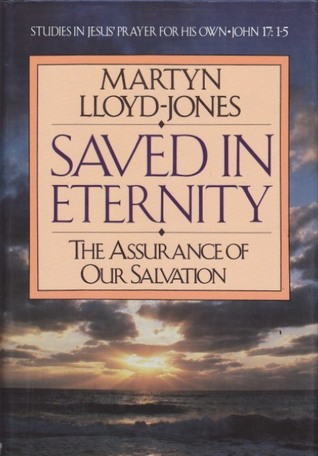
Book Review: Saved In Eternity

Saved In Eternity (The Assurance of Salvation #1) D. Martyn Lloyd-Jones. 1988. Crossway. 187 pages. [Source: Bought]

From the preface: The sermons in this book form the first part of a series on John 17 which Dr. Lloyd-Jones delivered on Sunday mornings in Westminster Chapel between 1952 and 1953. These particular sermons [Saved in Eternity] were preached between April and July 1952.

I have now read all four books in Lloyd-Jones' Assurance of Salvation collection. These four books explore the rich depths of John 17.

The first book, Saved In Eternity, merely covers the first five verses of John 17. Thirteen glorious chapters cover five glorious verses!

The Lord's Own Prayer (John 17:1)
Why Pray (John 17:1)
The Glory of God in the Plan of Salvation (John 17:1)
Our Security in God (John 17:1-5)
The Lord Jesus Christ, the Lord of Glory (John 17:1-5)
Antidote to Introspection (John 17:1-5)
It Is Finished (John 17:1-5)
The Hour Is Come (John 17:1)
That He Should Give Eternal Life To As Many As Thou Hast Given Him (John 17:2)
The Only True God (John 17:2-3)
A New Principle (John 17:2-3)
Filled With Life Anew (John 17:2-3)
Safe In His Eternal Kingdom (John 17:1-5)

I always suspected that I would love, love, love, absolutely LOVE Martyn Lloyd-Jones work if only I could stop being intimidated long enough to immerse myself. And indeed I do love him!!! I find him very readable! His writing is rich in scriptural truth. His love for the Word of God is very evident in his writing. I also love the depth and substance in his sermons. They are meaty sermons, but, ever-relevant.

From "The Lord's Own Prayer"
A quaint preacher in the seventeenth century said what is, I believe, the eternal truth about this prayer. "It is the greatest prayer that was ever offered on earth and it followed the greatest sermon that was ever preached on earth." In a sense nothing can be added to that. (11)
If we had nothing but John 17 we would surely have more than enough to sustain us, because here our Lord has given us an insight into our whole position, and into everything that is of importance and of value to us while we are in this world of time. (13)
We sometimes think that prayer is simple, but it is not. The great saints of all the centuries are agreed in saying that one of the most difficult things of all is to learn how to pray. If any Christian has been feeling cast down because he or she has found prayer difficult, they must not be discouraged, because it is the common experience of the saints. (16)
What he has done for us is that he has satisfied the law and all its demands. It is amazing to me how people can look at and preach about Christ, his life and death and never mention the law. Unless the law of God is satisfied, there is no salvation. (19)
From "Why Pray?"
Prayer, in many ways, is the supreme expression of our faith in God and our faith and confidence in the promises of God. There is nothing that a man ever does which so proclaims his faith as when he gets down on his knees and looks to God and talks to God. (35)
There is no conflict between the sovereignty of God and prayer, for it is the sovereign God who has chosen to do his work in this world through praying men and women. (37)
From "The Glory of God in the Plan of Salvation"
We want a bird's eye view of the whole Bible, and the result is that we miss the doctrine. (44) 
It is a tragedy that we tend to live as paupers in the spiritual realm, when God means us to be princes. (44)
Strangely enough, the Christian gospel--let me say this with reverence, lest I be misunderstood--the Christian gospel does not start even with the Lord Jesus Christ, it starts with God the Father. The Bible starts with God the Father always, everywhere, and we must do the same, because that is the order in the blessed Trinity: God the Father, God the Son, God the Holy Spirit. Salvation is entirely of God, it is the gift of God. (44)
The ultimate aim and object of our salvation is that we may glorify God. The essence of sin is that we do not glorify God--let us be quite clear about this; the essence of sin does not lie in the particular sins or actions of which you and I and others may be guilty. Now that is where we go wrong. We think of sin in terms of particular sins and that is why respectable people do not think they are sinners. They utterly fail to realize that the essence of sin is not to glorify God, and anybody who does not glorify God is guilty of sin of the foulest kind. (47)
From "It Is Finished"
God being God, cannot just forgive sin. Now the common idea about God, the one that we have instinctively, is that when we admit that we have sinned, all that is necessary is that we should come to God, say we are very sorry, and God will forgive us. But according to the Bible that is impossible, and I do not hesitate to use that word. As a preacher of the Christian gospel, I am compelled to say this and I say it with reverence: God, because he is God, cannot just forgive sin like that.
If you want me to prove what I am saying, this is how I do it. If God could have forgiven sin just by saying, "I forgive," he would have done so, and Christ would never have been sent into this world. The work that was given to him to do, this work, this assignment, this task, was given to the Lord Jesus Christ because, I say again, without it, God cannot forgive sin. He must not only justify the ungodly, he must remain just. The way of salvation must be consistent with the character of God. He cannot deny himself, he cannot change himself, he is unchangeable. (101)
He came to do certain things himself, and we are saved by what Christ has done for us, and not by what he tells us to do. (102)
He has done everything that is necessary for man to be reconciled to God. Have you realized, my friends, that this work is finished? (107)
The beginning of Christianity is the acceptance of this statement: "I have finished the work which thou gavest me to do." (107)
From "The Hour Is Come"
My friend, he came from heaven, he laid aside his glory, as we were considering earlier, in order to come to 'this hour.' He knew it from the beginning. He came to die, specifically to die. We have seen that, apart from that death on the cross, he cannot deliver me; that apart from the death on the cross, I say it again with reverence, even God cannot forgive man. The cross is absolutely essential, the cross was planned before the world was ever created. So the hour that produced the cross is the central, pivotal point, of history and God always knew about it, the Lord came for that hour. So we must never think of this hour as taking him by surprise, it was an hour that was appointed and determined, it was the crisis of the world itself. (113)
The cross of Jesus Christ makes this great proclamation. Unless I believe in him, unless I believe that his death at that hour is the only thing that reconciles me to God, I remain under the wrath of God. If I do not see that the wrath of God against my sin has been borne there by the Son of God, then the alternative is that I must live to experience the wrath of God: that is the essence of the Christian gospel. (120)
From "Filled With Life Anew"
To spend time in reading the Bible and in meditation is no burden to those who have eternal life. They delight in it, it is their greatest joy, because knowing God as they know him, they enjoy him. (169)
© Becky Laney of Operation Actually Read Bible