Saturday, January 6, 2018

My Victorian Year #1

This week, I reviewed J.C. Ryle's Coming Events and Present Duties. But it wasn't the only Victorian book I spent time reading.

This year, I'm reading Charles Spurgeon's Morning and Evening. I've started it many, many, many times. But I don't think I've ever finished it. But maybe this year is the year. Here are some of my favorite quotes so far:

  • Let us banish every fearful thought, and rejoice with exceeding great joy, in the prospect that this year we shall begin to be “forever with the Lord.”
  • We will be GLAD and REJOICE. These are two words with one sense, double joy, blessedness upon blessedness. Need there be any limit to our rejoicing in the Lord even now?
  • We will be glad and rejoice IN YOU. That last word is the dainty in the dish—the kernel of the nut—the soul of the text. What heavens are laid up in Jesus! What rivers of infinite bliss have their source, yes, and every drop of their fullness in Him!
  • We may be certain that whatever God has made prominent in His Word, He intended to be conspicuous in our lives. If He has said much about prayer, it is because He knows we have much need of it.
  • So deep are our necessities, that until we are in heaven we must not cease to pray. Do you need nothing? Then, I fear you do not know your poverty. Have you no mercy to ask of God? Then, may the Lord’s mercy show you your misery! A prayerless soul is a Christless soul.
  • If our piety can live without God—it is not of divine creating; it is but a dream; for if God had begotten it, it would wait upon Him as the flowers wait upon the dew.
  • Jesus Christ is Himself the sum and substance of the covenant, and is one of its gifts.
  • You may dive into the immense ocean of His love, and you may say of it all, “It is mine!”
  • “Grow in grace“ not in one grace only—but in all grace. Grow in that root-grace, faith. Believe the promises more firmly than you have done. Let faith increase in fullness, constancy, simplicity.
  • Grow also in love. Ask that your love may become extended, more intense, more practical, influencing every thought, word, and deed.
  • He who does not grow in the knowledge of Jesus, refuses to be blessed. To know Him is “life eternal,” and to advance in the knowledge of Him is to increase in happiness. He who does not long to know more of Christ—knows nothing of Him yet.
  • If you do not desire to know Him better—then you love Him not, for love always cries, “Nearer, nearer!” Absence from Christ is hell—but the presence of Jesus is heaven.
  • When the Holy Spirit gives us spiritual light, and opens our eyes to behold the glory of God in the face of Jesus Christ—we behold SIN in its true colors, and OURSELVES in our real position; we see the Most Holy GOD as He reveals Himself, the plan of MERCY as He propounds it, and the WORLD to come as the Word describes it.
  • Light and darkness have no communion; God has divided them—let us not confound them.
  • It is very comfortable for me to know that I am one of God’s people—but whether I know it or not, if the Lord knows it, I am still safe. This is the foundation, “The Lord knows those who are His.” 

I also read two sermons by J.C. Ryle from his At the Pulpits of Liverpool sermon collection. Both are EXCELLENT.

Be Zealous (Galatians 4:18)

  • If we make the Bible our rule of faith and practice, we cannot turn away from it [zeal]. We must look it in the face. What does the Apostle Paul say to Titus? "Christ gave Himself for us, that He might redeem us from all iniquity, and purify unto Himself a peculiar people, zealous of good works." (Titus 2:14.) What does the Lord Jesus say to the Laodicean Church? "Be zealous and repent." (Rev.3:19.)
  • Reader, I say plainly, I want to plead the cause of zeal in religion. I am not afraid of it. I love it. I admire it. I believe it to be a mighty blessing. I want to strike a blow at the lazy, easy, sleepy Christianity of these latter days, which can see no beauty in zeal, and only uses the word "zealot" as a word of reproach.
  • Zeal in religion is a burning desire to please God, to do His will, and to advance His glory in the world in every possible way.
  • A zealous man is pre-eminently a man of one thing. He only sees one thing he cares for one thing he lives for one thing he is swallowed up in one thing and that one thing is to please God.
  • There never was a grace of which Satan has not made a counterfeit. No grace has suffered so much in this way as zeal. Of none perhaps are there so many shams and counterfeits abroad. We must therefore clear the ground of all rubbish on this question. We must find out when zeal in religion is really good, and true, and of God.
  •  Reader, if zeal be true, it will be a zeal according to knowledge. It must not be a blind, ignorant zeal. It must be a calm, reasonable, intelligent principle, which can show the warrant of Scripture for every step it takes.
  • Furthermore, if zeal be true, it will be a zeal from true motives. Such is the subtlety of the heart, that men will often do right things from wrong motives.
  • Man looks only at the actions. God looks at the motives. Man only thinks of the quantity of work done. God considers the doer's heart.
  • Furthermore, if zeal be true, it will be a zeal about things according to God's mind, and sanctioned by plain examples in God's Word.
  • Furthermore, if zeal be true, it will be a zeal tempered with charity and love. It will not be a bitter zeal. It will not be a fierce enmity against people. It will not be a zeal ready to take the sword, and to smite with carnal weapons.
  • True zeal will hate sin and yet love the sinner. True zeal will hate heresy and yet love the heretic. True zeal will long to break the idol but deeply pity the idolater. True zeal will abhor every kind of wickedness but labor to do good, even to the vilest of transgressors. True zeal will be decided as a surgeon dealing with a diseased limb but true zeal will be gentle as one that is dressing the wounds of a brother.
  • Furthermore, if zeal be true, it will be joined to a deep humility.
  • In the name of the Gospel, and in the name of the Bible, I enter my protest against the theory, that mere earnestness can make a man a truly zealous and pious man in the sight of God.
  • These idolaters of earnestness would make out that God has given us no standard of truth and error, or that the true standard, the Bible, is so obscure, that no man can find out what truth is by simply going to it. They pour contempt upon the Word, the written Word, and therefore they must be wrong.
  • Let me show you WHY it is good for a man to be zealous.
  • It is certain that God never gave a man a commandment which it was not man's interest, as well as duty, to obey. He never set a grace before His believing people which His people will not find it their highest happiness to follow after. This is true of all the graces of the Christian character. Perhaps it is pre-eminently true in the case of zeal.
  • Zeal is good for a Christian's own soul. We all know that exercise is good for the health, and that regular employment of our muscles and limbs promotes our bodily comfort, and increases our bodily vigor. Now that which exercise does for our bodies, zeal will do for our souls.
  • It will help mightily to promote inward feelings of joy, peace, comfort, and happiness.
  • Reader, as zeal is good for ourselves individually, so it is also good for the professing Church of Christ generally. Nothing so much keeps alive true religion as a leaven of zealous Christians scattered to and fro throughout a Church. Like salt, they prevent the whole body falling into a state of corruption.
  • Oh, reader, there is little danger of there being too much zeal for the glory of God. God forgive those who think there is! You know little of human nature. You forget that sickness is far more contagious than health, and that it is much easier to catch a cold than impart a glow.
  • Go and read that long-neglected Bible. Take up that blessed Book which you have, and perhaps never use. Read that New Testament through. Do you find nothing there to make you zealous, to make you earnest about your soul? Go and look at the cross of Christ. Go and see how the Son of God there shed His precious blood for youhow He suffered and groaned, and died for you. how He poured out His soul as an offering for sin, in order that you, sinful brother or sister, might not perishbut have eternal life. Go and look at the cross of Christ, and never rest until you feel some zeal for your own soulsome zeal for the glory of Godsome zeal for extension of the Gospel throughout the world.
  • Think of the precious souls which are perishing, while you are sleeping.
  • But remember all this time souls are going to hell, and you might do something to save them by working, by giving, by writing, by begging, and by prayer. Oh, awake, be zealous, and repent.
  • In heaven there will be no ignorant people to instruct, and no unconverted to reclaim. Whatever you do must be done now. Oh, when are you going to begin? Awake! be zealous, and repent.
  • Think of the devil, and his zeal to do harm. It was a solemn saying of old Bernard when he said that "Satan would rise up in judgment against some people at the last day, because he had shown more zeal to ruin souls than they had to save them." Awake! be zealous, and repent.
  • Think of your Savior, and all His zeal for you. Think of Him in Gethsemane and on Calvary, shedding His blood for sinners. Think of His life and deathHis sufferings and His doings. This He has done for you. What are you doing for Him? Oh, resolve that for the time to come you will spend and be spent for Christ. Awake! be zealous, and repent.


Ready to Be Offered (2 Timothy 4:6-8)

  • In these words you see the apostle Paul looking three waysdownwards, backwards, forward. Downwards to the grave, backwards to his own ministry, forward to that great day, the day of judgment. Let us stand by his side a few minutes, and mark the words he uses. Happy is that soul among us who can look where Paul looked, and then speak as Paul spoke.
  • 1. He looks downwards to the grave, and he does it without fear. Hear what he says. "I am ready to be offered."
  • 2. Let us listen to him again. He looks backwards, to his ministerial life, and he does it without shame. Hear what he says. "I have fought a good fight." There he speaks as a soldier. I have fought that good battle with the world, the flesh, and the devil, from which so many shrink and draw back. "I have finished my course." There he speaks as one who has run for a prize. I have run the race marked out for me. I have gone over the ground staked out for me, however rough and steep. I have not turned aside because of difficulties, and have at length reached the goal. "I have kept the faith." There he speaks as a steward. I have held fast that glorious gospel which was committed to my trust.
  • 3. Let us hear the apostle once more. He looks forward to the great day of reckoning, and he does it without doubt. Mark his words: "Henceforth there is laid up for me a crown of righteousness, which the Lord, the righteous judge, shall give me at that day: and not to me onlybut unto all those who love His appearing." A glorious reward, he seems to say, is ready and laid up in store for me, even that crown which is only given to the righteous.
  • You see, brethren, he speaks without any hesitation or distrust. He regards the crown as a sure thing, as his own already. He declares his belief that the righteous Judge will give it to him, with an unfaltering confidence. Paul was no stranger to all the circumstances and accompaniments of that great day to which he referred. The great white throne, the assembled world, the opened books, the revealing of all secrets, the listening angels, the solemn sentence, the eternal separation, all these were things with which he was well acquainted. But none of these things moved him. His faith overleaped them all, and only saw Christ, his all-prevailing Advocate, and the blood of sprinkling, and sin washed away. "A crown," says he, "is laid up for me. The Lord Himself SHALL give it to me." He speaks as if he saw it all with his own eyes.
  • Now, there are just four things which I wish to bring before you, and it may perhaps clear our way if I name them to you at once: I. First, then, I will try to show you that an assured hope, such as Paul here expresses, is a true and Scriptural thing. II. Secondly, I will make this broad concession, that a man may never arrive at this assured hope, and yet be saved. III. Thirdly, I will give you some reasons why an assured hope is exceedingly to be desired. IV. Lastly, I will try to point out some causes why an assured hope is so seldom attained.
  • Assurance, such as Paul here expresses, is a positive gift of the Holy Spirit, bestowed without reference to men's bodily frames or constitutions, and a gift which every believer in Christ should aim at, and seek after.
  • I lay it down deliberately that a true Christian or converted man may reach that comfortable degree of faith, that in general he shall feel confident as to the safety and forgiveness of his own soul, shall seldom be troubled with doubts, seldom be distracted with hesitations, seldom be distressed with anxious questionings, seldom be alarmed about his own state.
  • It cannot be wrong to feel confident in a matter where God speaks unconditionally, to believe decidedly when God speaks decidedly, to have a sure persuasion of pardon and peace when one rests on the word and oath of Him that never changes.
  • It is an utter mistake to suppose that the believer who feels assurance is resting on anything he sees in himself. He simply leans on the Scriptures of truth, and on the Mediator of the new covenant. He believes the Lord Jesus means what He says, and takes Him at His word.
  • I shrink not from saying, that by grace a man may have sufficient faith to flee to Christ, really to lay hold on Him, really to trust in Him, really to be a child of God, really to be saved; and yet never, to his last day, be free from much anxiety, doubt, and fear.
  • A man must feel his sins and lost estate, must come to Christ for salvation, must rest his hope on this alone. But if he has only faith to do this, however weak that faith may be, I will engage he will not miss heaven.
  • Faith is the still small voice, "Lord, I believe, help my unbelief"; assurance is the confident challenge, "Who shall lay anything to the charge of God's elect? who is he who condemns?"
  • Faith is life. How great the blessing! Who can tell the gulf between life and death? Yet life may be weak, sickly, unhealthy, painful, trying, anxious, worn, burdensome, joyless, smileless, to the last. Assurance is more than life. It is health, strength, power, vigor, activity, energy, manliness, beauty.
  • Too many among us begin doubting and go on doubting, live doubting, die doubting, and go to heaven in a kind of mist. It would ill become me to speak slightingly of "hopes "and "wishes," but I fear many of us sit down content with them and go no further.
  • Know then, for one thing, that assurance is a thing to be desired, because of the present joy and peace it affords. Doubts and fears have great power to mar the comfort of a true believer. Uncertainty and suspense are bad enough in any conditionin the matter of our health, our property, our families, our affections, our earthly callings but never so bad as in the affairs of our souls.
  • Assurance, my brethren, goes far to set a child of God free from this painful kind of bondage, and mightily ministers to comfort. It gives him joy and peace in believing. It makes him patient in tribulation, contented in trial, calm in affliction, unmoved in sorrow, not afraid of evil tidings. It sweetens his bitter cups, it lessens the burden of his crosses, it smooths the rough places on which he travels, it lightens the valley of the shadow of death. It makes him feel as if he had something solid beneath his feet and something firm under his hand, a sure Friend by the way and a sure home in the end.
  • Assurance can give songs in the night.
  • Assurance is to be desired, because it tends to make a Christian an active, useful Christian.
  • A believer who lacks an assured hope will spend much of his time in inward searchings of heart about his own state. He will be full of his own doubtings and questionings, his own conflicts and corruptions. In short, you will often find that he is so taken up with this internal warfare that he has little leisure for other things, little time to work for God.
  • Assurance is to be desired, because it tends to make a Christian a decided Christian. Indecision and doubt about our own state in God's sight is a grievous disease, and the mother of many evils. It often produces a wavering and an unstable walk in following the Lord. Assurance helps to cut many a knot, and to make the path of Christian duty clear and plain.
  • Assurance is to be desired because it tends to make the holiest Christians.
  • I promised to point out some probable causes why an assured hope is so seldom attained. 1. One common cause, I suspect, is a defective view of the doctrine of justification. I am inclined to think that justification and sanctification are in many minds insensibly confused together. They receive the gospel truth that there must be something done in us, as well as something done for us, if we are true believers; and so far they are right. But then, without being aware of it perhaps, they seem to imbibe the erroneous idea, that this justification is in some degree affected by something within themselves. They do not clearly see that Christ's work and not their own work, either in whole or in part, either directly or indirectly, alone is the ground of our acceptance with God; that justification is a thing entirely outside of us, and nothing is needful on our part but simple faith, and that the weakest believer is as fully justified as the strongest. They appear to forget sometimes that we are saved and justified as sinners, and only as sinners, and that we never can attain to anything higher, if we live to the age of Methuselah. 
  • 2. Another common cause, I am afraid, is slothfulness about growth in grace.3. Another common cause is an inconsistent walk in life. With grief and sorrow I feel constrained to say, I fear nothing in this day more frequently prevents men attaining an assured hope than this. Inconsistency of life is utterly destructive of great peace of heart. 
  • Take the advice of a minister of Christ. Seek a treasure that cannot be taken from you; seek a city which has lasting foundations. Do as the apostle Paul did. Give yourself to Christ, and seek an incorruptible crown that fades not away. Come to the Lord Jesus Christ as lowly sinners, and He will receive you, pardon you, give you His renewing Spirit, fill you with peace. This shall give you more real comfort than this world has ever done. There is a gulf in your heart which nothing but Christ can fill.
  • For one thing, resolve this day to seek after an assured hope, if you do not feel you have got it. Believe, me, believe me, it is worth the seeking. If it is good to be sure in earthly things, how much better is it to be sure in heavenly things! Seek to know that you have a title, good and solid and not to be overthrown. Your salvation is a fixed and certain thing. God knows it. Why should not you seek to know it too?


© Becky Laney of Operation Actually Read Bible

Friday, January 5, 2018

Book Review: Enjoying God

Enjoying God: Finding Hope in the Attributes of God. 2017. 242 pages. [Source: Review copy]

First sentence: I remember Saturday mornings.

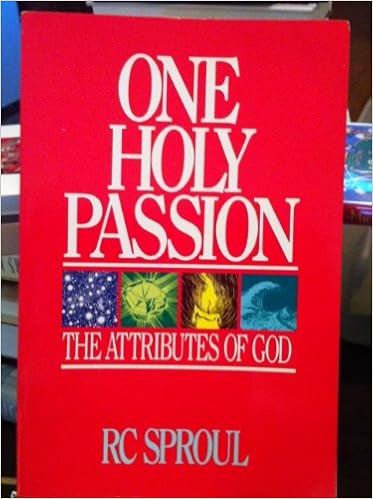
Enjoying God: Finding Hope in the Attributes of God by R.C. Sproul is a book that has been previously published under several different titles by several different publishers: The Character of God, Discovering The God Who Is, and One Holy Passion. I believe it was initially published in 1987. It is a book worthy of staying in print. (Though part of me wishes that it would keep the same title!)

In Morning by Morning, Charles Spurgeon writes, "He who grows not in the knowledge of Jesus, refuses to be blessed. To know him is "life eternal," and to advance in the knowledge of him is to increase in happiness. He who does not long to know more of Christ, knows nothing of him yet." Sproul, I believe, would agree wholeheartedly with that sentiment. Enjoying God reflects that sentiment in fact. We are to ENJOY God, and to enjoy God we first have to know God. Sproul encourages readers to KNOW God and to study his attributes.

Enjoying God has twelve chapters. In each chapter, Sproul examines an attribute (or two) of God. The chapter titles are: "Who Are You, God?" "Who Made You, God?" "I Want To Find You, God" "How Much Do You Know, God?" "Where Is Truth, God?" "The Shadow Doesn't Turn" "The Just Judge" "The Invincible Power" "Can I Trust You, God?" "The Love That Will Not Let Us Go" and "The Name Above All Names."

This one is now subtitled "finding hope in the attributes of God." It's not a bad subtitle. Our hope is GROUNDED in WHO God is. Growing in knowledge of who God is--as revealed in the Bible, in the Word of God--can only increase our hope. When our hope is in anything else--in ourselves, in our families, in our friends, in our government, in society--it's doomed to disappoint us. The only one who will never fail us is God himself.

I would recommend reading this one--whether it's a new edition or an old one. It is not perhaps as accessible as other books on God's attributes--I'm thinking of those by A.W. Tozer--but it is biblically sound and thought-provoking. If you make the effort, you will be rewarded for your time.

Favorite quotes:
Life is lived between two hospitals. We need a support system from birth to death to sustain life. As the Scripture states, “all flesh is grass” (Isa. 40:6). We are like flowers that bloom and then wither and fade. This is how we differ from God. God does not wither. God does not fade. God is not fragile. The very word existence is not quite accurate for him.
God promises you and me his presence. I don’t always feel his presence. But God’s promises do not depend upon my feelings; they rest upon his integrity. I may fail in my promises, but he does not break his. My doubts about his presence insult his integrity. Because I cannot see him or feel him, I begin to question his Word. To live by faith, on the other hand, is to live by trust. This means far more than believing in God; it means believing God.
God’s thoughts are pure; my thoughts are impure. God’s actions are perfect; my actions are imperfect. That is why I need a Savior. That is why my spirit rejoices in God my Savior! A personal, spiritual God has provided a personal, spiritual redemption for me. Salvation involves the reconciliation of a relationship. To be saved means to be restored to fellowship with the living God.
To be known by God is an idea that divides the human race. There are those who long to be known by God. For we Christians there is no greater solace than to know we are known by God and still loved. For unbelievers nothing is more dreadful than the thought of being known completely by God. The pagan does not want God to look at him; he wants God to overlook him. 
There is only one adequate cloak for our shame—the righteousness of Christ. Our nakedness and shame are covered by a shield that no guilt can pierce. Our lives are hid in him. He is our refuge. He who knows the fugitive’s crime gives the fugitive a hiding place. 
     The greatest event of human history was at the same time the most diabolical. No greater shame can be tacked to the human race than that a human being delivered up Jesus to be crucified. Judas betrayed Christ because Judas wanted to betray Christ. The Pharisees pressed for his death because the Pharisees wanted Jesus killed. Pilate succumbed to the howling crowd, not because God coerced him, but because Pilate was too weak to withstand the demands of the mob. Yet the Bible declares that the cross was no accident. The outcome of God’s eternal plan of redemption did not hinge finally on the decision of Pontius Pilate. What if Pilate had released Jesus and crucified Barabbas instead? Such a thought is almost unthinkable. It would suggest that God was only a spectator in the plan of redemption, that he hoped for the best but had no control over the events. God did more than hope for the cross. He willed the cross. He sent his Son for that very purpose. Before Jesus was brought before Pilate, he pleaded with the Father for a different verdict. He begged that the cup might pass. Before Pilate ever raised his Roman scepter, the gavel had fallen in Gethsemane. The verdict was in. Jesus was delivered by the determinate forecounsel of God.
 We can change our attitude toward God. But one thing we cannot do: We cannot change God. God is unchangeable. If changes are to be made, they must be made in us.
Justification is at the heart of the Christian faith because (1) God is righteous, and (2) man is not righteous. These two facts make Christianity necessary and stand behind the incarnation, the cross, and the empty tomb. If God were not righteous, unrighteous human beings would have no need of a Savior. But because God is righteous and we are not, we have a desperate need for a Savior. 
The temptation to reduce God to love alone is strong, especially when we fear his wrath or seek to flee from his justice. If we could strip God of all his attributes except for love, we would have nothing to fear from the last judgment. But to separate the love of God from his other attributes is impossible. God will not tolerate it. The love of God is a holy and righteous love. But his love does not compromise his integrity. 
I shudder when I hear professing Christians reject the sovereignty of God or the justice of God. “But my God is a God of love,” some say, as if God’s character could be exhausted by one attribute. Here the attribute of love is so exalted that it swallows up God’s other attributes. The result is a one-dimensional God, a God who is less than God, an idol. The God we love and worship is a God of depth and fullness. He is one and many. He has unity and diversity. He is one being with several attributes. In this life we only begin to understand the depth and the riches of his being. We only skate on the surface of understanding him. 

© Becky Laney of Operation Actually Read Bible

Thursday, January 4, 2018

Book Review: Coming Events and Present Duties

Coming Events and Present Duties. J.C. Ryle. 1879. 150 pages. [Source: Bought]

In 1879, Ryle published a theme collection of sermons and tracts about 'coming events and present duties' (aka end times prophecy). In his preface, he makes a great point, one that we'd all do well to remember. "I judge nobody. I only ask liberty to hold and state distinctly my own views. The day will decide who is right. It is the new heart, and faith in Christ’s blood — which are absolutely necessary to salvation. The man who knows these two things experimentally, may be wrong about prophecy—but he will not miss Heaven." He goes on to state eleven articles of his prophetic creed. Of those eleven, I find myself mostly in agreement.
1. I believe that the world will never be completely converted to Christianity by any existing agency, before the end comes. In spite of all that can be done by ministers, churches, schools, and missions —the wheat and the tares will grow together until the harvest; and when the end comes, it will find the earth in much the same state that it was when the flood came in the days of Noah.(Matthew 13:24-30; 24:37-39.)
2. I believe that the wide-spread unbelief, indifference, formalism, and wickedness, which are to be seen throughout Christendom —are only what we are taught to expect in God's Word. Troublous times, departures from the faith, evil men waxing worse and worse, love waxing cold —are things distinctly predicted. So far from making me doubt the truth of Christianity, they help to confirm my faith.
3. I believe that the grand purpose of the present dispensation is to gather out of the world an elect people —and not to convert all mankind. It does not surprise me at all to hear that the heathen are not all converted when missionaries preach, and that believers are but a little flock in any congregation in my own land. It is precisely the state of things which I expect to find.
4. I believe that the second coming of our Lord Jesus Christ is the great event which will wind up the present dispensation, and for which we ought daily to long and pray. "May Your kingdom come!" "Come, Lord Jesus!" should be our daily prayer. We look  backward, if we have faith, to Christ dying on the cross; and we ought to look forward no less, if we have hope, to Christ coming again.
5. I believe that the second coming of our Lord Jesus Christ will be a real, literal, personal, bodily coming; and that as He went away in the clouds of Heaven with His body, before the eyes of men —so in like manner He will return.
6. I believe that after our Lord Jesus Christ comes again, the earth shall be renewed, and the curse removed; the devil shall be bound, the godly shall be rewarded, the wicked shall be punished; and that before He comes, there shall be neither resurrection, judgment, nor millennium, and that not until after He comes, shall the earth be filled with the knowledge of the glory of the Lord.
7. I believe that the Jews shall ultimately be gathered again as a separate nation, restored to their own land, and converted to the faith of Christ, after going through great tribulation.
8. I believe that the literal sense of Old Testament prophecies has been far too much neglected by the Churches, and is far too much neglected at the present day, and that under the mistaken system of spiritualizing and accommodating Bible language, Christians have too often completely missed its meaning.
9. I do not believe that the preterist scheme of interpreting the Apocalypse, which regards the book as almost entirely fulfilled; or the futurist scheme, which regards it as almost entirely unfulfilled —are either of them to be implicitly followed. The truth, I expect, will be found to lie between the two.
10. I believe that the Roman Catholic Church is the great predicted apostasy from the faith, and is Babylon and Antichrist; although I think it highly probable that a more complete development of Antichrist will yet be exhibited to the world.
11. Finally, I believe that it is for the safety, happiness, and comfort of all true Christians, to expect as little as possible from Churches or Governments under the present dispensation —to hold themselves ready for tremendous convulsions and changes of all things established —and to expect their good things only from Christ's second advent. 
This one includes the following sermons: "Watch!" "What Time Is It?" "Idolatry!" "The Reading Which is Blessed" "Occupy Until I Come" and "Scattered Israel to Be Gathered."

Each sermon has a scriptural basis. "Watch!" is expository preaching on Matthew 25:1-13, "What Time Is It?" is expository preaching on Romans 13:12. "Idolatry" is expository preaching on 1 Corinthians 10:14. "The Reading Which Is Blessed" is expository preaching on Revelation 1:1-3. "Occupy Until I Come" is expository preaching on Luke 19:11-13. "Scattered Israel to Be Gathered" is expository preaching on Jeremiah 31:10. Most--if not all--sermons have application and invitation built right in.

I shared quotes from the first two sermons in my Happy New Year post.

Favorite quotes from "Idolatry":
It is not necessary for a man formally to deny God and Christ, in order to be an idolator. Far from it. Professed reverence for the God of the Bible, and actual idolatry, are perfectly compatible! They have often gone side by side — and they still do so!
In one word, idolatry is a natural product of man’s heart. It is a weed which, like the uncultivated earth — the heart is always ready to bring forth.
In fact, idolatry is all natural, downhill, and easy — like the broad way. Spiritual worship is all grace — all uphill, and all against the grain. Any worship whatever is more pleasing to the natural heart, than worshiping God in the way which our Lord Christ describes, “in spirit and in truth.” (John 4:23.)
Unity in the abstract is no doubt an excellent thing: but unity without truth is useless. Peace and uniformity are beautiful and valuable: but peace without the Gospel — peace not based on a common faith, is a worthless peace, not deserving of the name.
Let us arm ourselves, then, for one thing, with a thorough knowledge of the Word of God. Let us read our Bibles more diligently than ever, and become familiar with every part of them. Let the Word dwell in us richly. Let us beware of anything which would make us give less time, and less heart — to the perusal of its sacred pages. The Bible is the sword of the Spirit — let it never be laid aside. The Bible is the true lantern for a dark and cloudy time — let us beware of traveling without its light.
Let us arm ourselves, in the second place, with a godly jealousy about the least portion of the Gospel. Let us beware of sanctioning the slightest attempt to keep back any jot or tittle of it, or to throw any part of it into the shade by exalting subordinate matters in religion. 
Let us count nothing little which concerns our souls. Let us be very particular whom we hear, where we go, and what we do — in all the matters of our own particular worship.
Let us arm ourselves, last of all, with clear sound views of our Lord Jesus Christ, and of the salvation that is in Him. He is the “image of the invisible God,” — the express “image of His person,” — and the true preservative against all idolatry, when truly known. Let us build ourselves deep down on the strong foundation of His finished work upon the cross.
Let us settle it firmly in our minds, that Christ Jesus has done everything needful in order to present us without spot before the throne of God, and that simple childlike faith on our part, is the only thing required to give us a saving interest in the work of Christ.
Above all, let us keep up continual communion with the Lord Jesus! Let us abide in Him daily, feed on Him daily, look to Him daily, lean on Him daily, live upon Him daily, draw from His fullness daily. Let us realize this, and the idea of other mediators, other comforters, other intercessors — will seem utterly absurd. 
Favorite quotes from "The Reading Which is Blessed":
Wise mercy showed the early Christians a light in the distance — but did not tell them how far it was away. Wise mercy pointed out the far off harbor lights — but not the miles of stormy sea between. Wise mercy revealed enough to make them work, and hope, and wait. But wise mercy did not tell all that was yet to be fulfilled before the end.
I say, then, that there are many blessed and comfortable truths scattered up and down, all over the Book of Revelation, which are intelligible to the simplest comprehension — and yet full of food for the most spiritual mind. God has mercifully so ordered the composition of the book, that there is hardly a chapter from which a man may not draw some striking and edifying thought.
There is much about the Lord Jesus Christ in the book of Revelation. There are names, and titles, and expressions about Him there, which we find nowhere else. There is new light thrown on His offices, His power, His care for His people. Surely this alone is no small matter. To know Jesus, is life eternal. To abide in Jesus, is to be fruitful. If we are indeed born of the Spirit — we can never hear too much about our Savior, our Shepherd, our High Priest and Physician! If our hearts are right in the sight of God — we can never hear too much about our Savior-King! Like snow in summer and good news from a far country, so are any fresh tidings about Christ.
There is much about the desperate corruption of human nature in the book of Revelation. There is evidence on this subject in the Epistles to the Seven Churches, and the repeated accounts of the incorrigibleness and impenitence of the nations of the earth under judgments, which we shall all do well to lay to heart. We can never be too well acquainted with our own sinfulness and weakness. The spring of all humility, thankfulness, grateful love to Christ, and close walk with God — is real, thorough, scriptural knowledge of the wickedness of our own hearts. None will ever build high — who does not begin low. The soul that loves much — is the soul that feels its debt is great, and that much has been forgiven.
There is much about Hell in the book of Revelation. There are many fearful expressions which show its reality, its misery, its eternity, its certainty. How deeply important is it to have clear views on this solemn subject in the present day!
There is much about Heaven in the book of Revelation. I speak of Heaven in the common acceptance of the word. I mean the future abode of the people of God. And I say that no book in God’s Word tells us so much about Heaven as the Apocalypse. If there was nothing else to be learned from the book beside this, we ought to be most thankful.
There is much about the prospects of the Church of Christ in the book of Revelation. When I speak of the Church, I mean the Church of the elect, the living body of Christ, whose members are all holy. The pages of the Apocalypse show plainly that the triumphs, and rest, and ease, and peace of that Church, are not in this world.
Its members must make up their minds to battles and fightings, to trial and persecution, to cross and affliction. They must be content to be a little flock, a poor and despised people, until the advent of Christ. Their good things are yet to come.
There is much, in the last place, in the book of Revelation to show the safety of all true believers in Christ, whatever may come upon the world.
You may reach Heaven without knowing much about the deep things of the Apocalypse — but you will never get their without the saving knowledge of Christ and a new heart. You must be born again. You must renounce your own righteousness and acknowledge yourself to be a sinner. You must wash in the fountain of Christ’s blood. You must be clothed in the garment of Christ’s righteousness. You must take up the cross of Christ and follow Him. These are the things absolutely needful. These are the things without which no man, learned or unlearned, high or low — can ever be saved.
Favorite quotes from "Occupy Until I Come":
If the Jew thought too exclusively of Christ reigning — has not the Gentile thought too exclusively of Christ suffering? If the Jew could see nothing in Old Testament prophecy but Christ’s exaltation and final power — has not the Gentile often seen nothing but Christ’s humiliation and the preaching of the Gospel? If the Jew dwelt too much on Christ’s second advent — has not the Gentile dwelt too exclusively on the first?
If the Jew ignored the cross — has not the Gentile ignored the crown?
After 1900 years of Bibles and Gospel preaching, there is not a nation, or a country, or a town — where the devil has not more subjects than Christ. So fearfully true is it, that the world is not yet the kingdom of Christ.
The Lord Jesus bids you “occupy.” By that He means that you are to be “a doer” in your Christianity, and not merely a hearer and professor. He wants His servants not only to receive His wages, and eat His bread, and dwell in His house, and belong to His family — but also to do His work.
What has your Christianity done for you if it has not made you fit for the kingdom of Christ. Nothing — nothing! Nothing at all! Oh, that you may think on this matter, and never rest until you are ready to meet Christ!
Favorite quotes from "Scattered Israel to Be Gathered":
For many centuries there has prevailed in the Churches of Christ a strange, and to my mind, an unwarrantable mode of dealing with this word “Israel.” It has been interpreted in many passages of the Psalms and Prophets, as if it meant nothing more than Christian believers. Have promises been held out to Israel? Men have been told continually that they are addressed to Gentile saints. Have glorious things been described as laid up in store for Israel? Men have been incessantly told that they describe the victories and triumphs of the Gospel in Christian Churches.
Cleave to the literal sense of Bible words and beware of departing from it — except in cases of absolute necessity. Beware of that system of allegorizing and spiritualizing and accommodating, which the school of Origen first brought in, and which has found such an unfortunate degree of favor in the Church. 
Settle it in your mind, in the reading the Psalms and Prophets, that Israel means Israel; and Zion means Zion; and Jerusalem means Jerusalem.
And, finally, whatever edification you derive from applying to your own soul the words which God addresses to His ancient people — never lose sight of the primary sense of the text. 
I ask you, then, to settle it firmly in your mind that when God says a thing shall be done — we ought to believe it. We have no right to begin talking of probable and improbable, likely and unlikely, possible and impossible, reasonable and unreasonable. What is all this but veiled scepticism and infidelity in disguise? What has the Lord said? What has the Lord spoken? What says the Scriptures? What is written in the Word? These are the only questions we have a right to ask; and when the answer to them is plain — we have nothing to do but believe. We must abide by Scripture, or be of all men most miserable. At any cost, let us cling to the Word. “Let God be true and every man a liar.” I am determined to believe everything that God says. I know it will all prove true at the last day.
© Becky Laney of Operation Actually Read Bible
Wednesday, January 3, 2018

Book Review: Kiss the Wave

Kiss the Wave: Embracing God in Your Trials. Dave Furman. 2018. Crossway. 160 pages. [Review copy]

First sentence: How quickly we forget the identity of Jesus!

This book on suffering is titled, Kiss The Wave. The title comes from a Spurgeon quote: "I have learned to kiss the wave that throws me against the Rock of Ages." It wasn't easy for Spurgeon, and it's no easier for us, to kiss the wave. But it is necessary and beneficial that we learn how to embrace the grace in any and every situation. Furman writes, "In the midst of the storm, God has your good and his glory in mind."

The book seeks to do two things. First and foremost, it focuses on Jesus. Chapter after chapter, he asks us to remember who Jesus is and what he is like. The good news of Jesus Christ is proclaimed page after page. The gospel should encourage and not discourage us when we're down. The second focus of the book is on stories. Through stories of people who have suffered--past and present--Furman seeks to encourage and reassure us.

I liked this one. I wanted to love, love, love it. But I didn't quite. I thought the theology was good. No complaints there. I liked the focus on the gospel, on Jesus. I liked the practical advice on how to suffer well. But I felt that there were just a few too many stories.

Favorite quotes:
"We hope not in the things of this world, but in God himself." 
"If God is your treasure, your soul will never be empty. If God is your refuge, you will never be deserted. If God is your fortress, you will never be unprotected."
"Christmas is not a stand-alone event in salvation history. It is connected to Good Friday and Easter. Jesus, the Son of God, left heaven in order to redeem us. Christ’s birth was the ultimate rescue mission. For everyone else it would have been mission impossible. But for him and only him it was possible to be both God and man. We must not forget the depth of this rescue mission."
"Barabbas is the one person in history who could say that Jesus literally carried his cross. Jesus took his death, and Barabbas was given the freedom Jesus deserved. Jesus bore the guilt and shame and curse and disgrace and death that Barabbas deserved. Barabbas received the release, the freedom, and the life that Jesus deserved. It was an incredible scene."
"The cross of Christ is what we need to rejoice in today, tomorrow, and every day until we breathe our last breath."
"Not all of us are called to preach the gospel to a church on a Sunday morning, but all of us are called to preach truth to our own hearts each day. Remind yourself that God so loved you that he gave his one and only Son over to the cross for you. In your pain, preach to yourself that it should have been you up there on the cross, but that in the greatest exchange in all of history, he went there instead."
"Every bad day is a day Jesus is aware of. No trial surprises him or escapes his eye. Jesus encourages those who are facing persecution to not fear those who can kill the body but do nothing else. Instead we can trust the God who knows us and is keenly aware of all our circumstances."
"All Christians are a part of the body, even hurting Christians. Regardless of your health or capacity, if you are a believer, then you are a part of the body. If you are healthy, you are a part of the body. But if you are broken, depressed, and hurting, you are a part of that same body of Christ. No disease or disorder casts you outside the body. No sickness keeps you from playing a part."

© Becky Laney of Operation Actually Read Bible

Tuesday, January 2, 2018

Book Review: The Promise of Dawn

The Promise of Dawn. Lauraine Snelling. 2017. Bethany House. 386 pages. [Source: Review copy]

First sentence: Mor, a letter from Amerika!

Premise/plot: Signe and Rune travel with their three sons to America, to Minnesota, to help out their relatives, Uncle Einar and Aunt Gird. It won't be easy: not the journey, not the settling in, not the work. Uncle Einar and Aunt Gird are each difficult and demanding in their own ways. Aunt Gird is bed-ridden and incapable of doing anything for herself or for anyone else. Uncle Einar, well, he's strong and capable--of almost anything but being kind and considerate. It will take all their strength and courage to survive in their new environment. Einar is a logger, and, he wants Rune and at least the oldest boy--if not the two eldest--to give 110% sunup to sundown.

My thoughts: I need to read more Snelling. I do. I haven't read nearly enough. I believe this series will--sooner or later--connect to some of her other books.

It's set in 1909, I believe. And the pioneer way of life is anything but dead. Reading this one reminded me of the Little House books or some of Oke's earlier work. Signe has a house to manage, and it's a 24 hour job, an often thankless job. She's also pregnant. The family is very well-developed, as is the community.

I would definitely recommend this one!

© Becky Laney of Operation Actually Read Bible

Monday, January 1, 2018

2018 Reading Challenge: 52 Books in 52 Weeks

2018 52 Books in 52 Weeks
Read 52 Books in 52 Weeks (about) (links post)
Link back EVERY Sunday
# of books 52

1. The Promise of Dawn. Lauraine Snelling. 2017. Bethany House. 386 pages. [Source: Review copy]
2. Enjoying God: Finding Hope in the Attributes of God. 1987/2017. 242 pages. [Source: Review copy]
3. The Lacemaker. Laura Frantz. 2018. Revell. 416 pages. [Source: Review copy]
4. Spurgeon On the Christian Life: Alive in Christ (Theologians on the Christian Life) Michael Reeves. 2018. Crossway. 192 pages. [Source: Review copy]
5. Can I Have Joy In My Life. (Crucial Questions Series #12) R.C. Sproul. 2012. 66 pages. [Source: Free download]
6. Discipleship: What It Truly Means to Be A Christian. A.W. Tozer. 2018. [May] Moody Publishers. 176 pages. [Source: Review copy]
7. The Moment of Truth. Steven J. Lawson. 2018. Reformation Trust. 238 pages. [Source: Review copy]
8. Biblical Theology: How the Church Faithfully Teaches the Gospel. Nick Roark and Robert Cline. Crossway. 2018. [March] 160 pages. [Source: Review copy]
9. God's Grace In Your Suffering. David A. Powlison. 2018. Crossway. 128 pages. [Source: Review copy]
10. The Gospel According to God: Rediscovering the Most Remarkable Chapter in the Old Testament. John F. MacArthur. 2018. Crossway. 224 pages. [Source: Review copy]
11. Echoes of Exodus: Tracing Themes of Redemption Through Scripture. Alastair J. Roberts and Andrew P. Wilson. 2018. Crossway. 176 pages. [Source: Review copy]
12. The Kingdom of God and the Glory of the Cross. Patrick Schreiner. 2018. Crossway. 160 pages. [Source: Review copy]
13. Can I Be Sure I'm Saved? (Crucial Questions #7) R.C. Sproul. 2010. Reformation Trust. 72 pages. [Source: Free download.]
14. The Glory of Christ. R.C. Sproul. 1990. 223 pages. [Source: 223 pages.]
15. Lloyd-Jones on the Christian Life: Doctrine and Life as Fuel and Fire. Jason Meyer. 2018. Crossway. 272 pages. [Source: Review copy]
16. A Breath of Hope. Lauraine Snelling. 2018. Bethany House. 336 pages. [Source: Review copy]
17. Are These The Last Days? (Crucial Questions #20) R.C. Sproul. 2014. Reformation Trust. 55 pages. [Source: Free download]
18. The Prayer of the Lord. R.C. Sproul. 2009/2018. Reformation Trust. 130 pages. [Source: Review copy]
19. In His Image: 10 Ways God Calls Us To Reflect His Character. Jen Wilkin. 2018. Crossway. 176 pages. [Source: Review copy]
20. How Sweet the Sound: the Story of Amazing Grace. Carole Boston Weatherford. Illustrated by Frank Morrison. 2018. Simon & Schuster. 48 pages. [Source: Library]
21. The Church in Babylon: Heeding the Call to Be a Light in the Darkness. Erwin W. Lutzer. 2018. Moody Publishers. 208 pages. [Source: Review copy]
22. Sleep Sound in Jesus: Gentle Lullabies for Little Ones and Inspirational Devotions for Parents. Michael Card. Illustrated by Catherine McLaughlin. 1989. Harvest House. 36 pages.
23. Beyond Suffering Bible NLT: Where Struggles Seem Endless, God's Hope Is Infinite. Joni Eareckson Tada. Joni & Friends, Inc. 2016. Tyndale. 1696 pages. [Source: Bought]
24. Journeys with Jesus: Every Path in the Bible Leads Us to Christ. Dennis E. Johnson. Abridged by Richard B. Ramsey. 2018. P&R Publishing. 192 pages. [Source: Review copy]
25. The Holiness of God. R.C. Sproul. 1985/2012. 226 pages. [Source: Bought]
26. Commentary on the Epistle to the Romans. Martin Luther. 1954/1976. Kregel. 224 pages. [Source: Gift]
27. Depression, Anxiety, and the Christian Life. Practical Wisdom from Richard Baxter. Michael S. Lundy, J.I. Packer, Richard Baxter. 2018. Crossway Books. 192 pages. [Source: Review copy]
28.  The Preacher's Catechism. Lewis Allen. 2018. Crossway. 224 pages. [Source: Review copy]
29. Daily Chronological Bible: KJV Edition. Holman Bible Publishers. 2014. 1440 pages. [Source: Free giveaway]
30. Even Better Than Eden: Nine Ways the Bible's Story Changes Everything About Your Story. Nancy Guthrie. 2018. Crossway. 208 pages. [Source: Review copy]
31.  Prayer: How Praying Together Shapes the Church. John Onwuchekwa. 2018. Crossway. 144 pages. [Source: Review copy]
32. Piercing the Darkness. Frank E. Peretti. 1989. Crossway. 448 pages. [Source: Bought]
33. The Sovereignty of God. Arthur W. Pink. 1917. 272 pages. [Source: Bought]
34. Knowing Scripture. R.C. Sproul. Foreword by J.I. Packer. 1977. IVP. 126 pages. [Source: Bought]
35. The Joyful Christian. C.S. Lewis. 1977. 256 pages. [Source: Bought]
36. The Soul's Quest for God. R.C. Sproul. 1992. 266 pages. [Source: Bought]
37. The Hand of God. Alistair Begg. 1999/2018. Moody Publishers. 204 pages. [Source: Review copy] 
38. The Love Knot. Karen Witemeyer. 2018. 140 pages. [Source: Library]
39. The Quotable Tozer. A.W. Tozer. Compiled by James L. Snyder. 2018. Bethany House. 369 pages. [Source: Review copy]
40. In the Year of Our Lord: Reflections on Twenty Centuries of Church History. Sinclair B. Ferguson. 2018. Reformation Trust. 229 pages. [Source: Review copy]
41. The Rule of Love: How the Local Church Should Reflect God's Love and Authority. Jonathan Leeman. 2018. Crossway. 176 pages. [Source: Review copy]
42. NIV Rainbow Study Bible. 2015. Holman Bible Publishers. 1632 pages. [Source: Review copy]
43. Dear and Glorious Physician. Taylor Caldwell. 1958. 560 pages. [Source: Bought]
44. Thru the Bible: Genesis 1-15. J. Vernon McGee. 1975. 204 pages. [Source: Bought]
45. Exodus 1-18 (Thru the Bible #4) J. Vernon McGee. 1975. 170 pages. [Source: Bought]
46.  Leviticus 1-14 (Thru the Bible #6) J. Vernon McGee. 1975. 192 pages. [Source: Bought]
47. Leviticus 15-27 (Thru the Bible #7) J. Vernon McGee. 168 pages. [Source: Bought]
48. Numbers. (Thru the Bible #8) J. Vernon McGee. 1975. 204 pages. [Source: Bought]
49. How To Be A Perfect Christian. The Babylon Bee. 2018. 203 pages. [Source: Library]
50. Thru the Bible #9: Deuteronomy. J. Vernon McGee. 202 pages. [Source: Bought]
51. The Bride of Ivy Green. Julie Klassen. 2018. Bethany House. 448 pages. [Source: Review copy]
52 A Bound Heart. Laura Frantz. 2019. Revell. 400 pages. [Source: Review copy]


© Becky Laney of Operation Actually Read Bible

Happy New Year

I thought I would begin the year sharing some fantastic quotes from J.C. Ryle. I'm currently reading his Coming Events and Present Duties. These words are good to hear any day of the year, but are particularly applicable as a new year begins.

The first sermon in this collection, is "Watch." He's preaching on Matthew 25:1-13.
You are either traveling towards Heaven — or towards Hell. Never for a moment forget this. This is the point that concerns your eternal soul. Whatever your opinion may be on other points — this is the one that you should never lose sight of. Let not the devil divert your attention from it. Say to yourself, as you read this parable, “I am spoken of here!”
Reader, the suddenness of the Lord’s second advent is a truth that should lead every professing Christian to great searchings of heart. It should lead him to serious thought, both about himself and about the world. Think for a moment, how little the world is prepared for such an event. Look at the towns and cities of the earth, and think of them. Mark how most men are entirely absorbed in the things of time, and utterly engrossed with the business of their callings.
The world will let a man serve the devil and go to Hell quietly, and no one lifts a little finger to stop him, or says, “Be merciful to your soul.” The world will never let a man serve Christ and go to Heaven quietly, and does everything that can be done to keep him back.
Never, never be afraid of going too far. Never, never be afraid of being too holy. Never, never be ashamed of desiring to go to Heaven, and of seeking to have a great crown. Millions will lament in the day of Christ’s return, because they have not enough religion: not one will be heard to say that he has got too much.
Truly a religion that does not make a man ready for everything — for death, for judgment, for the second advent, for the resurrection — such a religion may well be looked on with suspicion. Reader, if your religion does not make you ready for anything — the sooner it is changed, the better!
Watch against SIN of every kind and description. 
Watch against doubts and unbelief as to the complete acceptance of your soul, if you are a believer in Christ Jesus. The Lord Jesus finished the work He came to do — do not tell Him that He did not. The Lord Jesus paid your debts in full — do not tell Him that you think He left you to pay part. The Lord Jesus promises eternal life to every sinner that comes to Him — do not tell Him, even while you are coming, that you think He lies. Alas, for our unbelief!
Watch against inconsistency of walk — and conformity to the world. Watch against sins of temper and of tongue. These are the kind of things that grieve the Spirit of God, and make His witness within us faint and low. Watch and pray!
Oh, my believing readers, let us all watch more than we have done! Let us watch more every year that we live. Let us watch, that we may not be surprised when the Lord appears.
Let us watch for the world’s sake. We are the books they chiefly read. They mark our ways, far more than we think. Let us aim to be plainly-written epistles of Christ! 
Let us live as if His glory was concerned in our behavior. Let us live as if every slip and fall was a reflection on the honor of our King. Let us live as if every allowed sin, was . . . one more thorn in His head, one more nail in His feet, one more spear in His side!
His next address is expository teaching on Romans 13:12.
1. You have here the present condition of the world. It is night. 2. You have the condition of the world which is yet to come. It will be day. 3. You have the particular time in which our lot is cast. The night is far spent, and the day is at hand. 4. You have the duty of all believers who know the time. They ought to cast off the works of darkness and to put on the armor of light.
I only ask that the believer in the New Testament should live by a New Testament standard — that he should look for the coming of the day of God, and wait for the Son of God from Heaven, and love his Lord’s appearing.
I only ask that we should take scriptural views of things as they are — and things as they yet will be. I ask that we should see our present evils — and mourn over them; that we should see our future good things — and long for them. Let us honestly confess that sin is around us — and long to be delivered from its presence. Let us honestly confess that holiness is one day to spread over the earth — and long for it to come. Let us never be ashamed to allow that it is “night” and that we want it to be “day.”
Reader, try all your employment of time by the test of Christ’s second coming. Place in this balance — your amusements, your books, your companions, your manner of conversation, your daily behavior in all the relations of life. Measure all by this measure, “The night is far spent and the day is at hand. Am I living as a child of the night — or as one who looks for the day?”
Wherever you may live — and whatever may be your trials; however great your difficulties — and however small your helps; nothing should prevent your aiming at the highest standard — to behave like one who believes that Christ is coming again!
Let there be light in your heart continually: Christ dwelling there by faith — felt, known, and experienced by your soul.
Let there be light in your life continually: Christ reflected there, followed, imitated, and copied. Seek to be a light in the world and nothing less — a bright light, a clear light, a light that men can see afar off. Do this and you will put on the armor of light.
Live as if you thought that Christ might come at any time. Do everything, as if you did it for the last time. Say everything, as if you said it for the last time. Read every chapter in the Bible, as if you did not know whether you would be allowed to read it again. Pray every prayer, as if you felt it might be your last opportunity. Hear every sermon, as if you were hearing once and forever. This is the way to be found ready.
If you're looking for a new way to live in 2018, you couldn't get much better advice than this last.

  • Live as if you thought that Christ might come at any time. 
  • Do everything, as if you did it for the last time. 
  • Say everything, as if you said it for the last time. 
  • Read every chapter in the Bible, as if you did not know whether you would be allowed to read it again. 
  • Pray every prayer, as if you felt it might be your last opportunity. 
  • Hear every sermon, as if you were hearing once and forever. 
  • This is the way to be found ready.

© Becky Laney of Operation Actually Read Bible