Showing posts with label 1995. Show all posts

Tuesday, August 4, 2026

6. NASB 95 Inductive Study Bible


6. New American Standard Bible 1995, New Inductive Study Bible. GOD. 1995. 2296 pages. [Source: Bought] [Bible, bible review, 5 stars]

First sentence: In the beginning God created the heavens and the earth. The earth was formless and void, and darkness was over the surface of the deep, and the Spirit of God was moving over the surface of the waters. Then God said, “Let there be light”; and there was light.

Start date: March 3, 2026
End date: August 4, 2026

The New American Standard Bible is one of my all-time favorite, favorite translations. Particularly the 1977 and 1995. This is the 1995 update. I have also read the New Inductive Study Bible in the NASB 1977. So I've now read this particular 'study' Bible in two translations.

This Bible is a study Bible if and only if you put in the work to make it so. The Bible includes detailed instructions on how to do inductive Bible study, how to mark up your Bible, how to write in your Bible, how to interpret and understand what you're reading, what you're marking, etc. It does include some maps, charts, illustrations, etc. that you could benefit from regardless of if you are doing the inductive part. Because this is a Bible that's meant to be marked, written in, etc, there's plenty of space to do so. Perhaps not as much as a wide margin or journaling Bible, but more than your regular Bible.

This is a SINGLE COLUMN, black-letter Bible. The font size is decent, perhaps more than decent. It is not large print or giant print. But it isn't tiny print either. This Bible is HEAVY. That's the trade-off for all the extra space for writing. I believe it is also verse by verse (and not paragraphed). There are no headings, sub-headings, etc. There are lines for YOU to fill in the headings. 

This is an older edition of the New Inductive Study Bible. I believe it has been reprinted several times. 


© Becky Laney of Operation Actually Read Bible

Tuesday, July 1, 2025

6. NASB 95 (New Inductive Study Bible)


6. New American Standard Bible 1995, New Inductive Study Bible. GOD. 1995. 2296 pages. [Source: Bought] [Bible, bible review, 5 stars]

First sentence: In the beginning God created the heavens and the earth. The earth was formless and void, and darkness was over the surface of the deep, and the Spirit of God was moving over the surface of the waters. Then God said, “Let there be light”; and there was light.

Start date: May 5, 2025
End date: June 30, 2025

The New American Standard Bible is one of my all-time favorite, favorite translations. Particularly the 1977 and 1995. This is the 1995 update. I have also read the New Inductive Study Bible in the NASB 1977. So I've now read this particular 'study' Bible in two translations.

This Bible is a study Bible if and only if you put in the work to make it so. The Bible includes detailed instructions on how to do inductive Bible study, how to mark up your Bible, how to write in your Bible, how to interpret and understand what you're reading, what you're marking, etc. It does include some maps, charts, illustrations, etc. that you could benefit from regardless of if you are doing the inductive part. Because this is a Bible that's meant to be marked, written in, etc, there's plenty of space to do so. Perhaps not as much as a wide margin or journaling Bible, but more than your regular Bible.

This is a SINGLE COLUMN, black-letter Bible. The font size is decent, perhaps more than decent. It is not large print or giant print. But it isn't tiny print either. This Bible is HEAVY. That's the trade-off for all the extra space for writing. I believe it is also verse by verse (and not paragraphed). There are no headings, sub-headings, etc. There are lines for YOU to fill in the headings. 

This is an older edition of the New Inductive Study Bible. I believe it has been reprinted several times. 

© Becky Laney of Operation Actually Read Bible

Wednesday, September 11, 2024

19. NASB 1995 Large Print Pew Bible

19. New American Standard Bible (1995 text) Large Print Pew Bible. (Lockman Foundation). 1995/2005. 1267 pages. [Source: Bought] [5 stars]

First sentence: In the beginning God created the heavens and the earth. The earth was formless and void, and darkness was over the surface of the deep, and the Spirit of God was moving over the surface of the waters. Then God said, “Let there be light”; and there was light.

Start date: July 11, 2024
End date: September 11, 2024

The NASB is one of my absolute favorite, favorite, favorite translations. It has had several editions: the first being in 1971 for the whole Bible and the last being in 2020. (It is also cousins with the Legacy Standard Bible, the LSB which released a few years ago). 

What should you know about this specific edition? 

It is compact in size being a pew Bible. Pew bibles are most similar perhaps to thinline bibles. Yet despite its compactness, it offers a "large print" font. According to Amazon it is listed as being a 10 point font. It is not in the newer "comfort print." It might be closer to a 9.5 font. 

It is double column. The text is not horrible about going into the gutter. It doesn't lay perfectly flat, however, I had no issue reading the inside column fully. 

It is black letter. SO many NASB bibles are red letter. Especially of the thinline sort. So it was a WONDERFUL, WONDERFUL find to discover this as an option.

It has been over a decade since this one was published and so it may be harder to find. However, other pew Bibles have been released since 2005. I'm not sure if all are black letter. 

© Becky Laney of Operation Actually Read Bible

Friday, April 5, 2024

6. NASB, Thompson Chain-Reference


NASB 1995, Thompson Chain-Reference Bible, Red Letter, Comfort Print, 2023. Zondervan. 2144 pages. [Source: Bought]

First sentence: In the beginning God created the heavens and the earth. The earth was formless and void, and darkness was over the surface of the deep, and the Spirit of God was moving over the surface of the waters. Then God said, “Let there be light”; and there was light.

Start date: February 14, 2024
End date: April 5, 2024

Was this my first time reading the New American Standard (1995)? NO. It is one of my all time favorite, favorite, favorite, favorite translations. I love and adore this translation. 

Was this my first time reading the Thompson Chain Reference Bible? No. I've read it in the NASB 1977 and the King James Version. I do LOVE the Thompson Chain Reference. 

This is a double column, red letter reference bible. It utilizes the chain references [and the chain reference system] of Frank Charles Thompson. This is one of the older "legacy" "study" Bibles available. It is available in many different translations--KJV, NKJV, ESV, NASB 1977, NASB 1995, NIV 1984, probably NIV 2011. This is an UPDATED edition of the Thompson Chain Reference. The changes are mostly superficial yet beneficial. 

One of the upgrades of the update is a larger font size in the "regular" edition. The font size is 9.5 instead of 8.3. It is also comfort print which can definitely be easier on the eyes. There are also options to buy this in large print--the large print is 10.5 font size. 

This is a LARGE Bible. It is heavy. IT is over three pounds. (The large print edition is over four pounds.)


© Becky Laney of Operation Actually Read Bible

Thursday, September 17, 2020

73. John 1-10 (Thru the Bible #38)


Thru the Bible #38: John 1-10. J. Vernon McGee. 1995. 180 pages. [Source: Bought]

First sentence: It is generally assumed that the Gospel of John is easy to understand. Often you hear the cliche, “The Gospel of John is the simple gospel.” And the simplicity of the language has deceived a great many folk.

I am reading the Bible in 2020 using the daily M'Cheyne (Robert Murray M'Cheyne) plan. I thought it would add a layer of substance to in addition to the four chapters a day, to also read commentaries for those chapters. For that I am using Matthew Henry's Commentary on the Whole Bible. But the plan goes through the New Testament (and Psalms, I believe) twice. So now that I've finished Henry's commentary for the New Testament, I am tackling the New Testament commentary section of J. Vernon McGee's series.

This is not my first time reading J. Vernon McGee. I've read probably twenty or so of his commentaries. (Most recently his volume on 1 Corinthians.) I honestly can't recall if I've read his volume on the Gospel of John before. 

Overall, I like his laidback, casual, straightforward, tell it like it is approach to teaching Scripture. There is something so grounded and down to earth about him. Each reader is "his" friend. It's hard not to feel like he is a friend too.

One of the things that I love about McGee's commentaries is that he just speaks timeless truths. He almost always leaves me thinking!!! IF I was reading this in a traditional book format, I would probably find myself underlining, putting stars, putting exclamation points, and a couple of AMENS. (With only a few question marks or zahs thrown in.)


Quotes:
  • We will never grow spiritually by singing “O Little Town of Bethlehem” umpteen times at Christmas. John won’t take us to Bethlehem because he wants you and me to grow as believers.
  • John takes us down the silent corridors of eternity, through the vast emptiness of space, to a beginning that is not a beginning at all. “In the beginning was the Word” (John 1:1).
  • The Christian who has come to a knowledge of Christ and faith in Him doesn’t need to have the Virgin Birth gone over again; he already believes that. Therefore, when he comes to the Gospel of John, he finds sheer delight and joy unspeakable as he reads and studies it.
  • The Gospel of John is for those who already believe. When you come to chapters thirteen through seventeen you can write a sign over it, For Believers Only and you could put under that, All Others Stay Out. I don’t think that section was ever meant for an unbeliever.
  • Man does not know God; man is in rebellion against God; man is in sin that blinds him to God. In the Lord Jesus Christ there is life, and the life that He gives is the light of men. In fact, His life is the only thing that can kindle light in the heart of an individual. An unregenerate man has no spiritual life within him. This is the reason that when you present to him Jesus Christ, he says, “I don’t get it. I don’t understand that at all.”
  • A great many people do not seem to recognize that unbelief and atheism go naturally with the natural man.
  • Obviously atheism precludes the possibility of being Christian, yet unbelief has moved into our seminaries and pulpits across the land. The world does not know Him.
  • Some people treat the church and the cause of Christ as something so cheap that at times it becomes necessary to sound an alarm.
  • There are two things that we need to note here. One is that we must be born again. The other is that the Son of Man must be lifted up. They are related. It takes the death of Christ and the resurrection of Christ—He must be lifted up. Since He has been lifted up, since He bore our penalty, the Spirit of God can regenerate us. And we must be born again—that is the only way God can receive us.
  • It doesn’t say that God’s love saved the world, because the love of God could never save a sinner. God does not save by love, friends. God saves by grace! “For by grace are ye saved through faith; and that not of yourselves: it is the gift of God: Not of works, lest any man should boast” (Eph. 2:8–9).
  • But God so loved the world, that He gave His only begotten Son that whoever (you can write your name in here and I can write mine) believes in Him should not perish, but have everlasting life. Notice that with the word believe is the little preposition in which means to believe in Christ. That is, we trust Him as the One who bore the penalty for our sins. This is a personal thing. We must each believe that He died in our place and in our stead. My friend, you must believe that He died for you.
  • The world is lost. You and I live in a lost world, and we’ll not wait until the final judgment to see that we are lost. Our position is something like a man who is in prison being asked whether or not he will accept a pardon. That is the gospel. It is not telling a man that he is on trial. He is already condemned. He is already in prison waiting for execution. But the gospel tells him a pardon is offered to him.
  • You can influence someone that no preacher can reach. In fact, nobody else can reach that individual but you. You have that influence over that individual. Be very sure that you bring him face to face with Christ.
  • Although I don’t find Him on every page, I believe He is on every page of the Pentateuch. He says, “Moses … wrote of me.” I think He is on every page of the Bible.
  • Friend, the mission of Jesus was not to restore our physical bodies. He wants to be Lord of our hearts.
  • Man has always felt that if he could just work at it, he could be saved. Man feels thoroughly capable of working out his own salvation. He feels competent to do it, and he feels that God must accept his works.
  • There is a theological argument that rages today on election or free will. There are some people who put all their eggs in the basket of election. There are others who put all their eggs in the basket of free will. I’m not proposing to reconcile the two because I have discovered that I cannot.
  • Election and free will are both in this verse. “All that the Father giveth me shall come to me” states a truth, and that is election. But wait a minute! “And him that cometh to me I will in no wise cast out” is also true, and “him that cometh to me” is free will. I don’t know how to reconcile them, but they are both true.
  • The Father gives men to Christ, but men have to come. And the ones that come are the ones, apparently, whom the Father gives to Him. You and I are down here, and we don’t see into the machinery of heaven.
  • We have the right to be the judge of others provided we meet the requirement. That requirement is sinlessness. May I say to you, my friend, I don’t know about you, but that takes me out of the stone-throwing business.
  • One is not lost because he is a murderer, or a liar, or a thief, or an adulterer, or because he has borne false witness or committed other sins. A person does these things because he is lost and does not believe in Jesus Christ. Jesus Christ forgives sins. He is the Savior. He died for the sins of the whole world. Any person who comes to the Lord Jesus Christ is forgiven.
  • The truth shall make you free. The truth is that Jesus Christ is the Savior of the world. He is the Truth. First we come to Him as our Savior. Then as we go on with Him, we know by experience that we are free. We are free from the penalty of sin—we don’t need to lie awake at night worrying about going to hell. He doesn’t even ask us to live the Christian life. He asks us to trust Him and let Him live His life through us. When we yield to Him, we are free.
  • It is our responsibility to get out the Word of God, and there our responsibility ends. It is the work of the Holy Spirit to open the heart of the listener and cause him to obey the Word. We should present the Light of the World to people, but the Holy Spirit must open the eyes.
  • It may be true that an ounce of prevention is worth a pound of cure, but after a man is sick, it’s pretty important to get that pound of cure for him.
  • God has created you and me for His glory. He did not create us that we might try to be a somebody down here. He created us for His glory. If we miss that, we miss the entire purpose of our creation.
  • Unless the Son of God, by means of the Holy Spirit, opens our eyes so that we can see spiritual things, we will remain blind as bats.
  • It is the most wonderful thing in the world to know that, when we give out the Word of God, Jesus is calling His sheep. The Spirit of God is the Porter who does the opening, and the sheep will hear. Our Lord will lead His sheep out of a legal system, perhaps even out of a church where they’re not being fed. They will follow Him. You cannot permanently fool God’s sheep.
  • I believe that you can fool some of God’s people some of the time, but I don’t think you can fool God’s people all the time. For a time, God’s sheep may think they hear Him but eventually discover that it is not His voice. Then they will turn to the teaching of the Word of God because they know their Shepherd.
  • Wherever we find people who are eager for the Word of God, we know they are His sheep.
  • The Lord Jesus Christ has a threefold relationship to this flock which is known as His church. First of all He is the Good Shepherd, and He defines the Good Shepherd in verse 11: “I am the good shepherd: the good shepherd giveth his life for the sheep.” Then He is the Great Shepherd, for we read in the magnificent benediction given in Hebrews 13:20: “Now the God of peace, who brought again from the dead the great shepherd of the sheep with the blood of an eternal covenant, even our Lord Jesus, make you perfect in every good thing to do his will …” (ASV). So today He is the Great Shepherd of the sheep, as seen in Psalm 23. But wait, that does not give the total picture. He is also the Chief Shepherd. This speaks of the future.
  • Modern cult leaders actually get rich off the people. In contrast to this, the Good Shepherd gives His life for the sheep, and He protects His own.
  • Friend, when He gives to them eternal life, that means they don’t earn it and they don’t work for it. He gives it to them. Note that it is eternal life. It is forever. If it plays out in a week, or in a year, or until they sin, then it is not eternal life after all. They are not really His sheep if the life does not last forever.
  • When I say to you that He gives me eternal life and I shall never perish, you may accuse me of bragging. No, my friend, I am not bragging on myself; I’m bragging about my Shepherd. I have a wonderful Shepherd. He won’t lose any of His sheep. If He starts with one hundred, He will not end with ninety-nine. If one gets lost, He will go out and find it. None will be lost.


© Becky Laney of Operation Actually Read Bible

Thursday, September 10, 2020

69. Romans 9-16 (Thru the Bible #43)

Romans 9-16. (Thru the Bible #43) J. Vernon McGee. 1995. 144 pages. [Source: Bought]

First sentence: We have now come to the second major division of this epistle. Romans chapters 1–8 is doctrinal. Romans chapters 9–11 is dispensational. Romans chapters 12–16 is duty.

I am reading the Bible in 2020 using the daily M'Cheyne (Robert Murray M'Cheyne) plan. I thought it would add a layer of substance to in addition to the four chapters a day, to also read commentaries for those chapters. For that I am using Matthew Henry's Commentary on the Whole Bible. But the plan goes through the New Testament (and Psalms, I believe) twice. So now that I've finished Henry's commentary for the New Testament, I am tackling the New Testament commentary section of J. Vernon McGee's series.

This is not my first time reading J. Vernon McGee. I've read twelve or so of his commentaries. (Most recently his volume on Romans 1-8.) 

Overall, I like his laidback, casual, straightforward, tell it like it is approach to teaching Scripture. There is something so grounded and down to earth about him. Each reader is "his" friend. It's hard not to feel like he is a friend too.

One of the things that I love about McGee's commentaries is that he just speaks timeless truths. He almost always leaves me thinking!!!

The remarkable thing is that we often do not question the judgments of men, but we do question the judgments of God.
I have read this book previously--in 2013. It was probably one of the first McGee commentaries I read. 

I will tell you here and now I do not always agree with McGee when it comes to the book of Romans--or any book where God's sovereignty over man's salvation comes up for discussion. Though you can pick and choose McGee quotes quite carefully to make him sound Reformed (aka Calvinist), he would never in a million years self-identify as such. Free Will was big for McGee. And though he never once says anything hostile about God's Sovereignty in general or attacks the doctrine of divine grace, he hasn't reconciled himself to TULIP. Though oddly enough he likes to use the phrase Total Depravity!!! 


Quotes:
My friend, although we cannot intrude into the mysterious dealings of God, we can trust Him to act in justice. We cannot avoid the doctrine of election, nor can we reconcile God’s sovereign election with man’s free will. Both are true. Let’s keep in mind that this is His universe. He is sovereign. I am but a little creature on earth, and He could take away the breath from me in the next moment. Do I have the audacity to stand on my two feet, look Him in the face, and question what He does?
The idea of a superior race or an inferior race is ridiculous. The ground at the foot of the cross is all level. Whoever you are, your social position, your church membership, your good works, or the color of your skin will not help you. Without Christ you are a hell-doomed sinner. God is just and righteous when He says that to you. Perhaps you say, “I don’t like what that preacher said.” Well, it is actually what God said, my friend. God is putting it in neon lights here. He doesn’t want you to miss it.
The average church today is as dead as a dodo bird. A fellow said to me some time ago concerning the church, “I would just as soon go out and play golf on Sunday.” Knowing the church he attended, I understood how he felt. In fact, I believe he could be more spiritual out on the golf course than he could be in a service in that church. The point is that he should find a church that is really preaching Christ.
It is wonderful to get out the Word of God. It is wonderful to have feet that the Lord calls beautiful!
Faith does not come by preaching philosophy or psychology or some political nostrum; it comes by preaching the Word of God. Until you hear the Word of God, you cannot be saved, my friend.
Many thinking people are very pessimistic about the future of our civilization. But my God is on the throne, and He is going to straighten it out. The greatest days are yet in the future. Oh, the glorious future a child of God has. If I were not a dignified preacher, I would say Hallelujah!
Oh, my friend, God is doing what is best for us. We may not understand the things that happen to us, but we must believe that it is for our good that God allows them. We are like little children, and we cannot understand God’s ways. Our circumstances may not always seem to be good, but they come from the “depth of the riches both of the wisdom and knowledge of God.”
The conduct of the Christian must be expressed in this world by his relationship to those with whom he comes in contact, and these relationships must be regulated in some way. It is so easy to put down rules of conduct, but Paul is not doing that. He has delivered us from the Mosaic Law, and he did not deliver us in order to put us under another legal system. There are a lot of Christians who call themselves separated Christians because they don’t do this, they don’t do that, and they don’t do about fifteen other things. I wish they would do something, by the way. I have found that those folk have gossipy tongues—you had better watch them. They ought to recognize that the child of God is not given rules and regulations.
Therefore, I beg of you, brethren, by the mercies of God that you yield your bodies—your total personalities—a living sacrifice, set apart for God, well-pleasing to God, which is your rational or spiritual service. We are called upon to “present”—to yield. This is the same word we had, you recall, back in chapter 6. Although some expositors suggest that there it refers to the mind while here it refers to the will, I think it is a false distinction. The appeal in both instances is to the will. In the sixth chapter, the way to Christian character is to yield to Him. Here yielding is the way to Christian consecration and conduct. He says to yield “your bodies,” your total personalities. The body is the instrument through which we express ourselves. The mind, the affections, the will, and the Holy Spirit can use the body.
We need men and women with backbone to express their hatred for that which is evil.
“Cleave to that which is good.” Cleave means to stick like adhesive tape, to be welded or cemented together with the good things. The believer should always be identified with good things rather than shady or questionable practices.
“Rejoice with them that do rejoice.” The world’s motto is “Laugh and the world laughs with you; weep and you weep alone.” But that is not true of the believer. We are to enter into the joys and sorrows of other believers. Weep with those who weep. “Be of the same mind one toward another” doesn’t mean uniformity of thought but that we are to have the mind of Christ. Believers ought to enter emotionally into the lives of other believers. I think that is something that makes genuine Christians so wonderful.
We live in a day when evil is called good and good is called evil.
We are to submit ourselves to governmental authorities for the very simple reason that they are ordained of God. It is true that the kingdoms of this world belong to Satan and that injustice and corruption abound in all governments; yet God still has control. History is the monotonous account of how a government flourished for a time in pomp and pride and then was brought to ruin and rubble. Why? Because corruption and lawlessness became rampant.
Christianity is not a movement to improve government or to help society clean up the town. It is to preach a gospel that is the power of God unto salvation which will bring into existence individuals like the men who signed the Declaration of Independence and gave us a government of laws.
My friend, nothing is wrong with our form of government; there is something wrong with the individuals who are in positions of power.
Oh, how many believers are making every provision for the flesh but are making no provision to go into His presence. My friend, I beg you to put Christ first in your life and to get out the Word of God. This is all important.
“Let every man be fully persuaded in his own mind” means literally he is to be filled to the brim—mind, heart, will, and the total personality. A believer should do only those things to which he can give himself fully and without reserve. My friend, whatever you do for God, you should do with enthusiasm.
The fact is that we as Christians cannot live our lives apart from Christ. Whether you live, you will have to live to Him; whether you die, you will have to die to Him. Our Christian conduct is not gauged by the foods spread out on the table, but by the fact that our lives are spread out before Him. That is the important thing.
The greatest sin in the church of Jesus Christ in this generation is ignorance of the Word of God. Many times I have heard a church officer say, “Well, I don’t know much about the Bible, but …” and then he gives his opinion, which often actually contradicts the Word of God! Why doesn’t he know much about the Bible? These things were written aforetime for our learning. God wants you to know His Word. As an officer of the church, are you boasting that you are ignorant of the Word of God? Well, you had better get down to business and find out what God has said to you in His Word. Ignorance of the Bible is the greatest sin of the hour—in and out of the church.
What will a knowledge of the Bible do for you? “That we through patience and comfort of the scriptures might have hope.” The Word of God imparts patience, comfort, and hope.
You won’t find any hope in the daily newspaper. You won’t find any hope in modern literature. Look at any field and see if you can find any hope. There is none whatsoever. It is dark and dismal when you look out at this world today. My friend, the only place you can find real hope is in the Word of God.

© Becky Laney of Operation Actually Read Bible

68. Romans 1-8 (Thru the Bible #42)

Romans 1-8 (Thru the Bible #42) J. Vernon McGee. 176 pages. [Source: Bought]

First sentence: Let me say just a word concerning Paul the apostle. With his writings we actually come now to a different method of revelation.

I am reading the Bible in 2020 using the daily M'Cheyne (Robert Murray M'Cheyne) plan. I thought it would add a layer of substance to in addition to the four chapters a day, to also read commentaries for those chapters. For that I am using Matthew Henry's Commentary on the Whole Bible. But the plan goes through the New Testament (and Psalms, I believe) twice. So now that I've finished Henry's commentary for the New Testament, I am tackling the New Testament commentary section of J. Vernon McGee's series.

This is not my first time reading J. Vernon McGee. I've read twelve or so of his commentaries. (Most recently his volume on Luke.) 

Overall, I like his laidback, casual, straightforward, tell it like it is approach to teaching Scripture. There is something so grounded and down to earth about him. Each reader is "his" friend. It's hard not to feel like he is a friend too.

One of the things that I love about McGee's commentaries is that he just speaks timeless truths. 

I have read this book previously--in 2013. It was probably one of the first McGee commentaries I read. 

I will tell you here and now I do not always agree with McGee when it comes to the book of Romans--or any book where God's sovereignty over man's salvation comes up for discussion. Though you can pick and choose McGee quotes quite carefully to make him sound Reformed (aka Calvinist), he would never in a million years self-identify as such. Free Will was big for McGee. And though he never once says anything hostile about God's Sovereignty in general or attacks the doctrine of divine grace, he hasn't reconciled himself to TULIP. Though oddly enough he likes to use the phrase Total Depravity!!! 

Quotes:
The world likes to hear, friend, about the glory of mankind. It likes to have mankind rather than God exalted. Now I am convinced in my own mind that any ministry today that attempts to teach the glory of man—which does not present the total depravity of the human family and does not reveal that man is totally corrupt and is a ruined creature, any teaching that does not deal with this great truth—will not lift mankind, nor will it offer a remedy. The only remedy for man’s sin is the perfect remedy that we have in Christ, that which God has provided for a lost race. This is the great message of Romans.
God takes lost sinners—like I am, like you are—and He brings them into the family of God and makes them sons of God. And He does it because of Christ’s death upon the cross—not because there is any merit in us whatsoever. This is the great message of Romans.
Let me urge you to do something that will pay you amazing dividends: read the Book of Romans, and read it regularly. This epistle requires all the mental make-up we have, and in addition, it must be bathed in prayer and supplication so that the Holy Spirit can teach us. Yet every Christian should make an effort to know Romans, for this book will ground the believer in the faith.
Romans teaches the total depravity of man. Man is irrevocably and hopelessly lost. He must have the righteousness of God since he has none of his own.
The Lord Jesus Christ loved us and gave Himself for us, but He never makes us His slaves. You must come voluntarily to Him and make yourself His slave. He will never force you to serve Him.
It is wonderful beyond measure that you have the privilege of making yourself a bondslave to the Lord Jesus Christ. You must do it on your own; He will not force you.
When I hear some people talk, I get the idea that they are doing a spiritual striptease. They say, “I don’t do this and I don’t do that anymore.” Well, my friend, unto what are you separated? Paul tells us that the Thessalonians turned to God from idols. They did not get up in a testimonial meeting and say, “We do not go to the temple of Apollo anymore.” There was no need to say that because they were separated unto the Lord Jesus Christ. A Christian who is separated from something and not separated unto Christ will have a barren life.
We often hear today that we need the religion of Jesus. My friend, He had no religion. He didn’t need one—He is God. What we need today is to have a religion that is about Jesus, that surrounds Him, that is all about what He has done. Jesus Christ actually is God. He cannot worship; He is to be worshiped.
A saint is not one who has been exalted; a saint is one who exalts Jesus Christ. A person becomes a saint when Jesus Christ becomes his Savior. There are only two classes of people in the world: the saints and the ain’ts. If you are not an ain’t, then you’re a saint. And if you are a saint, you have trusted Christ. It is not your character that makes you a saint, it’s your faith in Jesus Christ and the fact that you are set apart for Him.
Paul says, “I am debtor…. I am ready…. I am not ashamed.” I’m debtor—that is admission; I am ready—remission; I am not ashamed—submission. These are the three “missions” of Paul: admission, remission, and submission.

In this chapter Paul is showing that God will judge self-righteous and religious people. There are many people like the man on the top of the hill who looks down at the man at the bottom of the hill and says, “Something should be done for that poor fellow. We ought to start a mission down there. We should start giving him soup and clothes and a shower bath. I am living on the top of the hill, and I do not need anything.” The hurdle to meet the demands of God is just as high on top of the hill as it is at the bottom of the hill. The only difference is that the man at the bottom of the hill will probably see his need sooner than the man at the top of the hill. Religious people, self-righteous people, and so-called good people need a Savior.
What should be the attitude of a believer today toward this awful, horrible group who are mentioned in Romans 1? It should be this: We should want them to get saved; we should try to get the gospel to them; they are poor, lost creatures. It should be as the hymn writer, Fanny Crosby, expressed it: Rescue the perishing, Care for the dying, Snatch them in pity from sin and the grave; Weep o’er the erring ones, Lift up the fallen, Tell them of Jesus, the mighty to save.
If we could see ourselves as God sees us, we could see that we are obnoxious; we are repugnant! What contribution can you and I make to heaven? Would we adorn the place? I get the impression from some people that heaven is going to be a better place when they get there—yet the earth has not been a better place since they have been here! My friend, you try to deny God the same privilege you have of sitting in judgment on others. Well, God is going to judge you, and He won’t judge you by your standards, but by His standards. Does that begin to move you?
There are so many folk today, including church members, who live in a world of unreality. They do not want to hear the truth of the gospel. Now, I hear a great many pious folk who say, “Oh, I do want to study the Bible.” And then when they get into the Word of God, they find what John found in the Book of Revelation when he began to see the judgments of God. When he first started out, it was thrilling, it was “sweet in his mouth.” But when he ate that little book, it gave him indigestion, it was “bitter in his belly” (see Rev. 10:9–10). And there are a great many Christians today, who say they want Bible study, but they don’t want reality.
And, by the way, if you’re a lost man, don’t think I am the sort of preacher that tries to take everything away from you. If you haven’t trusted Christ and your only hope is in this life, brother, you had better suck this earth like it is an orange and get all you can out of it. Drink all you can, sin all you can, because you won’t have anything in the next life. You had better get it while you are here if that’s the way you want to live. Eat, drink, and be merry. Tomorrow you die.
Men are not saved by the light they have; they are judged by the light they have.
We have a false idea today that because we happen to be good folk, that is, we think we are, that we’ll be saved. God is going to judge the do-gooders. And He will judge them by Jesus Christ who said that if a man looks upon a woman to lust after her, he is guilty of adultery (see Matt. 5:27–28). This is only one example of the secrets of the human heart. Do you want the secrets of your heart brought out—not the lovely things you have said, but the dirty little thoughts that come to you? This should cause all of us to flee to Jesus to save us! 
God has the world shut up to a cross. He’s not asking you to join anything or do anything. What God is asking the lost sinner to do is to believe on the Lord Jesus Christ, and he shall be saved. And until a person answers that question, then God hasn’t anything else to say to him.
Man is a sinner four different ways. God is giving man four strikes (in baseball you get only three). (1) Man is a sinner by act. (2) Man is a sinner by nature. Sinning does not make a sinner; we sin because we are sinners. (3) Man is a sinner by imputation. We’ll see that later in this epistle. (4) The estate of man is under sin. We all are under sin—the entire human family.
How I wish that more men who claim to be evangelical really believed the Word of God—that it is the Word of God, that it is God speaking.
As I write this, a great many people believe that if you protest loudly enough you can bring peace to the world by human manipulation or psychological gyrations. Well, my friend, as long as there is sin in the hearts of men, there never will be peace in the world—not until the Prince of Peace comes. Christ will bring peace on this earth. But world peace is not the kind of peace that Paul is talking about here.

It is the Holy Spirit who actualizes, or makes real, the love of God in the hearts of believers—that is, God’s love for us. Today we need to be conscious of the fact that God loves us. How people need to be assured of that in their lives! Only the Spirit of God can make real to us God’s love.

A few years ago I talked to a young man who had love written on his cap, on his funny coat, on his trousers, and even on his shoes! I asked him why. He said, “Why, man, God is love.” I agreed with that. Then he said, “God saved me by His love.” I replied, “I disagree with that. God does not save you by His love.” Now that seems startling to a great many folk even today. But actually, friend, God does not save you by His love. You see, God is more than love; He is holy and He is righteous. God cannot open the back door of heaven and slip sinners in under the cover of darkness, and He can’t let down the bars of heaven and bring sinners in. If He does that, He’s no better than a crooked judge who lets a criminal off. God has to do something for the guilt of sinners. There must be judgment, you see. As I was talking to this young fellow with love written on his clothing, I asked him to show me a verse in the Bible that said God saves us by love. Of course he didn’t know any. I said, “The Word of God says, ‘For by grace are ye saved through faith; and that not of yourselves: it is the gift of God’ (Eph. 2:8). God saves us by His grace, not by His love. ‘God so loved the world’ that He saved the world? Oh, no—He couldn’t. A holy God has to be true to His character. But He did this: ‘… God so loved the world, that he gave his only begotten Son, that whosoever believeth in him should not perish, but have everlasting life’ (John 3:16).” God has demonstrated His love for you, my friend, in that He gave His Son to die for you. He paid the penalty for your sin, and our holy God now can save you if you come His way.
There is a mistaken idea today that you can come to Him your way. This isn’t your universe; it’s His universe. You and I don’t make the rules. He makes the rules. And He says that no man comes to Him except through Christ (see John 14:6).
There is a difference between justification and sanctification. These are two words from the Bible, my friend, that you ought to cozy up to and get acquainted with. There is a difference between merely being saved from sin and being made the type of folk we should be because we are separated unto God. Identification with Christ for justification is also the grounds of our sanctification. We are in Christ. These are two different subjects, but they are not mutually exclusive. Justification is the foundation on which all the superstructure of sanctification rests. Now let me put it like this: justification is an act; sanctification is a work. Justification took place the moment you trusted Christ—you were declared righteous; the guilt was removed. Then God began a work in you that will continue throughout your life. justification is the means; sanctification is the end. Justification is for us; sanctification is in us. Justification declares the sinner righteous; sanctification makes the sinner righteous. Justification removes the guilt and penalty of sin; sanctification removes the growth and the power of sin. God is both an exterior and interior decorator. He is an exterior decorator in that He enables us to stand before Him because He has paid the penalty and removed the guilt of sin from us. But He is also an interior decorator. He moves into our hearts and lives by the power of the Holy Spirit to make us the kind of Christians we should be. God does not leave us in sin when He saves us.
We died to sin in Christ—that’s our position—but we are never dead to sin in this life.
Don’t argue with me about whether the Jews crucified Christ—He died on the Roman cross—but let’s not argue that. My sin put Him up there, and your sin put Him up there, my friend. We were identified with Jesus Christ. That is something that we should know, and it is very important for us to know. We’re identified with Him. My friend, there are only two places for your sins: either they were on Christ when He died for you over nineteen hundred years ago—because you have trusted Him as your Savior—or they are on you today, and judgment is ahead for you. There is no third place for them.
A little girl fell out of bed one night and began to cry. Her mother rushed into her bedroom, picked her up, put her back in bed, and asked her, “Honey, why did you fall out of bed?” And she said, “I think I stayed too close to the place where I got in.” And that’s the reason a great many of us fall, my friend.
You are saved by faith. You are to live by faith. You are to walk moment by moment by faith. You cannot live for God by yourself any more than you can save yourself. It requires constant dependence upon Him, looking to the Lord Jesus Christ by the power of the Spirit.
Today we as believers need to know that we cannot live the Christian life; we need to learn that we cannot do it ourselves. In fact, we need an undo-it-yourself kit; that is, we need to turn our lives over to the Spirit of God, yield to Him, and let Him do for us what we cannot do ourselves.
Sin, like a Pied Piper, leads the children of men into believing that they can keep the Law and that God is not needed. This is the false trail that he has been talking about, which leads to death. It was ordained to life, Paul says, and he found it led him to death. Sin at last will kill, for the Law did bring the knowledge of sin, and man is without excuse. Again, the difficulty is not with the Law, but within man.
Man in his natural condition, if taken to heaven, would start a revolution, and he would have a protest meeting going on before the sun went down!
If you are a child of God and you have unconfessed sin in your life, do you want to go to church? Do you want to read your Bible? Do you want to pray? Of course you don’t. You are separated from God.
My friend, the lost are lost because they want it that way. There is not a person on topside of this world that is being forced to be lost. They are lost because they have chosen to be lost.


© Becky Laney of Operation Actually Read Bible

Thursday, February 28, 2019

Book Review: Knowing Christianity

Knowing Christianity. J.I. Packer. 1995. 191 pages. [Source: Bought] 

First sentence: Knowing God. Is there any greater theme to study? Is there any nobler goal to aim at? Is there any greater good to enjoy? Is there any deeper longer in the human heart than the desire to know God? Surely not. And Christianity's good news is that it can happen!

J.I. Packer is the author of Knowing God. If you haven't read Knowing God yet, then you should. That book is absolutely a must read. It focuses on the attributes of God.

Knowing Christianity has a different focus or slant. While in some ways it's still about knowing God, it's main focus is on answering a few basic questions: what is christianity? what do christians believe? which doctrines are key to the christian faith? how should christians live? In other words...Christianity has CONTENT. (It isn't a label that you can just slap on a person or slap on yourself.) That content should be learned/taught. It should be known. Doctrines should be informing how we live.

So essentially it spends a few chapters on HOW we know what we know and why we should live accordingly. OR to put it in its simplest terms: Christians should be people of THE BOOK. The Bible is true and authoritative. It is the Word of God for the people of God. Culture. Society. Polls. Traditions. Or own selfishness and self-centeredness. Or own love of pet sins. Or fears. NOTHING should have more authority than the Word of God in our lives. The Bible is trustworthy and true and Christians should hold it close and dear--live by it, be empowered by it, transformed by it. You cannot know God apart from knowing the Word of God. You just can't. You can't claim to want to know God and dismiss the Bible. You can't claim to want to live "in" God's will and never open the Word of God. You can't claim to be in right relationship with God but pick and choose which verses are true.

The book is also about God the Father, God the Son, God the Spirit, the cross, regeneration, prayer, worship, church fellowship, heaven, hell, etc.

Quotes:
  • Faith is the outgoing of our heart to God and Christ, who are there inviting us to themselves, saying to us, "Come and put your trust for eternal life in the Father and the Son." Faith focuses not on feelings but on facts, not on reactions inside us but on realities outside us, on the words and works of God who is there, searching us, knowing us, and personally addressing us, whether we like it or not. (15)
  • Knowing God is in fact more than knowing God. It involves knowing ourselves as needy creatures and lost sinners, for it is precisely a matter of knowing God in his saving relationship to us, that relationship in which he takes pity on us in our sinfulness and lovingly gives himself and his gifts to us for our renewal and enrichment. In other words, knowledge of God occurs only where there is knowledge of ourselves and our need and thankful reception of God's gifts to meet our need. (16)
  • God made the human race in order that he might communicate himself to us and draw us into loving fellowship with himself. This was always his purpose. But we have turned away from God; sin has come in; human nature has become twisted. The human race is now radically anti-God in all its basic attitudes. The human race is not interested in fellowship with God. It is no longer in our nature to love God or to respond to God in any kind of worship. We have our back to God, we might say. In consequence of the Fall it is now human nature to do over and over what Adam and Eve are found doing in Genesis 3, that is, hiding from God so as to avoid having to face our guilt and so establish independence of him in the way we live. We treat ourselves as though we were God. We live for ourselves; we are self-servers; we seek to bend everything to our own interests. In doing this, we fight God--the real God. We say no to him. We push him away from the center of our life to its circumference. We keep him at bay because it is our nature to do that. So God's communication to us in our sin has to do more than simply present truth to our mind; it has to work in the human heart and alter fallen human nature. (18)
  • If, therefore, God is ever to be acknowledged, worshiped and trusted as he should be, he not only must set his truth before us but must also give us eyes to see it, ears to hear it and hearts to receive it. And that, in fact, is precisely his agenda. (19)
  • What is called for now is the humility that bows before the Scriptures and accepts them as instructions from God. They are God preaching, God talking, God telling, God instructing, God setting before us the right way to think and speak about him. (22)
  • The privilege of knowing God's truth with certainty and precision carries with it the responsibility of obeying that truth with equal precision. Christianity is no armchair faith but a call to action. (27)
  • Bowing to the living Lord, then, entails submitting mind and heart to the written Word. Disciples individually and churches corporately stand under the authority of Scripture because they stand under the lordship of Christ, who rules by Scripture. This is not bibliolatry but Christianity in its most authentic form. (35)
  • Consciences not governed by God's Word are to that extent not Christian. (38)
  • Where basic beliefs about Jesus are denied and Christian behavior as he taught it is not practiced, Christianity does not exist, whatever may be claimed to the contrary. (53)
  • Luther gazed at Christ's cross with steady joy and gloried in the fact that whoever trusts Christ can be assured of his love. He once wrote a troubled friend, "Learn to know Christ and him crucified. Learn to sing to him, and say, 'Lord Jesus, you are my righteousness, I am your sin. You have taken upon yourself what is mine and given me what is yours. You have become what you were not so that I might become what I was not.'" (79)
  • Meditation, which as I use the word means thinking about God in God's presence, is a helpful preparation for speaking to God directly, and one that we seem regularly to need. (103)
  • Never are Christians so fully themselves or so happy as when their hearts are drawn out in the worship of God. (110)
  • It is not a good sign when a person sees no difference between sucking sweets and eating a square meal. (119)


© Becky Laney of Operation Actually Read Bible

Wednesday, July 11, 2018

Book Review: With an Everlasting Love

With an Everlasting Love. Kay Arthur. 1995. Harvest House. 144 pages. [Source: Borrowed]

First sentence: "Any Jew who has not a wife is no man." It was written in the Talmud. That settled it. The time had come for his son Joshua to take a wife. There could be no more delay. Shaddai paced the floor saying these things aloud to himself, as he awaited Joshua's return.

Premise/plot: Shaddai and Joshua have agreed upon a bride, a young woman named Christianna. Half-Jew, half-Gentile, Christianna never expected such a match. To be honest, she never expected a match at all. Shunned by both Jews and Gentiles alike, Christianna had no expectations of being any man's wife. Joshua. Well, Joshua's goodness--his righteousness--is almost legendary. The idea that ANY woman at all was worthy being his wife was ridiculous. There couldn't be a more unlikely choice than Christianna. But his choice is a forever-and-ever choice. He just has to woo her and wait.

My thoughts: I really enjoyed this allegory. I enjoyed it much more than I thought I would. As a story, a romance, it works. As a theology textbook perhaps not so much. I think the book does a good job in showing Christ's unconditional love for the church, and also in showing how the church faces temptation at the hands of the world, or in this case, Kosmos.

I would recommend this one.

© Becky Laney of Operation Actually Read Bible

Friday, May 18, 2018

Book Review: Made For His Pleasure

Made For His Pleasure: Ten Benchmarks of a Vital Faith. Alistair Begg. 1995/2018. Moody Publishers. 192 pages. [Source: Review copy]

First sentence: I remember the occasion vividly. The afternoon sun cast shadows over the small gathering of parents clustered at the center line of the high school soccer field...If I, an earthly father, can know such a sensation of pleasure in the well-being of my son, surely that gives an inkling of how our heavenly Father feels when we please Him. If we could only grasp and be grasped by this, our lives would be revolutionized.

The Christian faith has content and Alistair Begg reminds believers of ten benchmarks of the Christian faith in Made For His Pleasure. These doctrines if believed, if embraced, will transform how we live our lives. We are to live out our theology in other words.

How can we live lives that please God? That is the question Begg asks and answers in Made for His Pleasure. It should be noted that it is a question that can be answered. God has revealed in His Word how we can please him and how we should live. The problem is not that we have been left with the silence of God, left to wonder and puzzle out the answer for ourselves. The problem is that many of us--most of us, perhaps even all of us--understand all too well that the Bible has authority to speak over us. We don't want to relinquish that authority to another. We get uncomfortable with the idea of holiness, uncomfortable with the idea of living holy lives, of being pious. And what do we do with this discomfort? I fear most of us are like Scarlett O'Hara and put off until tomorrow thinking about anything that makes us uncomfortable or anxious.

I think there's also some misconception going on. We are not called to live holy lives on our own apart from the Spirit, apart from the grace of God, the strength of God. We are not called to power our own living. We are not called to independence but dependence. We are not called to be self-reliant but Spirit-reliant. If we are terrified at the idea of holy living, perhaps it's because we're trying to do it on our own. Or perhaps our PRIDE, our arrogance, our ego starts tripping us up. Or need to compete with others for God's attention. (A completely ridiculous idea when you think about it.)

Begg gives real answers and explores foundational doctrines of the faith.  He also shares some personal stories within each chapter.

I would recommend this one. It is a great read.

Spiritual Fitness in a Flabby Generation
One of the key reasons for the flabbiness of our spiritual lives is that a generation of Christians is growing up with little awareness of the necessity of dealing with sin. There are sins to be rejected. These are the things that “so easily entangle” us. We will not all be tripped up by the same things; the source of our temptations differs according to our personalities and circumstances. We must learn where our personal weaknesses lie—and once they are identified, we must be ruthless in dealing with them.
The power we need is the power that comes from the Lord, who works in our lives to enable us to do His good pleasure. Then we are responsible to work out what God by His Spirit is working.
We should not assume we are spiritually fit simply because we feel we are.
The Christian faith is like a muscle: the more we exercise it, the more we build it, but when we neglect it, it atrophies. It is in recognizing our weakness that we discover the strength that God provides. It is God who keeps us strong to the end.
Prayer That Is Larger Than Ourselves
How the devil loves to hear us talk about tomorrow!
Sacrifice: Wholehearted Commitment to God's Kingdom:
It is both dangerous and wrong to substitute personal preference for biblical principle, to place pleasing self above pleasing God. 
Relationships: A Marriage That Pleases God:
For those who are not married, the moments they share with friends, family members, neighbors, and coworkers provide ample opportunity to serve and demonstrate the joys of unwavering devotion to Christ. 
Vocation: Finding the Ideal Place to Serve God:
We need to view our daily round and common task as the realm in which we fulfill God’s call upon our lives and not rush to be done with these secular pursuits so that we might turn to spiritual activities.
Suffering: Pleasing God When the Wheels Fall Off:
The truth is that more spiritual progress is made through failure and tears than success and laughter. If we are to be honest, we have all faced, and continue to face, events in our lives which we assume will mar us—and yet, in God’s providence, we discover them to be incidents that make us more sensitive and faithful and useful. If this is true of individuals, it is equally true of church families.
We tend to run away from the things that make us. We should neither court suffering nor complain about it. Instead, we should see it as one of the means God chooses to employ to make us increasingly useful to the Master.
We need to remember this when talking with our friends who are in the eye of the storm. At that moment, our presence is more important than our pronouncements, and our silences more eloquent than our speech.
The Narrow Way: Never Did a Heedless Person Lead a Holy Life
To allow that everyone and everything is right is to destroy the notion of truth itself. This challenge is not unique to our time.
Twentieth-century British evangelist Alan Redpath used to talk to young people about the vital importance of what he called “blanket victory.” He was referring not to some strategy for overall success, but to the necessity of getting out of bed at a reasonable time in the morning to pursue the business of the day. If a young person could not get victory over his blankets, it was unlikely that he would be self-controlled in many other areas. 
Sow a thought, reap an action. Sow an action, reap a habit. Sow a habit, reap a character. Sow a character, reap a destiny.
Putting on the Garment of Humility:
We should not rely on only one good meal or two a week. Many of us, though, neglect the Scriptures on a daily basis. 
Evangelism: The Necessity of Bringing Others To Christ:
One doesn’t need to be a Christian to embrace an emphasis on the family and virtue, but only a Christian will be prepared to challenge the world with the claims of Jesus Christ. The unique danger at this point in history is that we will fail to “contend for the faith that was once for all entrusted to God’s holy people” (Jude 3), but instead succeed in passing on to the coming generation an agenda and not a theology. Without the fixed building blocks of biblical theology, our flimsy constructions will fall flat.

© Becky Laney of Operation Actually Read Bible

Friday, June 10, 2016

Book Review: Five Love Languages of Children

The Five Love Languages of Children. Gary Chapman, D. Ross Campbell. 1995/2016. Moody Publishers. 224 pages. [Source: Review copy]

Completely unrelated to the book itself, but (practically) guaranteed to bring a smile to your face, I share with you There Are Many Ways to Say I Love YOU.

The Five Love Languages of Children is a parenting book that seeks to teach parents how to speak all five love languages to their children and also how to recognize which of the five love languages is the primary love language of their children. Each person--no matter their age--has one primary way of giving and receiving love.

The book definitely makes a distinction between being loved and feeling loved. A child can be loved--very loved by both parents--but have an empty love tank and feel unloved. Feeling unloved impacts children deeply, strongly. It may show up as misbehavior, emotional immaturity, social immaturity, poor grades, etc.

The book suggests that discipline is ineffective if a child doesn't feel loved. Discipline only works if the child is secure in your love, if your love is unconditional.

The five love languages are 1) physical touch 2) words of affirmation 3) quality time 4) gifts and 5) acts of service.

The first chapter serves as an introduction to the love-language concept. Readers also get a taste of the writing style. The book is packed with stories. Essentially in each and every chapter the following happens: at least one parent goes to a conference or emails the author, the parent learns about the five love languages, the parent implements the love languages, the parent gets back in touch with the author and sings the praises of the love language system. There are probably hundreds of success stories related throughout the book.

Chapters two through six focus on the five love languages. One by one the love languages are explained and illustrated. Each of these chapters ends with a long bullet list of suggestions for parents. IF your child's primary love language is…then these are ways you might speak their language.

Chapter seven talks about how to discover what your child's primary love language is. It's a very practical chapter.

Chapter eight talks about disciplining your children.

Chapter nine talks about your child's learning ability and how important it is for your child to feel loved.

Chapter ten talks about single-parent families.

For those looking for parenting books saturated in Scripture--in the Word of God--this one isn't it. That
doesn't mean the book lacks spiritual value or spiritual principles. It just means the focus is not on God or the Word of God but on the Love Language System developed by Gary Chapman and D. Ross Campbell.

The book definitely is thought-provoking. It makes you really think about a lot of things. For example, what your own primary love language is and which love languages you most naturally like to speak. (Some people like to receive in one language, and give in another). The book stresses that all five love languages are important. You need to be aware of the people in your life, and really make an effort to speak love in a way they can appreciate.

© Becky Laney of Operation Actually Read Bible

Wednesday, February 4, 2015

Book Review: The Unexpected Jesus

The Unexpected Jesus. R.C. Sproul. 2005. (AKA Mighty Christ in 1995). Christian Focus. 142 pages. [Source: Bought]

The Unexpected Jesus is a book about Jesus, about how the names and titles closely connected to Him reveal who he is and what he came to do. If you're looking for one book that tells you both about the person and the works of Jesus Christ, this would be a good fit. Especially for new believers. It's not too short, not too long. Twelve just-right chapters: six focusing on WHO Jesus is and six focusing on WHAT he did. Sproul addresses the basics. If you've read the gospels, you've come across these phrases, these titles, these names. Maybe you understood what you read. Maybe you didn't. But Sproul carefully examines them all and presents them clearly. (Son of Man, Son of God, Lamb of God,  Messiah or Christ, Lord, Lion, Prophet, Priest, King, etc. The presentation isn't examining these titles or names in isolation or out of context.)

As much as I liked the first half, I think I loved the second half a little bit more. It is a very clear presentation of the gospel.


  • The Need for Atonement
  • Sin and Redemption
  • Christ Our Ransom
  • Blessing or Curse?
  • Securing Our Faith
  • Justification by Faith

It is easy to recommend this one. It does keep it simple--relatively speaking at least. It isn't comprehensive or exhaustive. This isn't the most in-depth treatment of the subject. But it does have a clear focus and it is accessible. It works for me.

© Becky Laney of Operation Actually Read Bible

Monday, September 8, 2014

Book Review: The Early Readers Bible (New Testament)

The Early Readers Bible: New Testament. V. Gilbert Beers. Illustrated by Terri Steiger. Zonderkidz. 256 pages. [Source: Bought]

The Early Reader's Bible was written specifically for beginning readers who are starting to read on their own. The book has two lists in the back. One list is a basic word list composed of words from standard word lists in public (and private) schools. One list is a new word list composed of words introduced in this bible story book. "No more than five new words are used in any story, and usually a smaller number is used." (At the top corner of every story, new words are introduced.)

The stories from the New Testament edition of the Early Reader's Bible:

  1. Jesus Came to Love Us
  2. Angels Sing to Shepherds
  3. The Wise Men Give Their Best
  4. Jesus' Happy Family
  5. Jesus Pleases God
  6. God's House
  7. What Should I Do In God's House
  8. A Friend Who Was Sick
  9. Doing God's Work
  10. Look What Jesus Can Do
  11. Can A Man Do This?
  12. A Boy Shares His Lunch
  13. Walking on Water
  14. God Talks About His Son
  15. A Man Who Did Not Say Thank You
  16. The Good Shepherd
  17. Jesus and the Children
  18. A Man Who Wanted to See
  19. Finding a Friend
  20. Jesus on a Donkey
  21. Supper with Jesus
  22. The Love of Jesus
  23. Jesus is Alive Again
  24. Telling Others About Jesus
  25. A Man Hears About Jesus
  26. Brighter than the Sun
  27. Singing in Jail
  28. Paul is a Brave Helper
  29. Helping a Friend

From Doing God's Work pp. 69-73
Matthew had good work.
He had all the money he wanted.
And people did what he told them to do.
But Matthew was not happy.
He knew that he did not please God in his work.
One day Jesus came to see Matthew.
"Matthew," Jesus said, "come with me and work for me."
Matthew looked at Jesus.
Jesus would not pay him for his work.
He would not make much money.
People would not do what he said.
He would have to do what Jesus said.
"What should I do?" Matthew asked.
Then Matthew knew.
He would please God if he went with Jesus.
And he would be happy.
So Matthew went with Jesus.
He helped Jesus do God's work.
Then Matthew was very happy.
Each story concludes with "something to ask" and "something to do" features.

The stories are very simple. The focus is more on making stories easy to read and using limited vocabulary than on 100% biblical accuracy. The focus isn't on explaining doctrine or theology…at all. The stories don't do the greatest at explaining the big picture of WHY Jesus came. A key three letter word is missing from the New Testament. That word is SIN. It is easy to read, easy to sound out. And it is one of the most essential doctrines of the whole Bible--both Old and New Testament. Why did Jesus come? To save us, to save us from our sin. Our sin separated us from God. At the cross, Jesus paid for our sins. He took our sins upon himself. He took our punishment. Because of Jesus I don't have to pay for my sins. I am made right with God through faith in Christ. (Also missing are baptism. Not even Jesus' own baptism by John is mentioned. Also the Holy Spirit and pentecost.)

The stories keep it very simple:

  • "This baby has come to love us, and he has come to help us love God" (9). 
  • "Jesus liked to go to God's house. He liked to talk to God there. He liked to be with God's people." (45)
  • "They knew that Jesus did good things for God. They knew that God helped Jesus do these things" (77)
  • "Jesus said many good things." (94) 
  • "God said that Jesus is his Son. Now they knew that Jesus was God's Son." (113)
  • "Jesus said that we are like sheep. We are far away from God. But Jesus came to find us. He loves us. And he helps us find the way to God's home in heaven." (129)
  • "In Jerusalem Jesus told people about God. He told them how to please God. He told them that he would die for them. God had sent Jesus to do these things. This was the work Jesus did for God." (161)
  • "When Jesus died on the cross, he showed how much he loved them. And he showed how much he loves you and me. How much does Jesus love us? He loves us so much that he died so we can come to God." (177)

© Becky Laney of Operation Actually Read Bible

Thursday, May 1, 2014

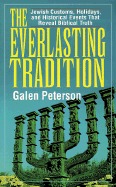
The Everlasting Tradition (1995)

The Everlasting Tradition: Jewish Customs, Holidays, and Historical Events That Reveal Biblical Truth. Galen Peterson. 1995. Kregel Publications. 160 pages. [Source: Bought]

I have now read The Everlasting Tradition several times now. Each time I read it, I am reminded of its richness. I love how informative it is. I love how relevant it is. I like learning the details, how knowing the details about Jewish life (culture, customs, religion) can help in understanding and appreciating Scripture. 

My last review of The Everlasting Tradition was thorough, in my opinion, so I'll keep this one brief. 

My favorite chapter is STILL probably the one about Jewish weddings. I love, love, love the charts on pages 136-138. 

God's Plan Revealed
Part One: The Match:
The Biblical Marriage

  • The groom is under the authority of his father.
  • The bride is under the authority of her father.
  • The father of the groom takes the initiative.
  • Some people need a matchmaker.
  • A price is paid by the groom.
  • The bride agrees to the price.
  • A covenant is made.
  • The groom and bride drink a cup.
  • The match is made public

God's Plan of Redemption

  • God's Son came under the Father's authority (John 5:26-27)
  • The world is under the power of the Adversary (1 John 5:19)
  • God the Father sent forth His son to the world (Gal. 4:4)
  • Some people need the insights of others to understand salvation (2 Cor. 11:2)
  • The son paid a great price for our salvation (1 Cor. 6:20)
  • We are saved when we accept the Son's sacrifice (Eph. 2:8-9)
  • The Son made a covenant with his people (Rom 11:27)
  • The Son drank the cup of death and believers share in the blessing it brings (1 Cor 10:16)
  • Believers are to make public their faith (Matt 10:32)

Part Two: The Betrothal Period
The Biblical Marriage
  • The groom returns to his father's house
  • A waiting period begins
  • The groom builds a place for his bride
  • The father decides the time to fetch the bride
  • The bride prepares herself for the groom

God's Plan of Redemption

  • Messiah returned to the Father (Mark 16:19)
  • We wait for Messiah's return (1 Thess. 1:10)
  • The Son is preparing a heavenly place for believers (John 14:2-3)
  • The father decides when to send the Son again (Matt 24:36)
  • Believers are to prepare themselves for Messiah's return (Matt. 25:1-13)

There is also a third chart, but, I hope I've given you enough of the general idea to make you want to read the book yourself! It is truly worth seeking out! 


© Becky Laney of Operation Actually Read Bible